A Step Beyond the Smartphone Safety Net
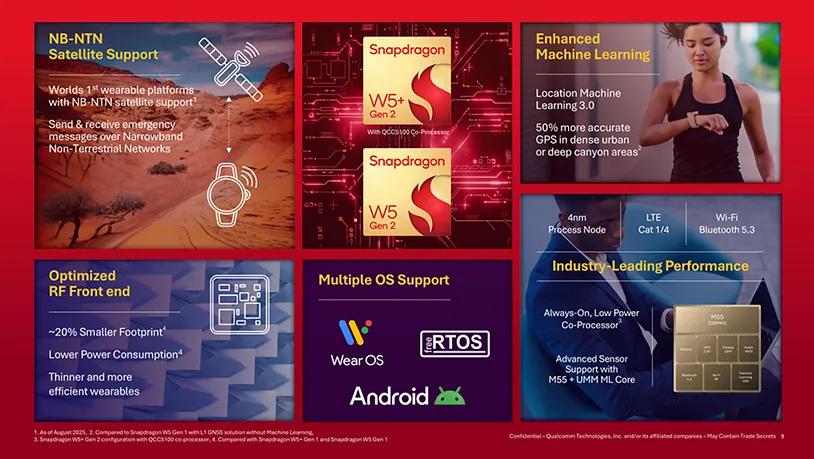
Qualcomm has taken a bold step in the wearable market with the launch of its Snapdragon W5+ Gen 2 and W5 Gen 2 platforms. For the first time, a smartwatch chipset includes support for satellite messaging, opening the door to communication when cellular and Wi-Fi networks are out of reach. The feature, delivered through Skylo’s Narrowband Non-Terrestrial Network (NB-NTN), turns a watch into more than just a companion device, it becomes a direct line for emergency contact in places where a phone can’t connect.
More Than Just Emergency Alerts
While satellite support will grab the headlines, Qualcomm has built in a number of quieter but equally significant improvements. The platforms are fabricated on a 4 nm system-on-chip (SoC), delivering better efficiency and more room for design flexibility. The W5+ Gen 2 variant also includes a low-power co-processor, handling background tasks without waking the main processor, a detail that can make the difference between a watch that lasts a day and one that lasts a weekend.
GPS tracking also receives an upgrade. With Location Machine Learning 3.0, Qualcomm claims positioning accuracy can improve by up to 50% compared with its earlier W5 series. For users, this means fewer erratic traces when running through cities or navigating deep valleys, where satellite signals often bounce or disappear altogether.
Designed for Slimmer Devices
Qualcomm’s updated RF Front End (RFFE) contributes to a smaller footprint, shrinking component size by about 20% while reducing power draw. For watchmakers, this creates space to slim down designs or extend battery life, both long-standing challenges in the wearable market. By offering a choice between the W5+ Gen 2 and the leaner W5 Gen 2, OEMs can decide whether to prioritise advanced efficiency features or focus on cost and compactness.
Launching First with Pixel Watch 4
The technology has already reached the market. Google’s newly announced Pixel Watch 4 is the first device to use the W5 Gen 2 platform. Running Wear OS 6, it integrates the new chipset’s efficiency improvements alongside the headline satellite capability. For consumers, it is likely to be the first real-world test of whether people will value emergency connectivity on a wearable.
A Shift in What Wearables Offer
The arrival of Snapdragon W5 Gen 2 underlines a shift in focus for wearables. Performance and battery life remain essential, but the conversation is increasingly about reliability and independence. A watch that can connect in the absence of a smartphone signal is no longer a futuristic concept, it’s now a commercial product. If widely adopted, this could redefine what users expect from a smartwatch, moving it from accessory to critical tool for safety and navigation.
Learn more and read the original article on www.qualcomm.com
You may also like