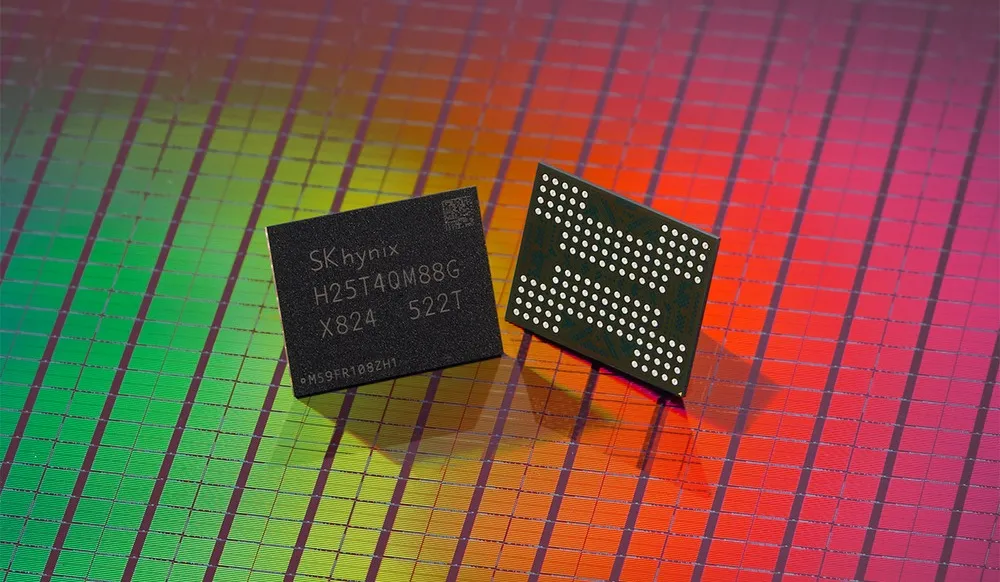
 As demand for AI storage climbs at an unprecedented pace, SK hynix has begun mass production of the world’s first 321-layer QLC NAND device. The new chip pushes QLC technology past the 300-layer mark for the first time, offering a 2Tb capacity per die and reshaping the roadmap for high-density storage.
Breaking New Ground in NAND Density
QLC (quad-level cell) NAND has always been about efficiency: storing four bits per cell allows much higher density than TLC or MLC at a lower cost per bit. By extending this to 321 layers, SK hynix has effectively doubled the capacity of earlier designs while keeping the package size the same.
The challenge with QLC has never been density alone, but performance. Higher storage levels typically bring slower response times and reduced endurance. To address this, SK hynix has increased the number of planes inside the chip from four to six. Each plane acts as an independent processing unit, so the extra parallelism enables faster simultaneous reads and more balanced throughput.
Performance Designed for AI
Early benchmarks show the new QLC part delivering meaningful gains across the board. Write throughput has climbed by as much as 56%, read performance is up 18%, and data transfer speeds have doubled. Just as important, power efficiency has improved, write operations now consume more than 23% less energy.
Those figures matter most in the data centre, where AI servers are under constant strain to move and process huge volumes of information. Reducing energy per operation not only cuts costs but also makes scaling these systems more practical.
From Consumer Drives to Enterprise AI
The rollout will begin with PC SSDs, but the real target is enterprise storage. SK hynix plans to integrate the 321-layer QLC into eSSDs for AI servers, supported by its 32-die packaging (32DP) technology. By stacking 32 dies in a single package, the company can double integration density and move toward multi-terabyte drives suited for training and inference workloads.
Jeong Woopyo, Head of NAND Development at SK hynix, described the launch as a turning point. “With the start of mass production, we have significantly strengthened our high-capacity product portfolio and secured cost competitiveness. We will make a major leap forward in line with the explosive growth in AI demand and high-performance requirements in the data center market.”
Outlook
For AI developers, the bottleneck is no longer just compute but also storage. By combining record density with stronger read and write performance, SK hynix is positioning its QLC technology as a cost-competitive solution for both PCs and hyperscale data centers. The 321-layer design may prove to be the foundation for the next wave of ultra-high-capacity drives in AI infrastructure.
Learn more and read the original article on www.skhynix.com
You may also like