
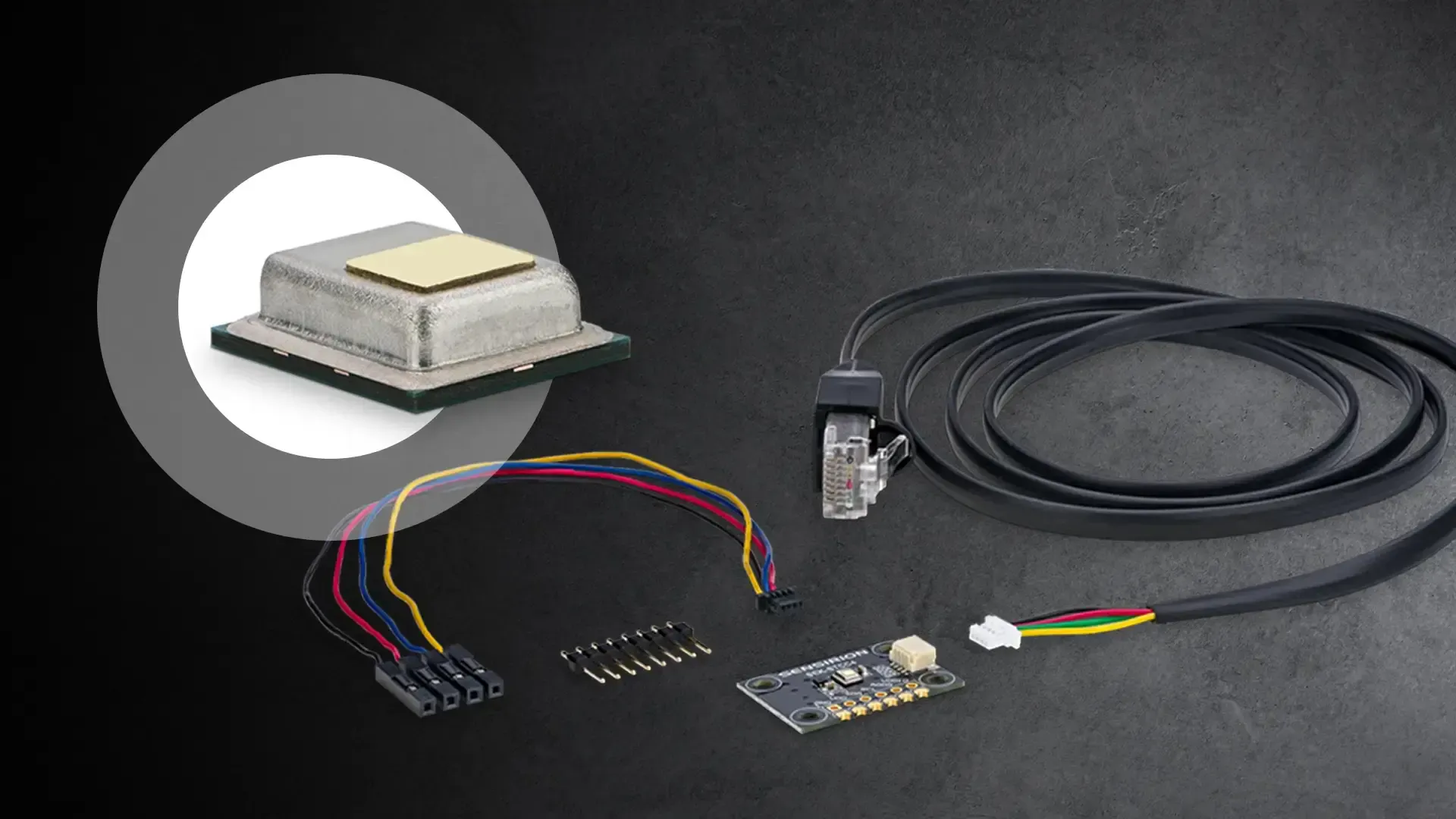
 For years, designers who wanted to integrate CO₂ monitoring into connected devices faced the same obstacles: modules were bulky, power-hungry, and often too costly for high-volume consumer products. Sensirion’s new STCC4 aims to change that equation. Measuring just 4 x 3 x 1.2 mm³ and consuming less than 100 µA on average, it introduces direct CO₂ measurement to spaces where it simply wasn’t possible before.
Beyond NDIR Limitations
Most of today’s CO₂ sensors rely on non-dispersive infrared technology. Accurate, yes, but size and energy draw make them a non-starter for compact, battery-powered devices. The STCC4 uses thermal conductivity sensing instead, a shift that trades the optics and heaters of NDIR for a form factor small enough to fit inside wearables, smart thermostats, or portable monitors. Accuracy of ±(100 ppm + 10%) keeps it competitive while slashing the integration barrier.
Engineering Trade-Offs That Matter
Ultra-low current draw isn’t just about ticking a datasheet box. In practical terms, it means designers can deploy CO₂ monitoring in wall-mounted HVAC nodes or battery-operated indoor air quality trackers without sacrificing runtime. Paired with Sensirion’s temperature and humidity sensors, the STCC4 can deliver compensated, multi-parameter data streams, critical for engineers aiming to meet stricter energy efficiency standards and rising expectations for indoor comfort.
Why This Could Shift the Market
Indoor air quality has become a mainstream concern. From post-pandemic office retrofits to energy-optimised smart homes, CO₂ data is moving from specialist instrumentation into everyday devices. By lowering the size and power barriers, the STCC4 isn’t just another sensor release, it’s a potential inflection point that makes large-scale deployment realistic.
For developers, the takeaway is clear: CO₂ sensing is no longer limited to niche equipment. With the STCC4, it can be a baseline feature, built into the next generation of thermostats, purifiers, and portable electronics.
Learn more and read the original article on www.sensirion.com
You may also like