
 Many small IoT devices need dependable Bluetooth without the overhead of writing and maintaining a full stack. Teams often spend weeks building firmware that adds little product differentiation, only to face certification hurdles and tight power budgets. That slows down programmes aimed at simple tasks like sensing, tagging or short-range data exchange where battery life and unit cost dominate.
Expanding the NORA-B2 Family for Simplified Wireless Design
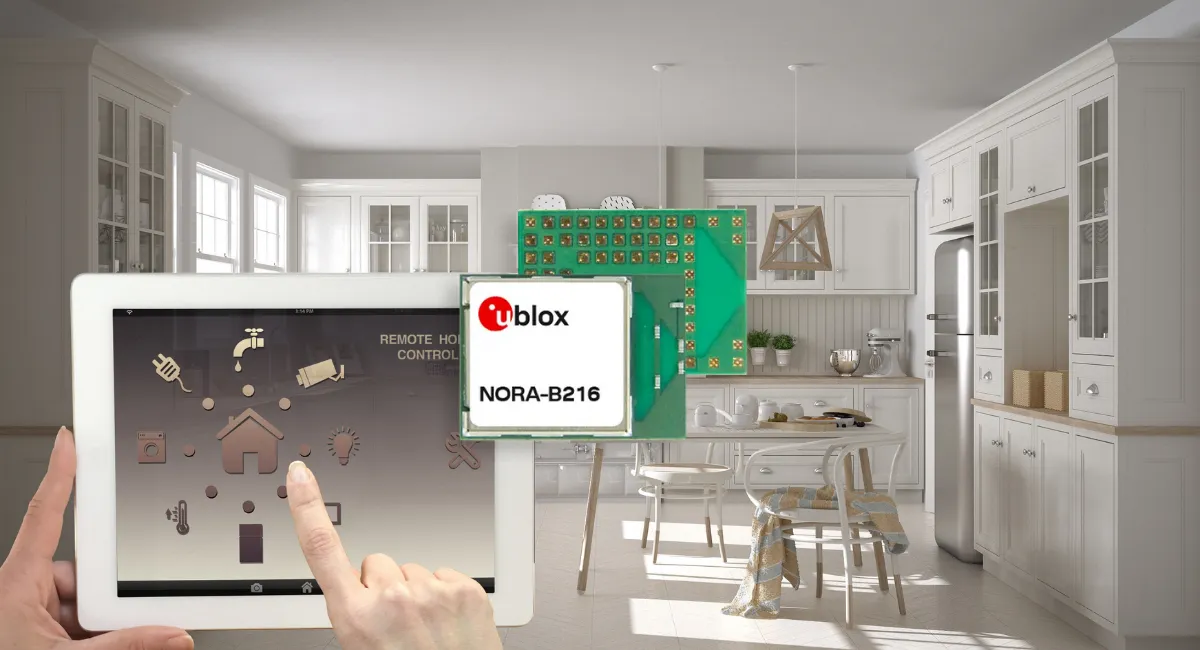
u-blox has added the NORA-B27 to its NORA-B2 family to address that gap. It is a stand-alone Bluetooth Low Energy module built on Nordic’s nRF54L05 and it arrives pre-flashed with u-connectXpress. Developers talk to the module over UART using AT commands, which removes the need to integrate or maintain a Bluetooth stack on the host MCU. The goal is straightforward: quicker prototypes, simpler production firmware and predictable power behaviour.
Key Technical Details
The module is qualified against Bluetooth Core 6.0 and operates from −40 °C to +85 °C. Radio performance targets low power and long range, with an internal-antenna EIRP of 10 dBm and sensitivity down to −102 dBm on LE Coded PHY. Deep sleep current is specified around 1 µA, with low-hundreds of microamps in idle and advertising use cases. Throughput over the UART data path is 0.8 Mbit/s, which suits sensor payloads, beacons and configuration traffic.
Security features include secure boot and 128-bit AES, with Bluetooth Low Energy secure connections enabled in u-connectXpress. The NORA-B27 exposes a GATT server, u-blox’s Low Energy Serial Port Service and beacon functions. It is the cost-optimised member of the family: a single Bluetooth link rather than the eight-link ceiling of the NORA-B26, and server-only rather than simultaneous GATT client and central roles.
Integration and Design Considerations
The attraction here is the AT-command surface. It reduces firmware risk on the host, which helps when the host MCU is already busy with sensing or control. Engineers planning mesh, multi-link gateways or complex role switching should review the family split: choose NORA-B26 for simultaneous central and peripheral behaviour or higher connection counts, and NORA-B27 where a single robust link is sufficient. The hardware choice is flexible. Internal PCB-antenna variants simplify compact designs, while an antenna-pin option in the sister device supports external antennas and enclosure constraints. Global certifications shorten regulatory effort, which matters for high-volume deployments landing in multiple regions.
Why It Matters
For a large class of battery-powered IoT products, the fastest path to shipping is a small module with stable power use, a locked-down software surface and global approvals. NORA-B27 leans into that requirement. It trades breadth of roles for predictable behaviour, long range when needed and straightforward integration, letting teams focus on the application rather than Bluetooth plumbing.
Learn more on www.u-blox.com
You may also like