
Skyworks Unveils Programmable BAW Clocks to Tackle Timing Challenges in 5G, 6G, and Data Centers
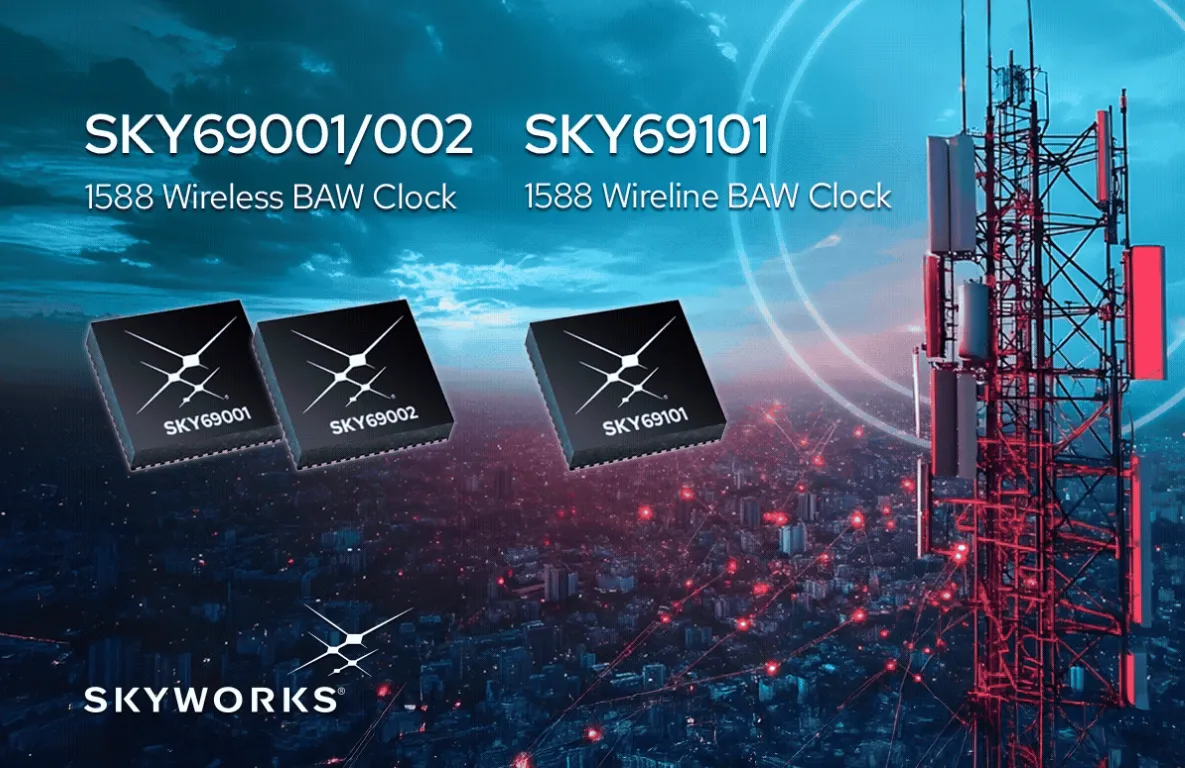 As data rates continue to climb beyond 200 Gbps, the need for precise, low-jitter clocking has become one of the most pressing challenges in network design. Even minor phase noise can distort multi-level modulation schemes like 224G PAM4 or destabilize synchronization in IEEE 1588 networks. Addressing this, Skyworks Solutions has introduced a new generation of programmable Bulk Acoustic Wave (BAW) clocks that push timing performance into new territory for both wireless and wireline systems.
Meeting Next-Generation Timing Demands
The new SKY63101/02/03 Jitter Attenuating Clocks and SKY69001/02/101 NetSync™ Clocks combine Skyworks’ DSPLL® and MultiSynth™ timing architectures with advanced BAW resonator technology. This combination provides an exceptionally stable timing reference while reducing the number of external components required.
For high-speed optical and data-center links, the SKY63101 family achieves 17 femtoseconds of jitter, enabling stable operation of 224G PAM4 SerDes used in 800G, 1.2T, and 1.6T optical interconnects. On the wireless side, the SKY69001 series supports IEEE 1588 Class C/D synchronization, delivering –142 dBc/Hz phase noise at 100 kHz offset, making it suitable for 5G and emerging 6G radios where timing precision directly affects network synchronization.
Bulk Acoustic Wave as the Foundation
At the core of these devices is Skyworks’ proven BAW resonator technology, the same foundation used in its high-volume filters for 5G and Wi-Fi front ends. In these timing products, the resonator replaces traditional quartz crystal or VCXO references. This design cuts down the number of external components, trims power use, and helps maintain a cleaner signal. By using the BAW resonator instead of a quartz crystal, the clock holds its stability even at high frequencies where phase noise can quickly impact eye quality on fast serial links.
The same BAW foundation also lets each device generate several independent frequencies from one chip without interference. Built-in isolation and power-supply filtering keep those signals steady, which is especially important in dense RF or networking environments.
Design Flexibility and Integration
Skyworks built both clock families around a shared footprint and software interface. That means engineers can move between jitter-attenuating and synchronization roles without having to redesign the board. Integrated flash memory stores the configuration so the device can boot with a predefined setup or be updated later in the field.
Operating from –40 °C to +95 °C, the devices are designed for infrastructure applications that must run continuously under variable environmental conditions. Typical power consumption is 1.2 W, more than 60 percent lower than comparable discrete solutions.
A Step Toward Smarter Timing Architectures
Skyworks’ latest clocks mark a shift toward timing solutions that merge precision with configurability. As data-center and wireless infrastructure move closer to the physical limits of signal integrity, programmable BAW-based clocks like these will be key in maintaining synchronization and reducing system-level complexity.
Learn more and read the original article on www.skyworksinc.com
Image credit: Skyworks Inc
You may also like