
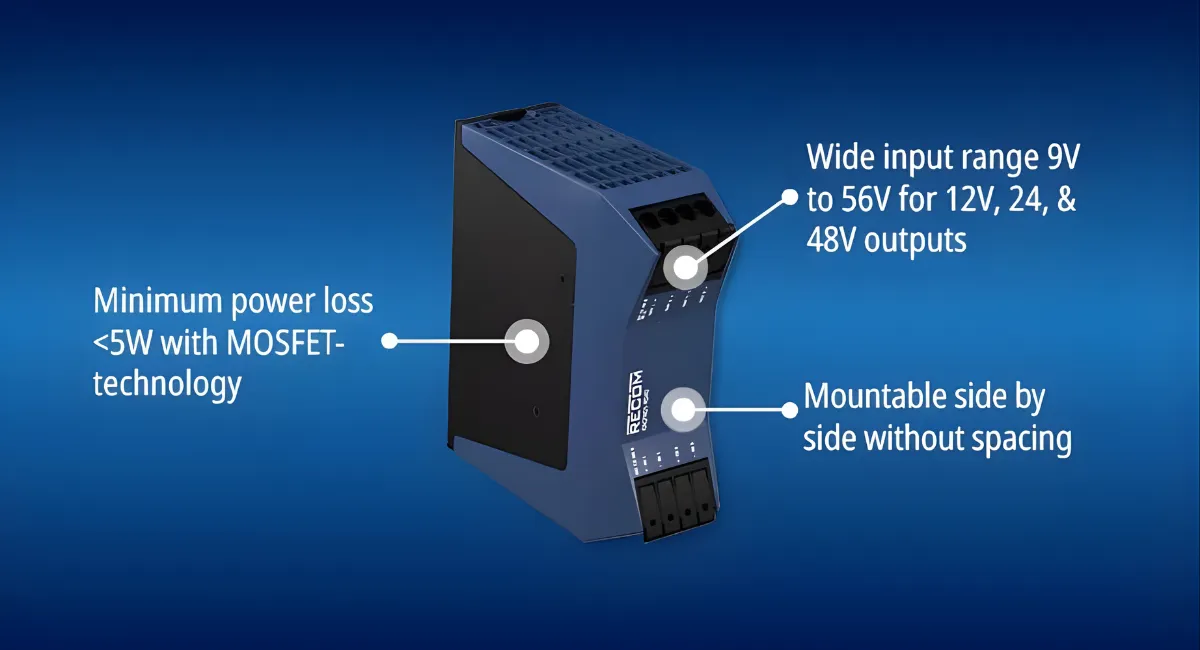
 Industrial equipment that must stay online cannot depend on a single power supply, especially in environments where load transients, cabinet heat and electrical noise are routine. Redundant architectures provide a practical path to higher uptime, but only if the power path between supplies and the load introduces minimal loss. RECOM’s RACPRO1-RD40 module targets this exact requirement by providing a compact, efficient way to combine multiple DIN rail AC/DC units into fault-tolerant power configurations.
Why This Matters for Engineers
Redundant power supplies are a common design pattern in PLC racks, industrial gateways and safety-critical automation nodes.
The challenge has always been how to connect two or more supplies without injecting large voltage drops or building complex gating circuitry. Diode ORing works, but it wastes power and generates heat. Active MOSFET gating solves that issue, provided the control stage remains robust. The RD40 simplifies this by integrating both the MOSFETs and their control into a single DIN rail unit, allowing engineers to move redundancy out of the custom PCB and directly onto the rail.
Key Technical Capabilities
The RD40 uses a matched MOSFET pair configured as high-efficiency gating elements. This approach limits voltage drop to around 140 mV, which translates to an efficiency of roughly 99.5 percent. That difference matters in cabinets where every watt contributes to heating, especially when loads can reach tens of amps. The module supports up to 20 A per input in redundancy mode or a combined 40 A output in parallel mode. Short bursts up to 60 A for five seconds support systems with heavy inrush characteristics. Input compatibility ranges from 9 V to 56 V, with immunity to reverse voltages up to 63 V, allowing the module to sit comfortably in 12 V, 24 V and 48 V architectures without modification. Low no-load consumption under 200 mW helps keep standby behaviour predictable in distributed power systems.
Design Considerations and Use Cases
Thermal performance is a key concern in high-current architectures, yet the RD40 maintains its current ratings over a wide ambient range from minus 40 to plus 70 degrees Celsius using only convection cooling. That reduces the need for airflow planning inside compact cabinets. With a width of just 43 mm and push-in angled terminals, the module fits neatly alongside existing DIN rail AC/DC units. Redundancy and parallel arrangements become a tool-less assembly task rather than a custom wiring exercise. For systems integrators who deploy equipment across industrial facilities, the module’s long service life of over 268,000 hours at 40 degrees Celsius provides confidence in installations where maintenance visits are rare.
Implications for Future Designs
As more industrial control systems push towards modular, rail-mounted architectures, power redundancy becomes a requirement rather than an option. Engineers increasingly want redundancy without adding complex circuitry or accepting large power losses. The RD40 points toward a future where power distribution blocks are as modular as the supplies themselves, with MOSFET-based gating becoming the default choice for high-uptime designs. Its efficiency, low losses and straightforward integration reduce design overhead and support the growing trend of distributed, fault-tolerant industrial systems.
Learn more and read the original announcement at www.recom-power.com
You may also like