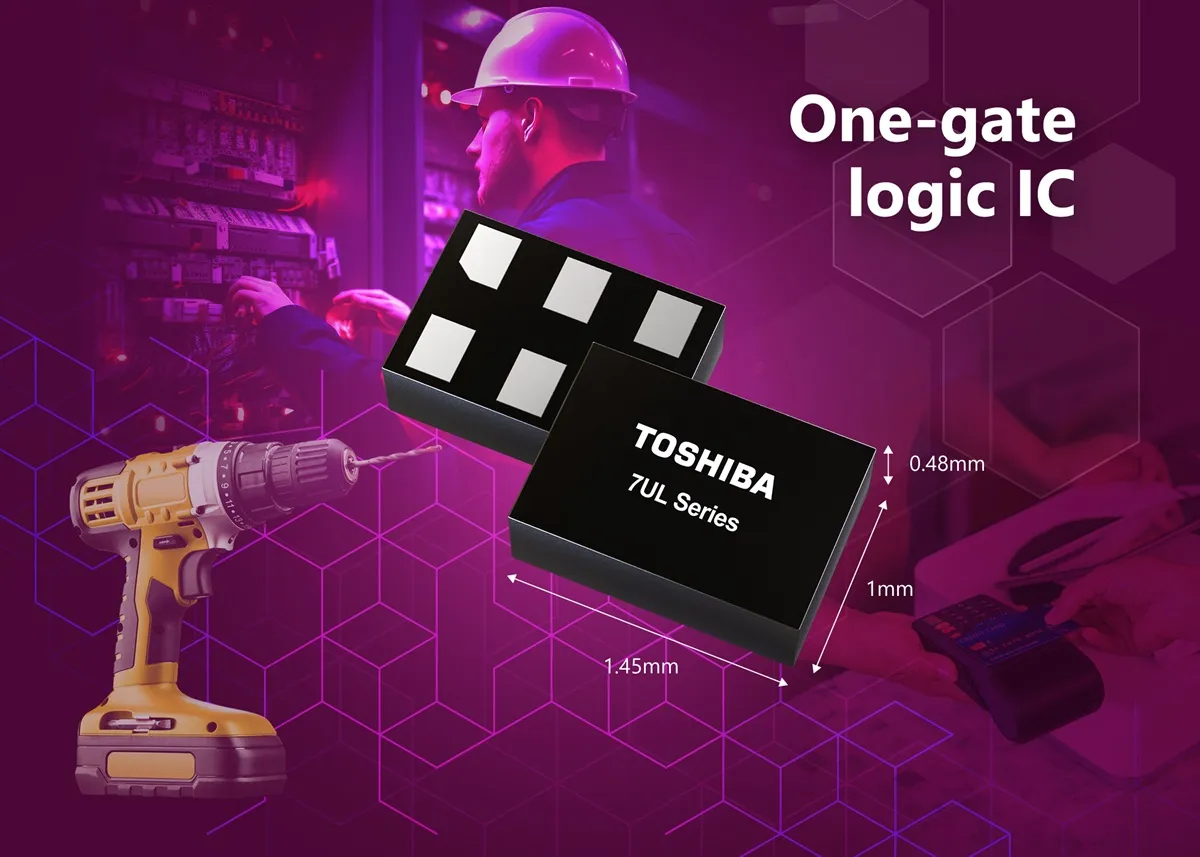
 Designers working with today’s mixed-voltage systems often face a familiar problem. Modern processors, sensors and memory devices all run at different supply levels, yet still need a reliable way to exchange digital signals. Small logic devices remain one of the simplest ways to bridge those voltage domains without adding extra power rails or complex support circuitry. Toshiba’s latest expansion of its 7UL series adds 21 new single-gate ICs to address that exact challenge, widening the options available for compact boards in mobile, IoT and edge AI applications.
Extending the 7UL Series for Mixed-Voltage Systems
The growing number of power domains found in edge devices and AI-enabled hardware makes predictable logic behaviour increasingly important. Toshiba’s new additions to the 7UL family are built to support those designs by offering stable logic thresholds, low-voltage operation and minimal board impact. All 21 devices arrive in the small XSON6 package, giving engineers more freedom in dense layouts where every square millimetre of PCB space is contested by sensors, radios and power circuits.
Logic Behaviour Tuned for Real System Constraints
The 7UL1G and 7UL1T devices target different voltage ranges but share the same goal: clean signal translation between mismatched rails. The 7UL1G versions operate from 0.9 V to 3.6 V and remain tolerant to higher-voltage inputs even when powered from just 0.9 V. This is helpful when ultra-low-voltage cores need to pass status or control signals to devices running at more conventional levels.
The 7UL1T devices sit slightly higher on the supply range but use a lower input threshold that allows them to recognise 1.8 V logic while powered from 3.3 V. Anyone who has seen marginal VIH performance in mixed-voltage timing paths will understand why that threshold behaviour is important. Both device families prioritise predictable logic levels in situations where voltage margins are shrinking as designs become more compact.
Package Size and Layout Considerations
The XSON6 package measures roughly 1.45 mm by 1.0 mm, which is small enough to sit close to the signal path without forcing long, inductive routes. Shorter traces improve edge stability and reduce the chance of distorted transitions during high-speed switching or noisy operating conditions. The small thermal footprint also helps in applications that rely on tightly packed components, such as battery-powered IoT nodes or miniature camera modules.
Supporting Trends in Embedded and Edge Designs
As more hardware platforms combine low-core voltages with higher-voltage peripheral interfaces, level translation continues to be a routine but essential part of board design. Compact single-gate logic parts help maintain system reliability without adding excess power consumption or extra rails. Toshiba’s expansion of the 7UL range gives engineers more granularity when selecting these translation points, particularly in designs that prioritise power efficiency and size reduction.
Learn more and read the original release on www.toshiba.semicon-storage.com
You may also like