
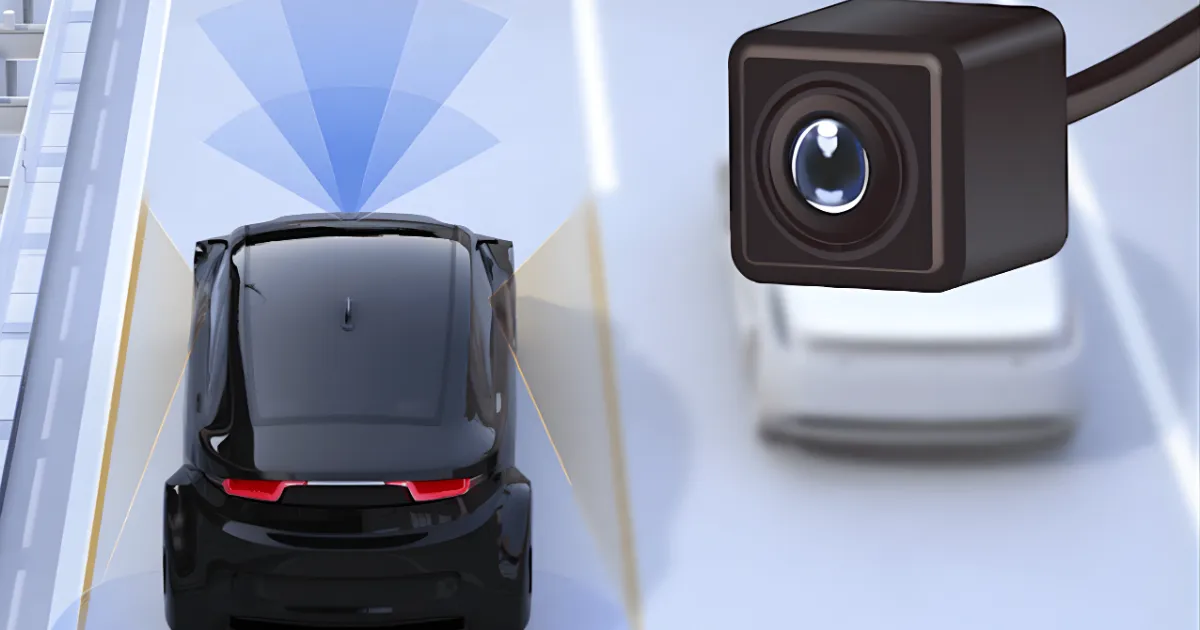
 Automotive camera modules have become increasingly complex as vehicles add more viewing and sensing functions for ADAS and driver monitoring. Each module typically needs multiple regulated rails with precise sequencing, low noise and tight thermal control, yet space around the image sensor continues to shrink. ABLIC has introduced the S-19560B Series to address these constraints by integrating three power channels into a compact package while allowing designers to manage heat and maintain clean power delivery close to the sensor.
Power Architecture Designed for Camera Module Constraints
Most camera modules need at least three voltage domains for the image sensor, serializer and associated logic. The S-19560B integrates two step-down converters and one LDO into a 2.0 by 3.0 millimetre HSNT-8 package, reducing the number of discrete components required to build the power tree. For platforms that need an additional rail, the device can be paired with ABLIC’s small high-PSRR LDO to create a four-channel supply without increasing the mounting footprint beyond what a single PMIC typically occupies. ABLIC states that this approach can reduce board area by around twenty percent compared with competing four-channel devices.
Thermal Behaviour and Layout Considerations
Camera modules located near windscreens, grilles or mirror housings can experience elevated temperatures and limited airflow. One of the challenges with integrating multiple rails into a single PMIC is the concentration of heat. ABLIC’s approach places one of the LDOs externally when a fourth rail is required. This allows heat to be distributed and also lets the LDO sit closer to the CMOS image sensor, which helps reduce noise pickup on low-level supply traces. The three-channel PMIC itself requires only two inductors and five capacitors, which simplifies placement and shortens critical routing paths.
Preset Configuration and Power-Up Control
Different image sensors and serializers often require specific startup sequences and output voltages. The S-19560B is shipped with preset configurations so that the module powers up without firmware-based initialization. For manufacturers producing multiple camera variants, this reduces setup time and avoids introducing microcontrollers purely for sequencing. Output accuracy is rated at plus or minus one point five percent across junction temperatures from minus forty to one hundred twenty-five degrees Celsius, aligning with typical automotive camera operating conditions.
Protection and Qualification for Automotive Use
The device supports input voltages from four to sixteen volts, covering standard vehicle supply environments including stop-start operation. Protection features include pulse-by-pulse overcurrent limiting, thermal shutdown, short-circuit handling using a hiccup method and undervoltage lockout at three point three five volts. Spread spectrum clocking can be enabled to help reduce electromagnetic emissions in modules located near other sensitive systems. The product is undergoing AEC-Q100 qualification and is intended for use in ADAS-related cameras, drive recorders and driver monitoring systems as well as other control modules that require compact multi-rail power delivery.
Learn more and read the original announcement at www.ablic.com
You may also like