
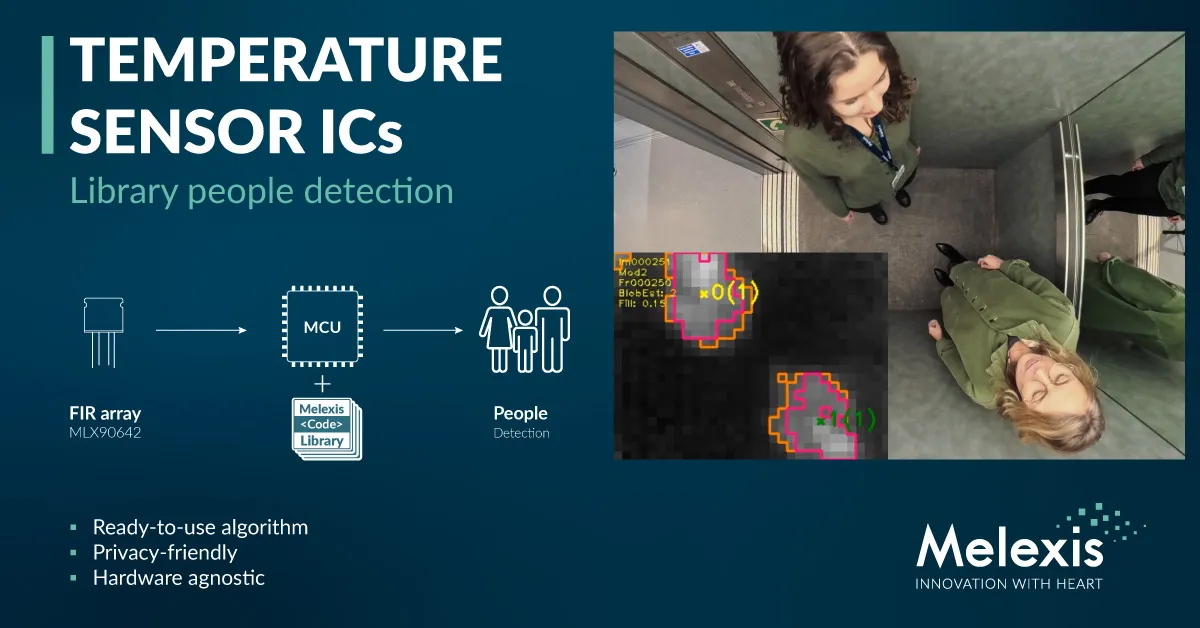
 Smart building systems are increasingly expected to monitor occupancy, manage energy use and maintain privacy while operating in a wide range of lighting and environmental conditions. Traditional camera based solutions can provide detail but introduce privacy concerns and require more processing to operate reliably. Far infrared sensing offers a simpler and more privacy preserving alternative, and Melexis has developed a dedicated people detection algorithm for its MLX90642 thermal array to help engineers move quickly from hardware to functional occupancy awareness.
How Melexis Enhances FIR Based Occupancy Sensing
The new algorithm is designed specifically for the 32 by 24 pixel MLX90642 far infrared sensor. By working directly with the sensor’s noise characteristics, field of view and thermal behaviour, the logic based approach avoids the instability and retraining effort commonly associated with AI models. This matters for building systems that must maintain consistent performance across meeting rooms, hallways, elevator cabins and other constrained indoor environments where lighting conditions vary and thermal gradients change throughout the day. Because the algorithm detects presence, counts people and infers location within the array’s field of view, it provides a foundation for energy management, space utilisation and access control without compromising user privacy.
Technical Model Tailored to Embedded Constraints
Melexis ships the algorithm as a precompiled library that runs on commonly used microcontrollers. The memory footprint is modest and intentionally hardware agnostic, which allows developers to integrate the solution on cost optimised platforms. This reduces time spent evaluating processing requirements or redesigning boards to accommodate a specific vendor’s acceleration hardware. For engineers building ceiling mounted or space constrained devices, the MLX90642’s compact form factor pairs well with the lightweight computation model, enabling reliable detection even in thermally dynamic locations such as elevator cabins.
Integration Path Through Evaluation Hardware
To streamline development, Melexis also offers an evaluation kit that combines the MLX90642 sensor with firmware running the people detection algorithm. By providing a ready to use reference hardware setup, engineers can validate performance under real world conditions without writing any initial processing code. Configurable parameters allow the system to be adjusted for room size, mounting height or expected thermal backgrounds, which helps teams confirm whether the FIR approach meets their accuracy and responsiveness targets before committing to commercial hardware design.
Broader Implications for Privacy and Building Intelligence
People detection is becoming a defining capability in modern buildings, but camera based approaches raise privacy and deployment challenges. A far infrared solution addresses many of these issues by avoiding identifiable imagery while still producing consistent, actionable occupancy data. Melexis positions this algorithm as an accessible entry point for engineers who want to introduce presence detection without the overhead of machine learning pipelines or high power compute. For building automation designers, the main advantage is a shorter development cycle and a predictable sensing model supported by a mature FIR component ecosystem.
Learn more and read the original announcement at www.melexis.com
You may also like