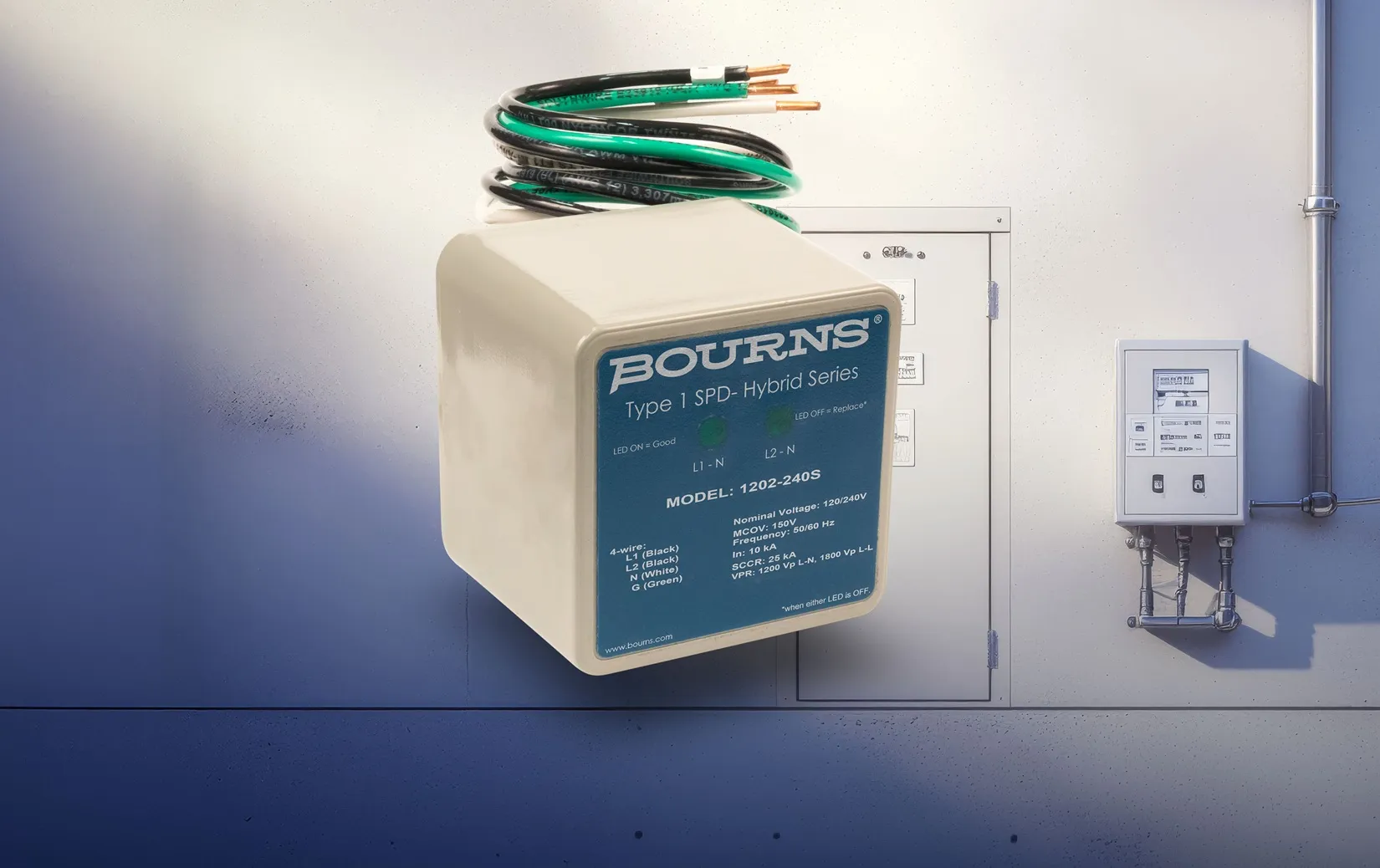
 AC infrastructure has become far more demanding in recent years. Systems now carry higher loads, sit closer to renewable sources and face more frequent abnormal voltage conditions. Engineers designing protection for these panels need devices that survive large transient events while managing the slower, more damaging rise of temporary overvoltage. The new Bourns 1202 P Series Surge Protective Devices aim to close this gap by combining high surge current capability with internal thermal protection to keep installations stable under real world faults.
High Energy Handling for Service and Branch Panels
Many designs in commercial and industrial spaces now require protection at the service entrance level, where the surge energy can be substantial. The 1202 P Series is built for this environment. It supports a nominal discharge current of 20 kA and a peak level of 50 kA, placing it in a class suited to heavy AC infrastructure rather than light equipment protection. In practice, this means an engineer can deploy the device in main panels or downstream branch circuits and expect consistent behaviour when the grid experiences abrupt faults. Because it is a Type 1 SPD, it can sit on the line side of the main disconnect without relying on external line fusing. This simplifies installation and reduces the number of coordinated protection elements a project must account for.
Thermal Safeguards for Abnormal Overvoltage
MOV based surge protection has long been dependable for short transients, but one of the more difficult conditions to handle is the temporary overvoltage event. These events can occur when neutral connections are disturbed or when equipment on the same feeder fails in unusual ways. Under these conditions, a standard MOV may overheat if the voltage remains elevated for too long. Bourns integrates a thermally protected MOV mechanism into the 1202 P Series that opens the device cleanly when it encounters this kind of sustained fault. This matters because it offers a controlled interruption rather than a catastrophic failure mode. LED indicators on the housing show when this internal fuse path has acted, which helps maintenance teams identify issues quickly and bring the system back online with minimal downtime.
Environmental Flexibility for Distributed Installations
Outdoor electrical equipment is becoming more common as renewable installations and distributed grid assets grow. Enclosures might sit on poles, in compact cabinets or in exposed industrial zones where dust and water are constant challenges. The 1202 P Series carries IP66 and NEMA 4X ratings, giving engineers a single product that works in indoor distribution boards and harsher exterior locations. This reduces the need for multiple SPD variants across a project and gives system designers a predictable thermal and mechanical profile in both environments. For OEMs building panel products shipped into varied climates, this consistency can simplify qualification and lifecycle planning.
Role in Next Generation Power Networks
As more infrastructure ties into renewable sources and as loads become more dynamic, the stress on surge protection equipment continues to rise. Meeting UL 1449 5th Edition requirements is one part of that shift, but the broader trend points to SPDs that integrate both high surge capability and strong safeguards against abnormal overvoltage conditions. Devices like the Bourns 1202 P Series align with this direction by addressing failure modes that traditional MOV based solutions struggle with in real installations. For engineers designing panels intended for long service life, this combination of energy handling, thermal protection and environmental durability provides a pathway to more resilient systems.
Learn more and read the original announcement at www.bourns.com
You may also like