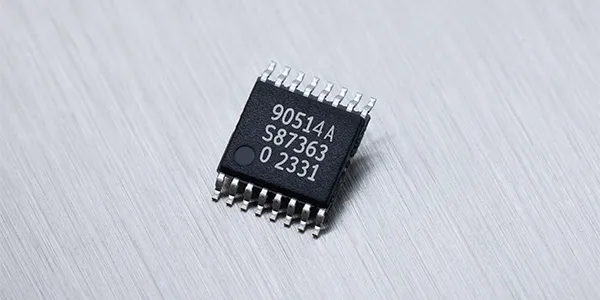
 Position feedback sits at the centre of most modern motion systems, and it tends to be one of the harder elements to get right. A robotic joint might move through tight angles at speed, a small gearbox may see sudden torque spikes and industrial equipment often runs in places where dust or vibration never really disappear. Optical and magnetic encoders can handle precision work, but both come with practical limits once the environment gets cramped or unpredictable. Melexis positions the MLX90514 as an alternative by using inductive sensing to achieve stable, high resolution feedback without relying on magnets or optical components. This creates a path for motion systems that require precision but cannot tolerate fragile or debris sensitive assemblies.
Inductive Sensing Suited for Robotics, Drives and Industrial Equipment
Many engineers adopt inductive sensing when the mechanical environment becomes difficult for optical encoders to survive. Dust, oil and mechanical wear can distort optical paths, while magnetic encoders depend heavily on magnet quality, alignment and long term stability. The MLX90514 removes these concerns by measuring changes in coil geometry rather than an external field or light pattern. This makes the sensing method tolerant of debris and mechanical stress, which is valuable for robotic joints, e mobility gear stages and industrial motor commutation. The device outputs absolute position over SSI and maintains noise immunity in electrically busy systems, which helps improve feedback reliability when switching currents and motor transients are nearby.
Dual Input Architecture for Synchronous Multi Point Position Feedback
One of the more technically interesting aspects of the MLX90514 is its dual input design. The IC can read two coils at once and compute vernier angles internally. In practice, this allows both sides of a mechanism to be monitored using a single sensor interface. For a robotic joint or a two stage motor gearbox, tracking both input and output angles can help detect mechanical slack, torque behaviour or unexpected mechanical deformation. It also removes the need for two separate encoder systems and external synchronization circuitry. For engineers building multi degree of freedom robots or compact drive modules, the dual input structure reduces PCB count, simplifies electromechanical integration and maintains timing coherence between measurements.
Measurement Range, Resolution and Integration Considerations
The MLX90514 supports rotary coils ranging from twenty millimetres to three hundred millimetres and linear configurations up to four hundred millimetres. This range gives engineers freedom to scale the sensor to small joints or larger mechanical assemblies. Position resolution reaches sixteen bits with accuracy better than 0.1 degrees and zero latency output, which suits both real time robotic motion and high speed industrial control loops. The device operates from a five volt supply and requires minimal configuration. Only offset compensation and linearisation need adjustment in most designs, which shortens setup time and reduces the tuning effort usually associated with inductive sensing. Because the coils are PCB based, designers can integrate them directly into structural elements, avoiding the cost and handling associated with permanent magnets.
Broader Impact on Scalable Position Sensing Architectures
The trend toward compact actuators and environmentally exposed mechanisms makes inductive sensing increasingly relevant. With on chip signal processing, a small bill of materials and no reliance on magnetic materials, the MLX90514 points toward a sensing architecture that scales cleanly across product families. For mobility platforms, its robustness against contamination and vibration enables more reliable long term operation. For robotics, engineers gain the ability to monitor multiple motion points without adding encoder stacks that increase weight and mechanical complexity. In practice, this creates opportunities to design cleaner mechanical assemblies while preserving the precision needed for demanding motion control.
Learn more and read the original announcement at www.melexis.com
You may also like