
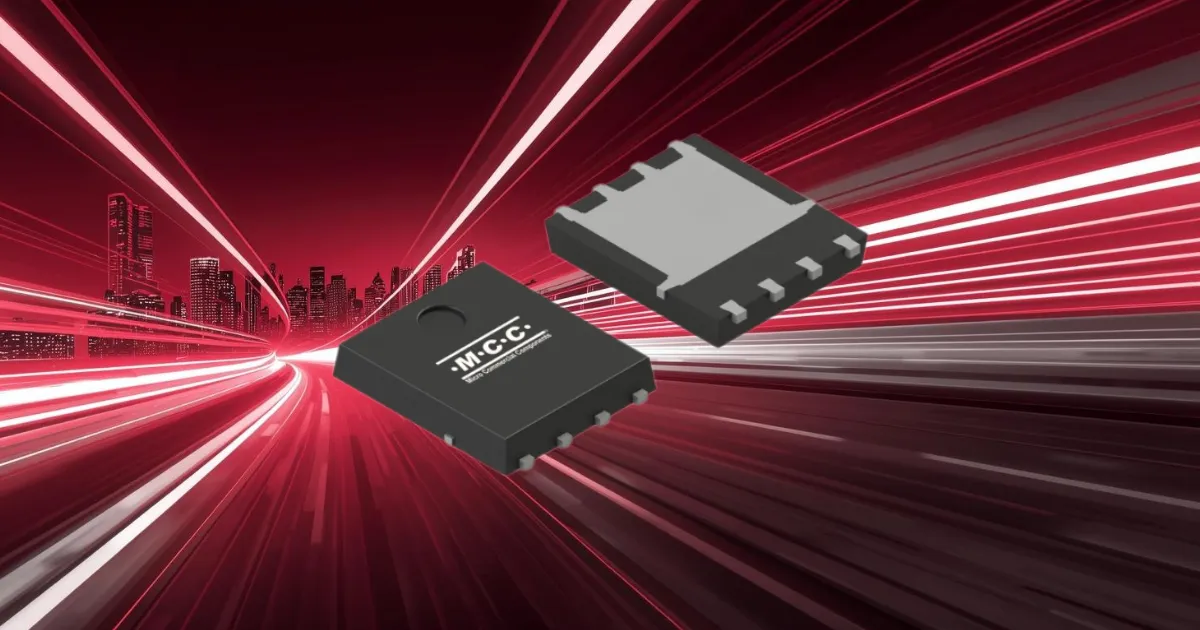
 High-current switching in low-voltage systems tends to expose the weak points of a power design very quickly. Losses climb, copper fills up, and thermal margins disappear faster than expected. This is especially true in 12 V and 24 V architectures where space is tight but current demand keeps rising. MCC is addressing that pressure point with the MCAC2D9N04YHQ, a 40 V N-channel MOSFET aimed at delivering low conduction loss and controlled thermal behaviour in compact power stages.
Where Ultra-Low Rds(on) Changes the Design Trade-Off
In many dense power layouts, MOSFET losses dominate once current increases beyond a certain threshold. A maximum Rds(on) of 2.9 mΩ shifts that balance. Lower resistance directly reduces conduction losses, which in turn reduces heat generation at the silicon level. For engineers working on load switches, DC-DC converters or motor drive stages, this can be the difference between a design that needs aggressive copper and one that fits comfortably within its thermal limits. The practical benefit is not just efficiency, but predictability under sustained load.
Electrical Margin and Qualification for Harsh Environments
A 40 V drain-source rating provides meaningful headroom in systems where transient events are common. Automotive and industrial rails rarely behave like clean lab supplies, and voltage spikes are often what define long-term reliability. The MCAC2D9N04YHQ carries AEC-Q101 qualification, signalling that it is designed to tolerate those conditions over extended lifetimes. Interestingly, this level of robustness is increasingly valued outside traditional automotive platforms, particularly in energy storage and industrial power systems where downtime is costly.
Thermal Behaviour in a DFN5060 Footprint
Small packages often struggle to move heat efficiently, but thermal resistance figures tell a more nuanced story. With a junction-to-case thermal resistance of 1.4 °C/W, this device is designed to pass heat into the PCB effectively rather than trapping it in the silicon. In practice, that simplifies thermal design and reduces reliance on bulky heatsinks or exotic board constructions. The DFN5060 package also keeps current paths short, which helps limit parasitic effects and supports stable operation at higher currents.
Switching Performance and Integration Considerations
Split-gate trench technology is used to balance low on-resistance with controlled switching behaviour. Faster transitions can improve efficiency, but they also place greater demands on layout and gate drive design. For engineers integrating this MOSFET into high-frequency converters or motor control stages, careful attention to gate resistance and loop inductance remains essential. The upside is flexibility. Lower losses and better heat transfer give designers more room to tune switching behaviour without immediately running into thermal constraints.
What This Indicates for Compact Power Architectures
Power density continues to increase across automotive, industrial and energy storage systems, and component choices increasingly define system size and reliability. Devices like the MCAC2D9N04YHQ reflect a broader move toward MOSFETs that prioritise thermal efficiency and electrical margin as much as headline performance. For engineers, the takeaway is straightforward. Managing heat and loss at the device level is often the most effective way to simplify the entire power stage.
Learn more and read the original announcement at www.mccsemi.com
You may also like