 The software-defined vehicle has been promised for more than a decade, yet most production platforms still rely on heavily fragmented electronics architectures. Separate ECUs for propulsion, body control, safety, gateways, and dynamics remain the norm, even as software content continues to grow. The challenge is no longer whether vehicles can run more software, but whether the underlying hardware can support that software without ballooning cost, wiring complexity, and validation effort.
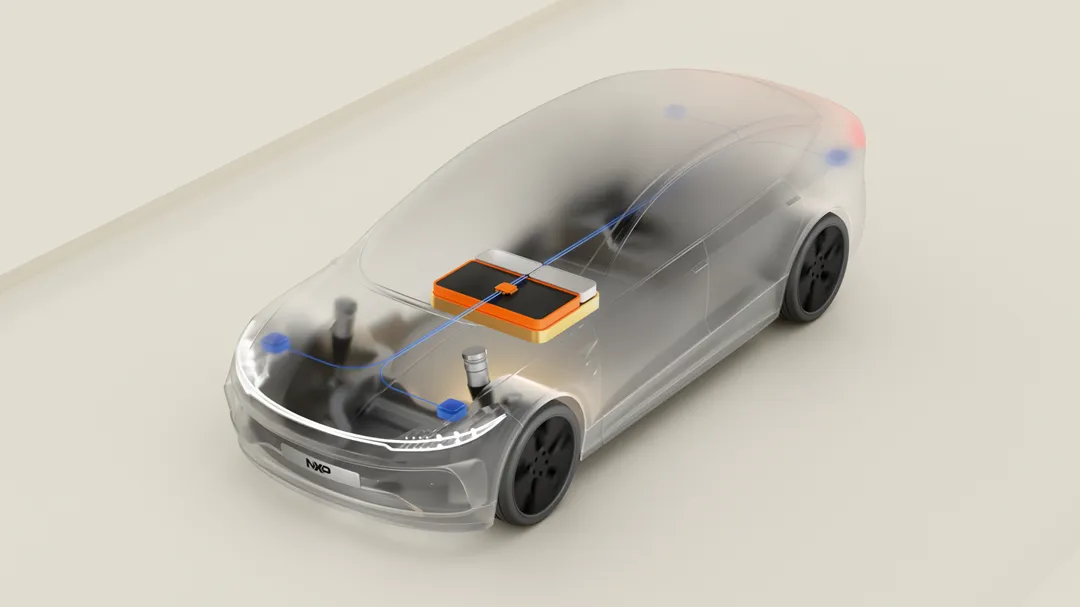
This is the context for NXP’s S32N7 processor series, announced at CES 2026. Rather than positioning the device around a single feature or workload, the S32N7 is clearly aimed at centralizing core vehicle functions into a single compute domain. The intent is to replace dozens of distributed modules with a consolidated processing hub that can handle real-time control, safety-critical workloads, and higher-level data processing within one platform.
Centralizing the Vehicle Core Changes the Design Problem
Traditional automotive electronics architectures evolved incrementally. New functions were added as new ECUs, each optimized for a narrow task. That approach becomes increasingly difficult to sustain as vehicles transition toward software-defined behavior, where features span multiple domains and evolve over time.
The S32N7 is designed to address this by collapsing propulsion, vehicle dynamics, body, gateway, and safety domains into a central compute point. From an engineering perspective, the significance lies less in raw compute capability and more in architectural simplification. Reducing the number of hardware modules directly affects wiring complexity, power distribution, failure points, and integration effort.
NXP claims that this consolidation can reduce total cost of ownership by up to 20 percent. While exact savings will vary by platform, the direction is clear. Fewer ECUs mean fewer variants to validate, fewer interfaces to manage, and fewer software stacks to maintain across a vehicle’s lifetime.
Compute Headroom for Long-Lived Software Platforms
One of the persistent risks in software-defined vehicle design is platform longevity. Vehicles are expected to remain in production for years, while software capabilities evolve much faster. The S32N7 builds on NXP’s existing S32 foundation using a 5 nm process, providing compute and networking headroom intended to support that mismatch.
By consolidating data and software into a central hub, automakers gain more flexibility to deploy AI-assisted features that cut across traditional domain boundaries. Predictive maintenance, virtual sensors, and adaptive control strategies become easier to implement when core vehicle data is accessible in one place. Just as importantly, the architecture allows upgrades to newer AI accelerators without requiring a complete vehicle re-architecture, which has historically been a major barrier to long-term feature evolution.
Safety and Timing at the Vehicle Core
Centralizing core vehicle functions introduces its own challenges, particularly around safety isolation and real-time performance. Functions such as braking, steering, and propulsion impose strict timing and safety requirements that cannot be compromised by higher-level software workloads.
The S32N7 addresses this by combining application processing, real-time compute, networking, and hardware isolation within a single SoC, while targeting the safety and security requirements expected at the vehicle core. For system architects, this kind of integration is essential if centralization is to extend beyond infotainment and ADAS into primary vehicle control.
Early Integration Signals Industry Direction
Bosch’s early adoption of the S32N7 within its vehicle integration platform is a useful signal of where the industry is heading. Reference designs, safety frameworks, and pre-integrated hardware reduce the friction associated with moving to centralized architectures, which is often where ambitious platform shifts stall.
For automakers and Tier 1 suppliers, this kind of ecosystem support matters. Architectural changes of this scale are rarely limited by silicon availability. Integration effort and validation timelines tend to be the real constraints.
What the S32N7 Says About Future Vehicle Platforms
NXP’s S32N7 reinforces a broader trend emerging across CES 2026 announcements. The next phase of vehicle development is less about adding isolated capabilities and more about restructuring how vehicles are built electronically. Centralizing core functions, reducing module count, and designing for software evolution are becoming baseline requirements rather than differentiators.
For engineers, the takeaway is straightforward. As vehicles become more software-driven, the cost of architectural fragmentation continues to rise. Platforms that address that problem at the hardware level will shape how quickly new vehicle features can be deployed, maintained, and scaled across fleets.
Learn more and read the original announcement at www.nxp.com
You may also like