
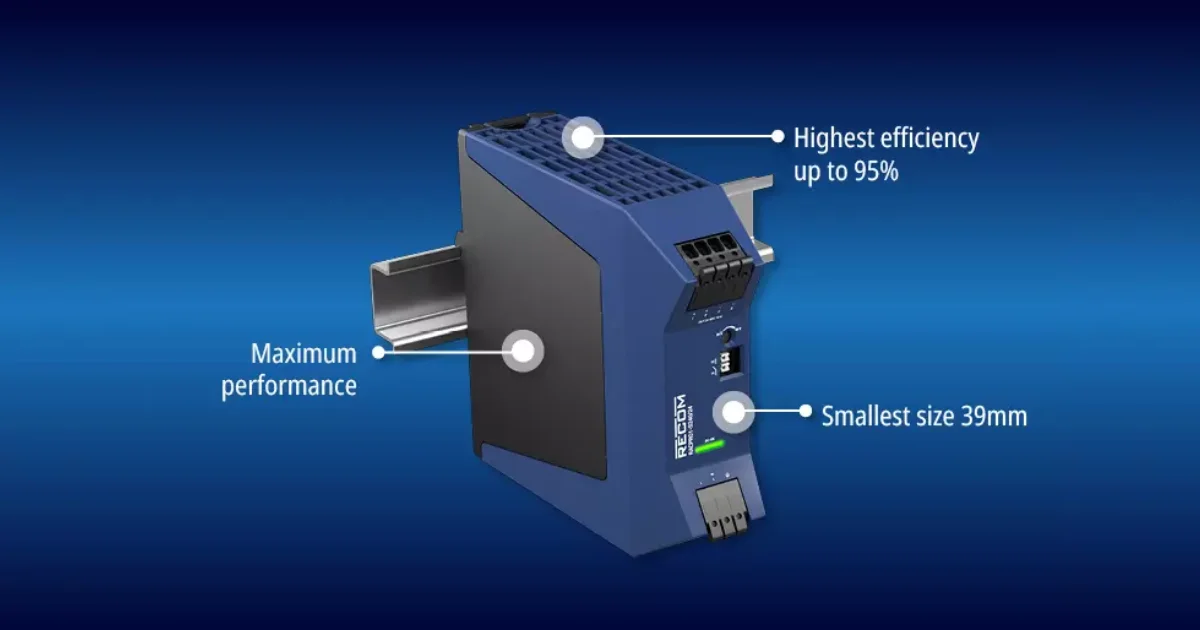
 A familiar challenge in cabinet design appears when loads draw more current during startup than they do once settled. Motors, latching actuators and communication hardware often ask for a brief surge, yet many DIN rail supplies cannot hold that peak without derating or tripping protection. It becomes a balancing act between available headroom, thermal limits and how much space is left in the enclosure. The RACPRO1-S240 from RECOM steps into that space with a density level that keeps the supply narrow while leaving room for a short but useful burst of additional power.
Power Behavior That Helps With Real Transient Loads
The supply delivers 240 watts in a 39 millimeter footprint, which already helps when a cabinet is filled with I/O modules and motion hardware. What stands out is the ability to push to 150 percent for several seconds without relying on airflow or accepting a derating curve that cuts into usable energy. In practice this means a motor can overcome static friction or an inductive stage can settle without the rest of the system seeing the voltage sag that normally accompanies these events. The regulated 24 volt output sits behind protection that accounts for short circuits, over current and over voltage, along with the return currents that appear when inductive loads feed energy back into the rail. Engineers working with mixed loads will recognize how often that return spike can make or break a design when the protective margin is thin.
Redundancy That Does Not Require External ORing Blocks
Many industrial systems expect n+1 redundancy or some degree of power sharing. The built in ORing diode lets multiple units operate together without adding discrete ORing hardware, which is usually bulkier and can create thermal hotspots when the current path concentrates in a small region. By keeping the diode inside the supply, panel builders get a simpler layout and a more predictable thermal profile. For field replaceable or high uptime equipment, this reduces the number of components that need to be validated and maintained over the life of the installation.
Electrical Characteristics Suited to Global and DC-Backed Installations
Wide input acceptance from 85 to 277 volts AC or 88 to 370 volts DC means the supply fits installations that switch between mains regions or share a DC bus. Inrush limiting and active power factor correction keep upstream breakers and wiring from seeing unnecessary stress when the cabinet powers up. Efficiency up to 95 percent gives more thermal room in enclosures that rely entirely on convection, which is common in building automation or compact industrial nodes. The operating window from minus 40 to plus 60 degrees Celsius broadens where this supply can sit, especially in locations where ambient temperature fluctuates throughout the day without active cooling. Compliance with IEC, EN and UL 61010 and the associated EMC standards places it firmly within heavy industrial expectations where electrical noise margins are often tight.
Mechanical Details That Reduce Panel Assembly Time
Tool-less rail mounting and angled push in terminals reflect how panel builders actually work when many devices must be wired in a confined space. The orientation of those terminals makes a small difference when viewed alone, but it adds up in cabinets where both hands are already reaching around other modules. A DC OK LED alongside volt free relay contacts offers a straightforward way to report supply health to upstream logic. These touches matter in distributed control schemes where fast diagnostics determine how quickly a panel can return to operation after an unexpected interruption.
How This Supply Fits Into Modern Cabinet Design
Control panels are trending smaller even as the number of loads they drive continues to rise. Engineers often choose a supply based not on the steady state draw of the system but on the most demanding transient it needs to survive. The RACPRO1-S240 provides a wider performance envelope without forcing a larger enclosure or adding forced cooling. For engineers, the takeaway is that it offers enough electrical and mechanical flexibility to support cabinets that must carry varied loads, withstand challenging environments and remain serviceable without expanding the footprint of the design.
Learn more and read the original announcement at www.recom-power.com
You may also like