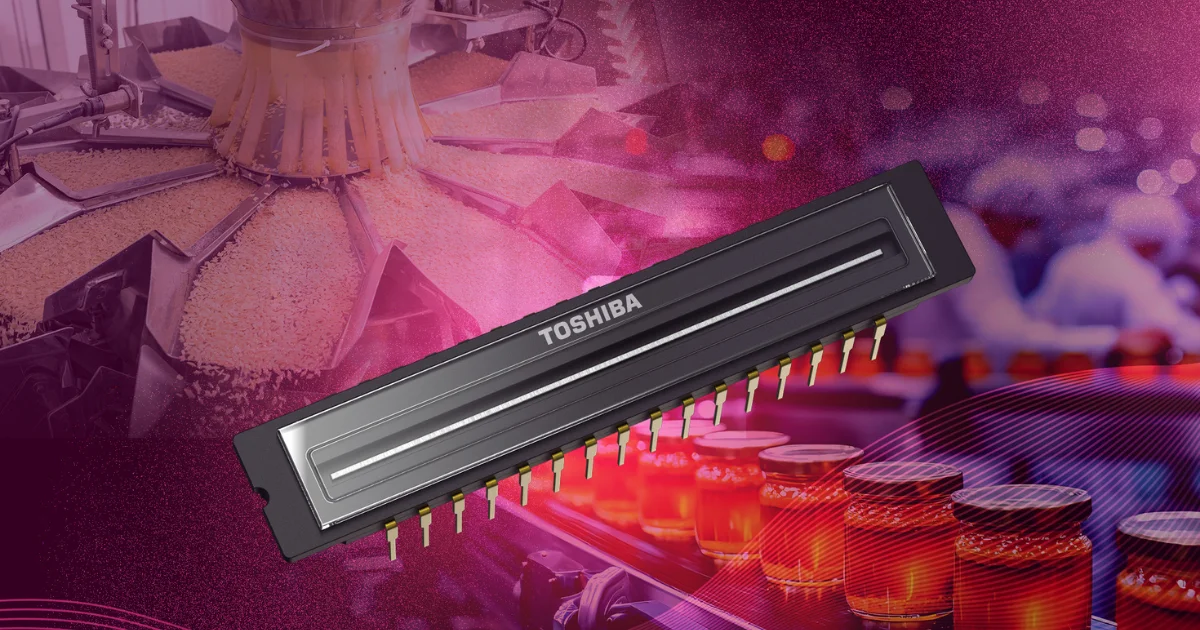
 Automated inspection systems rely on a predictable flow of pixel data, and as production speeds increase, sensors often become the limiting point. When line rates climb into the tens of kilohertz, even small inefficiencies in readout timing or channel routing start to show up as blur, dropped samples or jitter in downstream classification. The TCD2400DG linear CCD sensor from Toshiba Electronics Europe tackles this bottleneck by increasing the data rate while cutting the amount of external circuitry needed to keep the sensor running at full speed.
Readout Architecture That Handles High Line Rates
A notable detail in this device is its ability to push 100 MHz of pixel data across two output channels. The sensor maintains a 22.7 kHz maximum line rate, which more than doubles the throughput of the older TCD2564DG. In practical terms this means a sorter or inspection head can examine much faster conveyor lines without losing spatial accuracy. Engineers building rapid grading or defect detection systems usually have to balance exposure window, LED intensity and readout timing. Higher readout limits ease those constraints by allowing shorter exposures without compromising scene information.
RGB Capture Without Interpolation Overheads
The sensor includes three independent 4096 element arrays, one for each color channel. This arrangement removes the need for Bayer interpolation and avoids color mixing that can become problematic when objects move quickly across the field of view. For grain sorters, electronics inspection lines or material grading machines, having discrete color channels simplifies object classification because the signal chain processes full resolution RGB data from the start. It also reduces latency because interpolation stages often add additional processing steps that scale poorly when line rates are high.
Integrated Timing Generation That Simplifies System Wiring
One area that tends to complicate CCD integration is the need for external driver circuitry. The TCD2400DG includes an on sensor timing generator and CCD driver. This eliminates several control lines and removes the requirement for a dedicated driver IC. For engineers designing compact line scan modules, fewer control signals usually mean fewer opportunities for skew and reduced board area around the sensor head. It also helps when routing within enclosures where long parallel control lines can pick up noise or radiate more interference than expected. By keeping the driver function inside the package, the sensor reduces that wiring burden and lowers the likelihood of EMI issues, which is a common challenge at high clock rates.
Optical Layout Built For Fast Object Movement
The 7 µm pitch and optical reduction design are intended for machine configurations where parts move quickly relative to the sensor. With predictable element spacing and high uniformity across the 4096 pixel span, downstream software can maintain stable edge detection and color segmentation. In inspection environments this consistency helps maintain accuracy from line to line, even when machine speeds fluctuate or lighting conditions shift throughout the day. For engineers, the takeaway is that the TCD2400DG provides a more straightforward path to high resolution color capture without the timing and wiring overhead typically associated with CCD based systems.
Learn more and read the original announcement at www.toshiba.semicon-storage.com
You may also like