Allegro MicroSystems ACS37017 Current Sensor Targets 0.55% Lifetime Accuracy
 Accuracy in high voltage current measurement tends to look simple on paper. A number is specified, a tolerance is given, and the control loop is tuned around it. The problem shows up later. Temperature shifts, packaging stress, aging, and noise slowly push that number away from where it started. In traction inverters, AI server power shelves, and industrial converters, those small shifts accumulate. Allegro Microsystems' ACS37017 Hall-effect current sensor is built around limiting that movement, focusing less on extreme bandwidth and more on holding measurement fidelity steady over years of operation.
Holding Sensitivity Error To 0.55% Across Temperature And Time
The ACS37017 is factory calibrated and specified at 0.55% typical sensitivity error across temperature and lifetime. That figure directly affects how tightly engineers can tune compensation networks in closed loop power systems. If the sensor drifts, the loop must be given margin. Margin costs efficiency and can slow dynamic response.
Unlike shunt based measurement approaches that sacrifice isolation to gain precision, this device combines magnetic sensing with reinforced high voltage isolation. That matters in electrified vehicles and industrial drives where measurement nodes sit at elevated potentials. Precision is useful only if it survives real operating conditions, not just room temperature testing.
Managing Drift In Long-Life Power Platforms
A common challenge in Hall-effect sensors is drift over time. Offset and gain shift as materials experience repeated thermal cycling and electrical stress. Allegro’s internal compensation architecture is intended to counteract those effects instead of relying solely on initial production calibration.
For systems designed to operate for a decade or more, stability after year five is as important as performance on day one. Control loops commissioned in a vehicle or grid-tied inverter need to behave predictably across seasonal temperature swings and long service intervals. Reducing long term drift preserves the original control strategy rather than forcing conservative guard bands into the design.
Integrated Reference And Signal Integrity At The PCB Level
The ACS37017 includes a stable, non-ratiometric voltage reference. Removing the need for an external precision reference component simplifies the analog front end and reduces one potential noise source. In practice, fewer precision parts clustered around the sensor means fewer opportunities for layout induced error or reference instability to corrupt the measurement before it reaches the microcontroller.
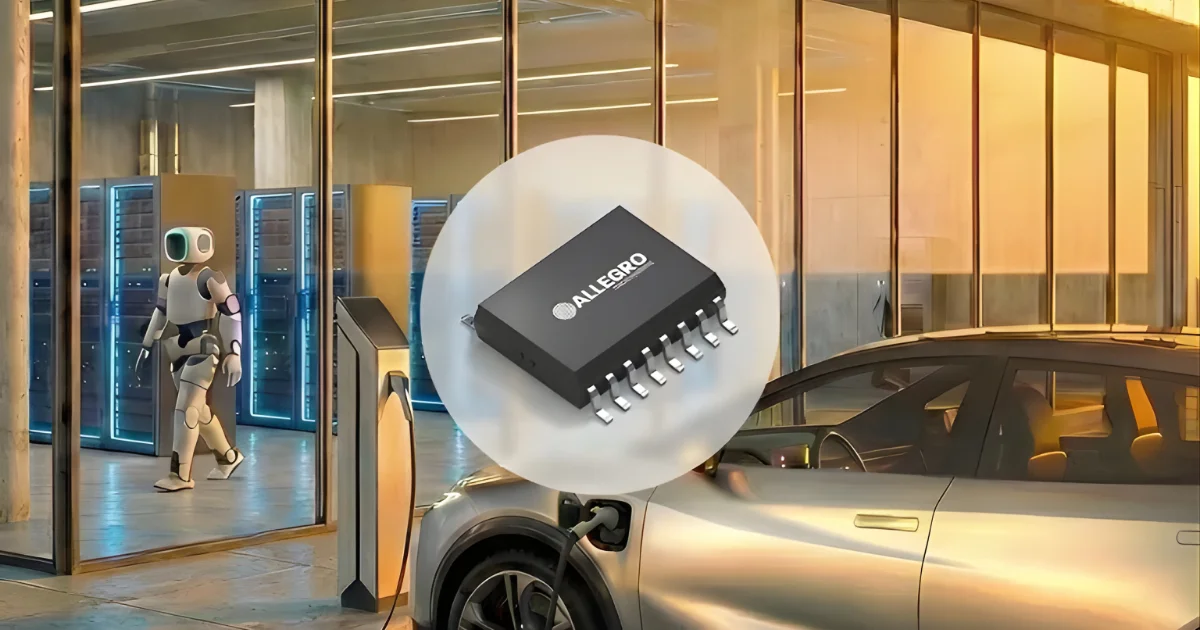
The device is offered in a monolithic surface mount leaded package that provides reinforced isolation without the bulk of module based solutions. That helps maintain creepage and clearance requirements while keeping board height manageable in space constrained systems.
Completing Allegro’s Speed, Density, And Accuracy Portfolio
Allegro has recently expanded its current sensing lineup along three distinct priorities. The ACS37100 addresses bandwidth for fast switching GaN and SiC platforms. The ACS37200 focuses on conductor resistance and density, reducing insertion loss where copper loss and footprint dominate the design discussion. The ACS37017 sits on the accuracy axis.
In some designs bandwidth is the limiting factor. In others, conductor resistance defines thermal performance. In long life power platforms, especially in electrified vehicles and data center infrastructure, sensing stability becomes the controlling variable. The ACS37017 is positioned for those cases where long term measurement integrity defines how confidently the rest of the system can be engineered.
Learn more and read the original announcement at www.allegromicro.com
You may also like