The Challenges with HDDs
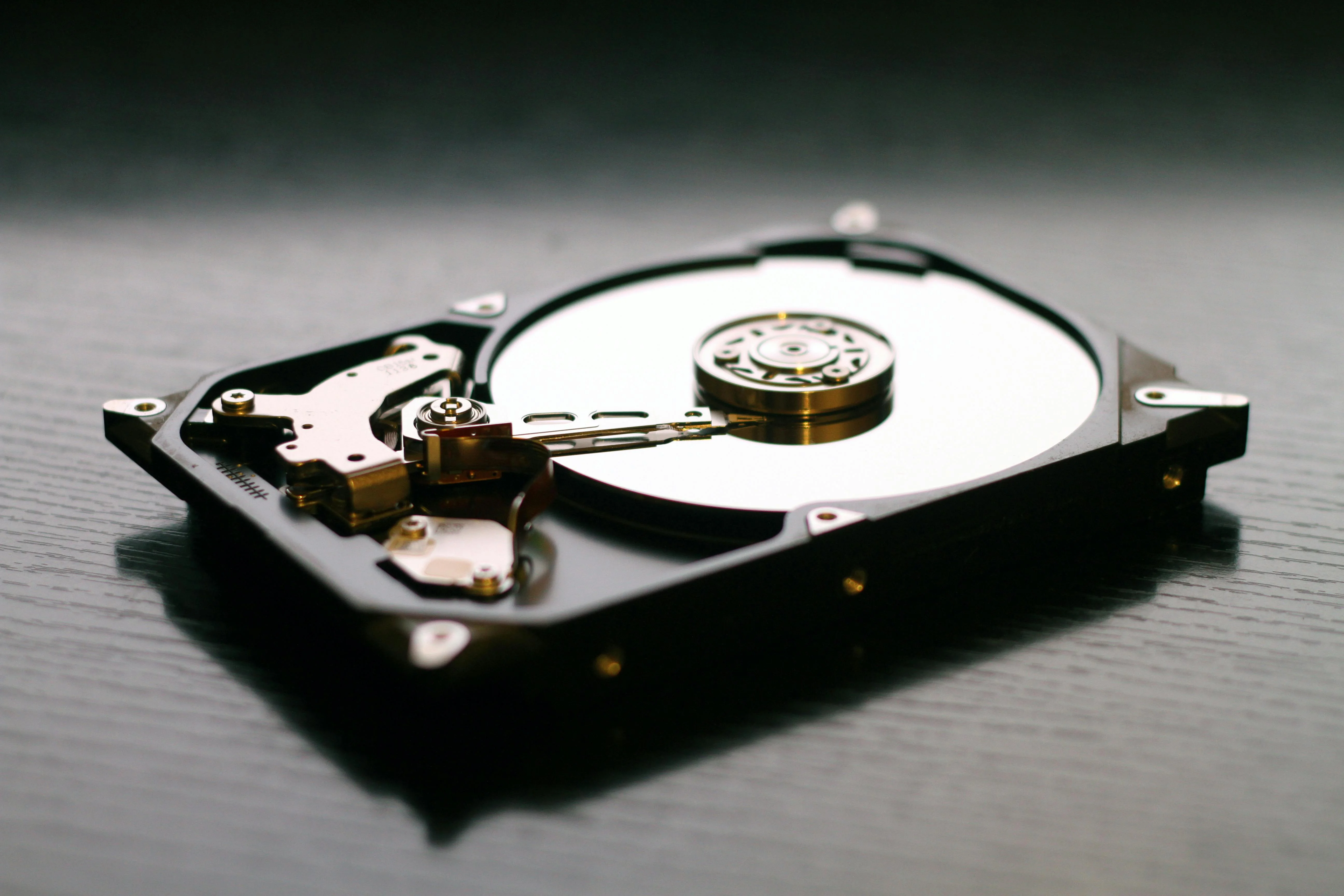
Hard disk drives have been the backbone of digital storage for decades. They evolved from bulky, unreliable machines to compact, high-capacity devices that are capable of storing vast amounts of data. Early disks were gigantic compared to modern devices, being the size of coffee tables and held a few megabytes at best. Today, a platter only a few inches in diameter can store tens of terabytes with ease.
But this evolution was not magic, but instead was the result of decades of incremental advances in material science, precision engineering, and electronics. Improvements, such as thinner read/write head-to-disk spacing, stronger and more uniform magnetic materials, and faster control electronics allowed density to increase while maintaining reliability.
Despite these many advances, HDDs face fundamental mechanical limitations. For example, their reliance on spinning platters and moving actuator arms makes them inherently slower than solid-state memory, as seek times, rotational latency, and vibration sensitivity limit performance, especially for random access workloads. Energy efficiency is another challenge faced with HDDs, as high-speed platters and actuators draw significant power (something that scales poorly in dense server environments). Because of these limitations, mobile devices abandoned HDDs years ago, and even desktops increasingly rely on SSDs for faster boot times and responsive performance. Many servers still use HDDs (in the form of specialised SAS drives), but they are typically used for archival storage or applications where capacity matters more than speed.
Of course, HDDs are also facing indirect competition from emerging technologies beyond SSDs. Advances in non-volatile memory, such as MRAM and 3D XPoint, offer new speed and durability advantages that even SSDs struggle to compete with. Cloud computing has also shifted storage strategies toward distributed SSD architectures for performance-critical applications, making HDDs further obsolete.
Yet, HDDs retain major advantages that are hard to replicate, including cost per terabyte, scalability, long-term reliability, and mature manufacturing processes. Thus, for large-scale storage (data lakes, backups, media archives), HDDs remain the practical choice.
Researchers Create 0.8nm Carbon Layer for Future HDDs
In a notable materials breakthrough, researchers at the National University of Singapore developed a protective coating called MAC (monolayer amorphous carbon), only 0.8 nanometers thick. This is roughly a third the thickness of conventional coatings, allowing the read/write head to operate closer to the magnetic layer, which is a critical factor for increasing storage density.
The MAC layer was applied directly to commercial 2.5-inch platters using a low-temperature laser and plasma process at around 300 degrees Celsius, and this preserved the delicate surface roughness and magnetic domain structure of the platters. Despite its extreme thinness, MAC delivers corrosion protection comparable to traditional 2.5-nanometer layers, achieving over 80 percent effectiveness in electrochemical tests. Furthermore, it also demonstrated thermal stability under HAMR-like conditions, withstanding laser heating up to 450 degrees Celsius without structural changes.
The process developed by the researchers is fully compatible with double-sided platters and larger diameters, and coating times currently take only minutes. However, experts have cautioned that thinner coatings alone are not enough to enable the next generation of HDD capacities. Achieving higher storage densities also requires simultaneous scaling of the write head, TMR read sensors, grain sizes, and head-to-media spacing. While MAC is promising in fundamental research, questions remain about long-term stability, cost-effectiveness, and readiness for mass production.
Why HDDs Will Remain a Key Technology
Despite their mechanical limitations, HDDs retain a central role in modern computing. SSDs have undeniable advantages, including low latency, high IOPS, and suitability for AI workloads and high-performance compute tasks. They also dominate scenarios where speed is paramount, such as frequent repeated file access. Yet, when evaluating storage purely on cost, capacity, and durability, HDDs remain unmatched.
Manufacturing processes for HDD are extremely mature, components are widely available, and production of HDDs scales efficiently. An SSD with equivalent capacity, however, would cost several times more per terabyte, especially at the multi-terabyte scale needed for data centers, media storage, and cloud services. Unlike SSDs, HDDs also have proven reliability spanning decades. When paired in RAID configurations, they provide redundancy and fault tolerance that scales well for enterprise workloads. Even for consumers, HDD arrays are a practical solution for backups, media libraries, and long-term storage where speed is not the primary concern.
Long-term durability of HDDs is another factor that will see them persist in the coming decades. SSDs degrade with write cycles, which becomes a limiting factor for workloads requiring repeated storage operations (such as AI workloads during training). HDDs, by contrast, are mechanically robust when operated within design specifications, and their failure modes are predictable and well understood.
HDDs may be disappearing from laptops and desktops, but in servers, cloud infrastructure, and large-scale storage systems, they are likely to remain dominant for decades. They are slow, yes, but capacity, reliability, and cost are the metrics that matter when storing petabytes of data. HDDs will coexist with SSDs, complementing them rather than being replaced entirely. As data demands continue to grow exponentially, HDDs will continue to underpin the storage strategies of enterprise and cloud providers alike.