
 Anyone who has worked with surge protection circuits long enough eventually develops a cautious relationship with MOVs. They do their job quietly most of the time, clamping transient voltages that would otherwise reach sensitive electronics. But they also have a reputation. When the energy in a surge exceeds what the varistor can safely absorb, the device can enter thermal runaway. That scenario is why many protection circuits end up including extra components around the MOV itself, not because the clamp function is insufficient but because the failure mode needs to be managed.
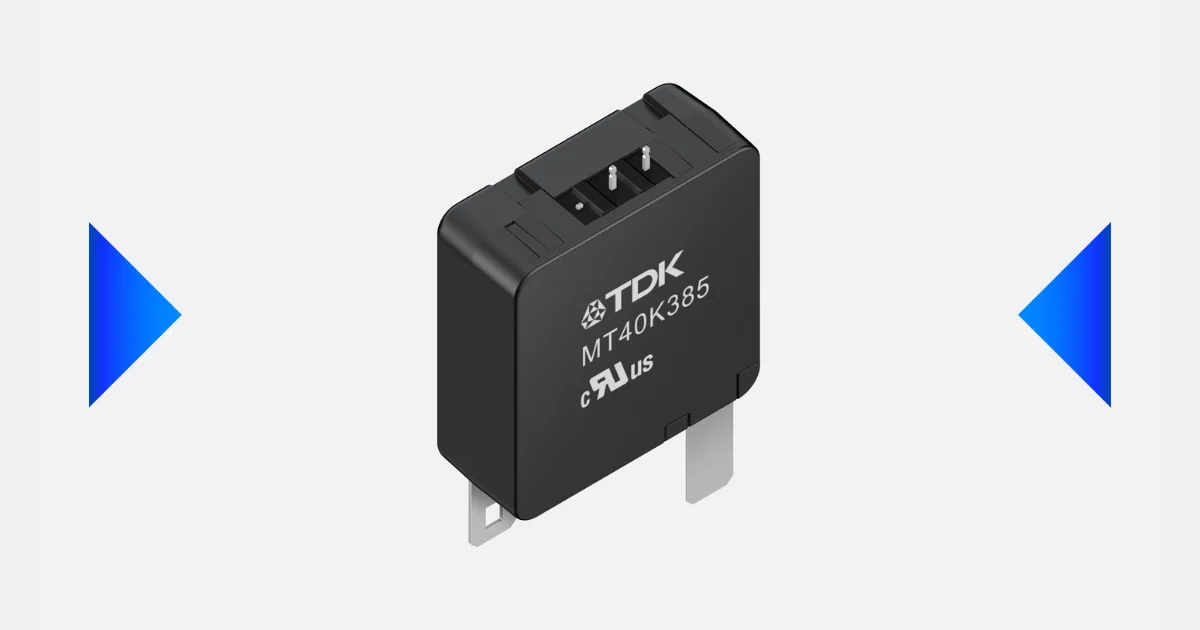
The MT40 series from TDK approaches that long standing issue by combining a metal oxide varistor with an integrated thermal disconnect structure inside a single package.
MT40 ThermoFuse Varistors and the Problem of MOV End-of-Life
MOVs operate by becoming conductive when voltage rises beyond a defined threshold. During a surge event the device absorbs energy and diverts current away from downstream circuitry. Repeated exposure to high surge energy slowly degrades the varistor material. The clamping voltage shifts, leakage increases, and eventually the device can begin heating continuously under normal line conditions.
That heating is the point where surge protection designers start thinking about protection for the protector itself. The MT40 series incorporates a thermal disconnection mechanism intended to interrupt the current path if the varistor reaches unsafe temperature levels. Instead of relying on an external fuse or thermal cutoff device mounted nearby, the disconnect structure is integrated directly within the component package.
In practice this means the varistor and its thermal safeguard share the same housing. If excessive temperature develops the internal disconnect separates the varistor from the line before the package experiences destructive failure.
Surge Handling in High Energy Environments
The MT40 devices are intended for environments where surge currents are measured in tens of kiloamps rather than a few hundred amps. According to TDK specifications the series can tolerate surge currents approaching 50 kA using the standard 8/20 microsecond waveform commonly used in surge testing.
Short circuit current capability also appears unusually high for a device of this size. Ratings up to 200 kA are specified in accordance with UL 1449 requirements. In practice these numbers place the MT40 series firmly in the category of protection components used inside surge protection devices, industrial power electronics, and outdoor electrical infrastructure where lightning induced transients are a realistic concern.
Voltage variants cover AC systems from roughly 150 V through 550 V while DC operating ranges extend into the 200 V to 750 V region. Those values align with applications such as photovoltaic inverters, telecom power equipment, and industrial power supplies where DC bus voltages frequently exceed several hundred volts.
Integration Details Designers Usually Notice Late
Packaging choices often influence surge protection design more than the electrical ratings alone. The MT40 devices use a strap terminated structure that mounts directly to the PCB. The body itself measures roughly 38 millimeters long, about 15 millimeters wide, and slightly over 40 millimeters tall. That form factor reflects the physical reality of dissipating large surge energy in a relatively compact enclosure.
A normally open monitoring switch is also integrated into the device. When the thermal disconnect mechanism activates, the switch changes state and can signal the host system that the surge protection element has reached end of life. Designers building surge protection modules often add similar monitoring circuits externally, so integrating the indication path within the component can simplify that part of the design.
The package is encapsulated in flame retardant epoxy and rated for operating temperatures spanning from negative 40 degrees Celsius to roughly 85 degrees Celsius. Those numbers will not surprise anyone designing industrial protection hardware but they do indicate the device is intended for real infrastructure rather than controlled indoor electronics.
Surge Protection Components Continue Evolving With System Requirements
Electrical systems exposed to outdoor infrastructure, renewable energy installations, or telecommunications equipment face surge events that are difficult to predict but impossible to ignore. Protection devices must not only clamp transient voltages but also fail safely when their energy limits are exceeded.
Integrated solutions such as ThermoFuse varistors reflect a broader shift in surge protection hardware. Instead of treating thermal protection, status monitoring, and voltage clamping as separate functions scattered across a board, newer components are absorbing those mechanisms internally.
Engineers designing surge protection circuits will still spend time choosing placement, grounding paths, and coordination between multiple protection stages. The fundamentals of surge design have not changed much. But the components implementing those functions continue to evolve.
Learn more and read the original announcement at www.tdk.com
You may also like