
 Wireless connectivity chips in IoT systems used to be fairly predictable parts of a design. They handled the radio link, moved packets between devices, and stayed mostly out of the way while the host processor handled the rest. Things get messy once sensing and local intelligence enter the picture. Suddenly the wireless subsystem is not just forwarding data. It is participating in the system logic. That change tends to pull extra silicon onto the board.
Wi-Fi 7 Radios Begin Absorbing Edge Compute Workloads
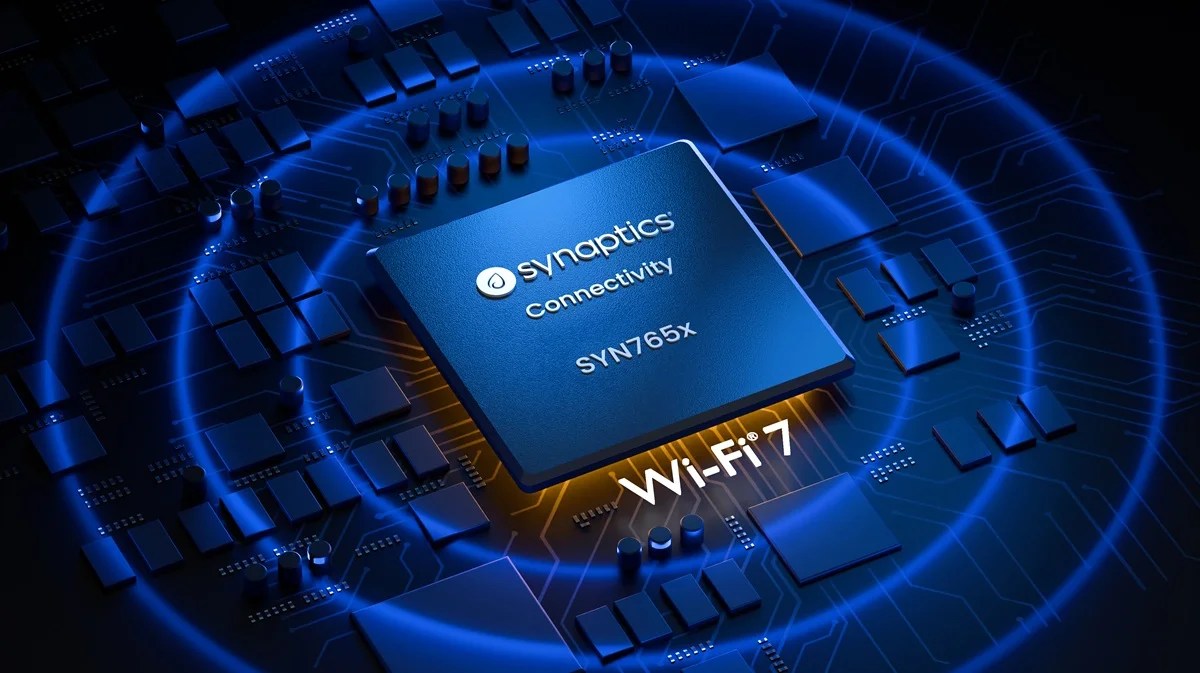
Synaptics is approaching that problem with the SYN765x, a connectivity device that pulls several wireless protocols and local processing resources into the same silicon. Instead of behaving purely as a network interface, the device carries logic, DSP capability and neural processing resources intended to handle parts of the workload that normally sit elsewhere in the system.
The radios themselves are fairly ambitious for an IoT-class device. Wi-Fi 7 is present, operating alongside Bluetooth LE 6 and Thread or Zigbee connectivity across the familiar 2.4 GHz, 5 GHz and 6 GHz bands. Multiple links can operate at once, which becomes useful when devices need to speak several wireless languages simultaneously. Anyone who has tried to combine those radios on a tight embedded board will immediately recognize the appeal of collapsing them into a single device.
Space matters more than people admit. PCB real estate disappears quickly once several RF devices, switching networks and antennas start competing for routing space.
Channel State Information Turns a Radio Link Into a Sensor
One capability buried inside the architecture is support for sensing using channel state information extracted from Wi-Fi transmissions. Instead of using the radio purely as a communication link, the device analyzes the RF channel itself.
Movement inside an environment alters how signals propagate. Reflections shift. Multipath components change shape. Small variations in the channel become visible to the receiver. Extracting those characteristics and feeding them through local processing allows the system to infer motion or presence without dedicated sensors.
This approach shows up increasingly in smart environments. It is not perfect. RF propagation can be unpredictable. But when it works, the same infrastructure carrying the data also becomes part of the sensing system.
Bluetooth Channel Sounding Introduces Low-Cost Ranging
The SYN765x also introduces Bluetooth channel sounding for distance estimation between connected devices. Compared with technologies such as ultra-wideband, the precision is lower, but the hardware requirements are also dramatically simpler.
Distance measurements derived from channel characteristics allow devices to estimate proximity without introducing a separate positioning subsystem. For embedded systems that already include Bluetooth connectivity, the ability to reuse that radio for basic ranging functions changes the system trade-offs.
Designers who only need approximate distance information will often accept slightly lower accuracy if the hardware footprint stays small. You tend to appreciate that trade-off when a design review reveals one more component that needs space on the board.
Connectivity Silicon Quietly Evolves Into Edge Platforms
Architecturally the SYN765x sits somewhere between a connectivity chip and a small processing platform. It can operate alongside a host MCU or application processor, acting as a co-processor responsible for wireless communication and localized AI workloads. In some designs it can operate without a host at all, relying on its own compute resources and memory.
That flexibility hints at a broader trend inside embedded systems. Connectivity hardware is slowly accumulating enough compute capability to run parts of the application itself. The boundary between “radio chip” and “edge processor” becomes less obvious with each generation. Somewhere in the middle of a board layout review, the distinction starts to matter less than the number of components that disappeared from the design.
Learn more and read the original announcement at www.synaptics.com