
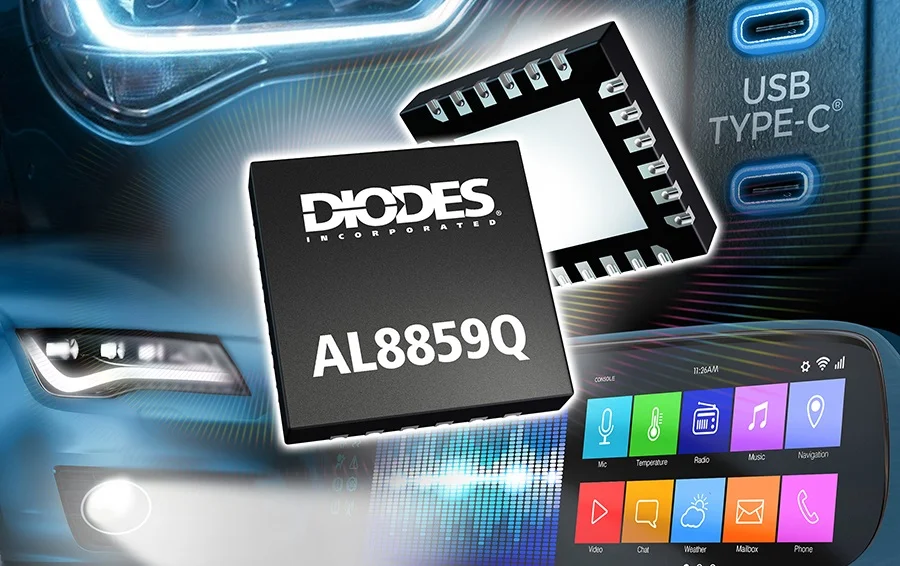
 Automotive headlights stopped being simple loads a long time ago. What used to be a bulb hanging off a relay has turned into a tightly controlled electronic system where multiple LED channels operate inside a sealed housing with limited thermal headroom. Those lighting modules still depend on vehicle power rails that can sag during cold crank or spike during load dump. Somewhere in that environment a stable supply has to exist before any LED driver can regulate current properly. The AL8859Q from Diodes Incorporated is intended to sit in that first stage, acting as a boost controller that generates the regulated voltage rail feeding modern automotive headlight electronics.
Multi-Phase Boost Stages Inside Headlight Control Units
LED headlight assemblies are no longer single circuits. Adaptive front lighting systems typically combine several LED drivers managing high beams, low beams, daytime running lights, cornering lights, and indicators within the same enclosure. Once everything lives in one module the front-end power stage has to handle a much larger electrical load than a traditional lighting circuit ever did.
The AL8859Q approaches that problem with a current-mode multi-phase boost architecture. One controller operates two phases, but additional controllers can be synchronized when designs move beyond that. In practice the load spreads across multiple inductors and switching devices instead of forcing a single stage to carry everything. Ripple current drops, heat moves around the board instead of piling up in one corner, and the converter behaves a little more predictably when the lighting module begins pulling serious power.
Surviving Automotive Voltage Events
Vehicle power rails rarely behave like regulated laboratory supplies. A cold crank can drag voltage down just as systems begin operating, while a load dump can push the rail far beyond nominal levels for a short moment. Power stages inside the vehicle have to tolerate that behavior without collapsing.
The AL8859Q operates across an input range from about 4.5 V up to 60 V, which allows the same design to function across common automotive rails including 5 V, 12 V, 24 V, and 48 V systems. Output behavior during transient events can be tuned through programmable registers so the converter does not respond the same way in every platform. Voltage regulation sits around ±0.5% near the fifty volt region under typical conditions. That number matters less on paper than it does inside the headlight module. Once several LED channels begin operating simultaneously, even small upstream voltage shifts tend to show up as uneven current distribution between channels.
Software Configuration Inside the Power Stage
Lighting platforms rarely stay fixed across a single vehicle generation. A power stage designed for one headlight assembly often finds itself reused in several variants, which means flexibility becomes useful. The AL8859Q exposes its control parameters through an SPI interface. Switching frequency, voltage targets, current limits, and protection thresholds all live inside the device register map, which allows the hardware design to remain largely unchanged while the configuration evolves between vehicle platforms. Configuration data can also be stored in integrated one-time programmable memory. If communication with the system MCU disappears the controller can still continue operating using the stored configuration.
Diagnostics are integrated as well. Thermal warning and shutdown, current limiting, overvoltage and undervoltage protection, SPI error detection, and VDRIVE monitoring provide system feedback and allow designers to build lighting modules capable of meeting functional safety requirements.
Managing EMI Inside Dense Vehicle Electronics
Switching converters positioned near cameras, radar sensors, and vehicle communication networks must operate within strict electromagnetic limits. Headlight modules tend to sit in a crowded electrical environment where emission control matters. The AL8859Q includes spread-spectrum frequency modulation that distributes switching energy across a wider frequency band. Instead of concentrating emissions at a single switching frequency, the energy spreads across the spectrum, which helps systems meet CISPR 25 Class 5 EMI limits and can reduce the need for large external filtering components.
The controller is packaged in a 4 mm by 4 mm V-QFN4040-24 device with wettable flanks. That feature allows automated optical inspection of solder joints during production, something automotive manufacturers rely on heavily when verifying assembly quality at scale.
Learn more and read the original announcement at www.diodes.com
Component Overview
The AL8859Q from Diodes Incorporated is an automotive multi-phase SPI boost controller designed to generate a constant-voltage rail for adaptive LED headlight systems. The controller operates from 4.5 V to 60 V input rails and supports two-phase boost operation that can be expanded to three or four phases by synchronizing additional controllers. These configurations enable headlight power stages delivering roughly 100 W to 400 W for integrated automotive lighting modules.
Frequently Asked Questions
What is the AL8859Q used for?
The AL8859Q is used as a constant-voltage boost controller that powers LED driver stages inside adaptive automotive headlight systems.
What input voltage range does the AL8859Q support?
The controller operates from 4.5 V to 60 V, allowing it to work across common automotive supply rails including 5 V, 12 V, 24 V, and 48 V systems.
You may also like