
 Battery powered IoT systems rarely fail because the processor is too slow. They fail because something has to stay awake to watch the world. A sensor might only need attention when a threshold is crossed or when motion begins, but the firmware rarely trusts the hardware to sit alone for long. So the microcontroller wakes, checks a register, goes back to sleep, then repeats the whole process thousands of times a day. The energy spent doing nothing useful adds up faster than most early power budgets predict.
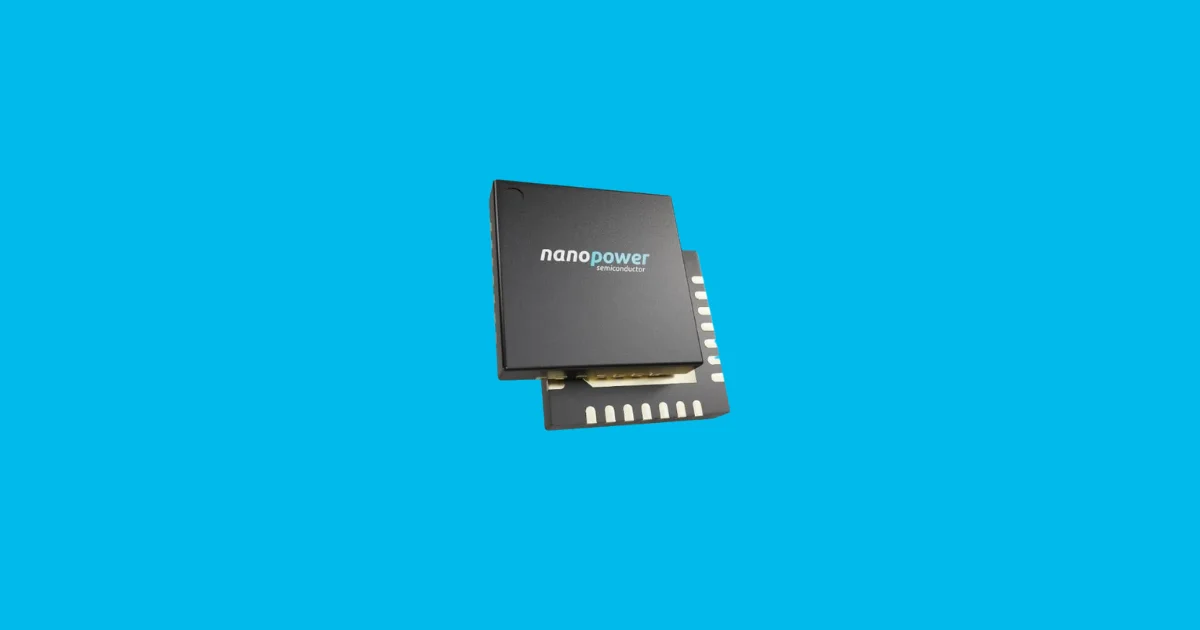
Somewhere inside that loop sits the nPZero from Nanopower Semiconductor. The nPZero is a power-saving integrated circuit used to monitor sensors and wake a host microcontroller only when defined conditions occur. Instead of the MCU repeatedly polling sensors, the device reads them directly and evaluates the results internally while the rest of the system stays powered down.
In a typical remote sensing node the MCU might wake every few milliseconds to sample a temperature sensor or accelerometer before dropping back into sleep mode. That behaviour looks harmless until the device is expected to sit in a field for years. The energy lost in those tiny wake cycles becomes the dominant drain on the battery.
When the MCU Stops Watching the Sensors
The unusual part of the nPZero architecture is not the sensing interface itself. Interfacing to sensors is routine. What changes is who controls the process. The chip can configure and read data from up to four sensors without the host processor running at all. That shifts the monitoring task into dedicated hardware that continues operating while the MCU remains completely off. Only when the defined rules are satisfied does the host wake.
In a small agricultural monitoring node, for example, environmental sensors may only need attention when conditions drift outside a defined window. Until then the radio, processor, and memory can remain dormant while the monitoring logic quietly waits.
Event Driven Sensing Instead of Firmware Polling
Traditional embedded firmware assumes the MCU must orchestrate everything. Polling loops, timer interrupts, and sensor reads are built directly into the application code. With the nPZero sitting between the sensors and the processor, that pattern starts to disappear. The device evaluates sensor outputs locally and only signals the host when something meaningful happens. That might be a threshold crossing, a motion event, or some other rule defined during configuration.
The result is less time spent waking the processor for routine checks. Nanopower reports that the approach can reduce system energy consumption by as much as 90 percent in certain scenarios. That figure depends heavily on the application and event frequency, but the direction is obvious once the polling loop is removed from the firmware.
Development Workflow Around the PSIC
Moving the sensing logic into hardware changes how developers bring up a system. Instead of writing large blocks of firmware dedicated to sensor supervision, the behaviour is configured through Nanopower’s development tools. The company provides a graphical configurator that allows engineers to define sensor conditions and triggering rules. Once those parameters are set, the environment generates the supporting API structures that integrate the device with the host firmware.
Development kits and samples are already available, which suggests the company expects designers to experiment with the architecture early in the prototyping phase rather than treat it as a late optimisation.
Why Sensor Monitoring Is Becoming a Hardware Problem
As more IoT devices move toward multi year deployment targets, the energy cost of firmware driven sensing becomes difficult to ignore. Wireless radios have become efficient and microcontrollers spend most of their time asleep. Yet the sensing loop still wakes the system repeatedly even when nothing changes.
Hardware blocks like the nPZero attempt to shift that responsibility away from the processor entirely. The MCU becomes an occasional participant instead of the constant observer. That idea feels slightly backwards at first. Firmware engineers are used to keeping control inside the processor. But once a device has spent months in the field surviving on a coin cell, the appeal of letting something else keep watch starts to make sense.
Learn more and read the original announcement at www.nanopowersemi.com
Technology Overview
The nPZero is a power-saving integrated circuit designed to monitor sensors while the host microcontroller remains powered down. It can configure and read up to four sensors and wake the MCU when user defined conditions occur. The device reduces energy consumption by removing frequent firmware polling cycles in IoT systems.
Frequently Asked Questions
What is the nPZero used for?
The nPZero is used in IoT systems to monitor sensors and wake a microcontroller only when defined conditions are met, reducing energy spent on continuous polling.
How many sensors can the nPZero monitor?
The device can autonomously configure and read up to four sensors while the host MCU remains powered down.