
 Samtec Slim Cables Add More Flexible Signal Routing
Dense systems rarely keep one clean signaling strategy for long. A board may need fast differential lanes in one area, lower-speed single-ended lines in another, and all of it still has to move through a space that is already crowded with processors, FPGAs, heatsinks, and connectors. That is usually where the interconnect starts shaping the design more than expected.
Samtec Slim Cables Add More Flexible Signal Routing
Dense systems rarely keep one clean signaling strategy for long. A board may need fast differential lanes in one area, lower-speed single-ended lines in another, and all of it still has to move through a space that is already crowded with processors, FPGAs, heatsinks, and connectors. That is usually where the interconnect starts shaping the design more than expected.
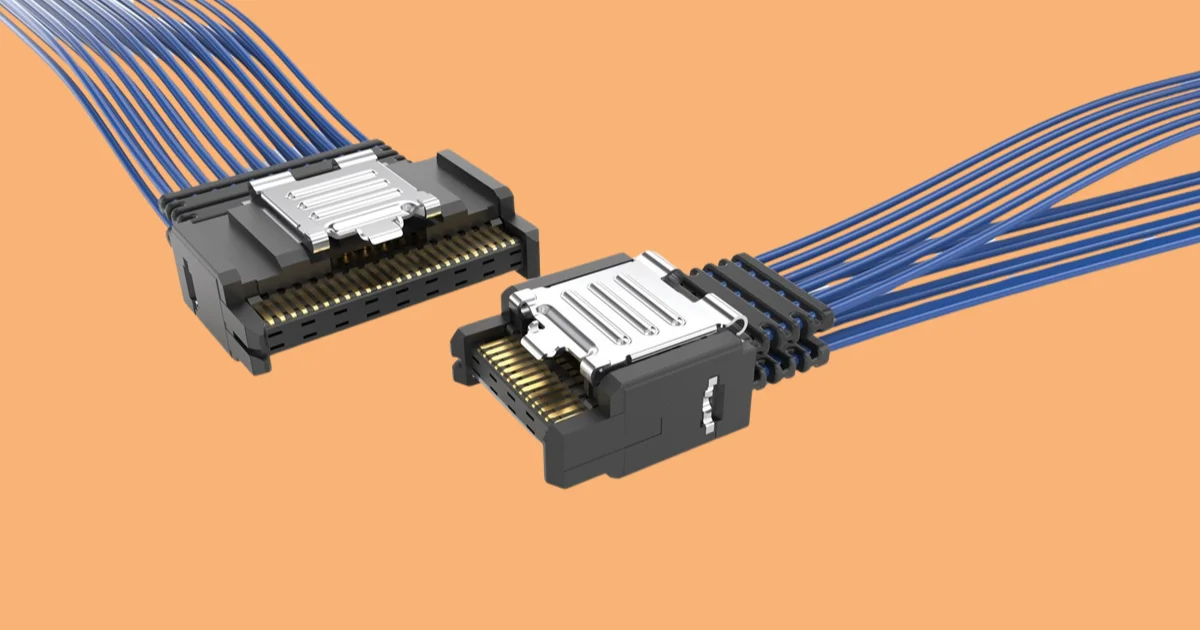
That is where Samtec’s AcceleRate Slim ARC6 cable assemblies have broadened their role. The ARC6 is a slim cable assembly used to route signals in dense computing, FPGA prototyping and emulation, and MIPI-related systems. In a typical FPGA platform or compute board, this type of cable is used to move signals off a tightly packed area of the board toward another board, front panel, or backplane without adding more routing pain than necessary.
The key change here is not simply that Samtec has added new variants. It is that the cable family is no longer limited to differential signaling only, which makes it more relevant to systems where fast lanes and lower-speed signals have to coexist in the same interconnect scheme.
Mixed Signaling Makes The Cable More Useful In Real Systems
The original ARC6 family was aimed at differential pair applications supporting 64 Gbps PAM4, PCIe 6.0, and CXL 3.2. That gave it a clear place in high-data-rate hardware, but it also made it more specialized. Samtec has now added two new options. The ARC6 (-S) supports single-ended 50 Ohm signaling at 5 Gbps NRZ, while the ARC6 (-M) combines 50 Ohm single-ended lines with 92 Ohm differential pairs. That is where the release becomes more interesting, because many real systems do not stay neatly split into one signaling type or another.
In FPGA prototyping, emulation, and MIPI-related hardware, some channels need high-speed differential performance while others are carrying control, interface, or lower-speed traffic. Once both have to pass through the same cable path, a mixed-signaling option starts making much more sense than forcing everything into an all-differential approach.
Direct-Attach Contacts Help Keep The Path Cleaner
The ARC6 assembly keeps the direct-attach contact structure that was already one of its stronger points. The contacts solder directly to the cable, eliminating the transition card from the transmission path. At higher data rates, that kind of simplification matters because extra interfaces rarely come for free.
Samtec also keeps the body narrow at 7.6 mm, which is useful in systems where cable routing space is limited and airflow is already under pressure. The integrated flexible strain relief and metal latching system add a bit more mechanical robustness too, which matters in development platforms and other systems where cables may be handled repeatedly.
Smaller Cable Geometry Helps In Crowded Hardware
All ARC6 variants use Samtec’s Eye Speed cable technology. The single-ended micro coax version uses a 0.024 inch outer diameter, while the differential twinax cable is specified at 3.5 ps/meter maximum skew and has a cross-sectional area 40 percent smaller than Samtec’s original Eye Speed cable. That smaller geometry matters because cable assemblies in dense systems quickly become mechanical problems as well as signal ones. They take up space, affect airflow, and complicate access around already crowded hardware. A narrower cable does not solve all of that, but it helps.
This is really what the new ARC6 options are about. Not replacing the high-speed differential story, but making the same cable system more useful in hardware that needs a less uniform signaling mix. In dense systems, that kind of flexibility often matters more than one more headline bandwidth number.
Learn more and read the original announcement at www.samtec.com
Technology Overview
The AcceleRate Slim ARC6 is a slim cable assembly for dense computing, FPGA prototyping and emulation, and MIPI-related systems. It now includes single-ended 50 Ohm signaling at 5 Gbps NRZ and mixed signaling with 50 Ohm single-ended lines and 92 Ohm differential pairs, alongside existing differential configurations supporting 64 Gbps PAM4. The assembly uses direct-attach contacts, a 7.6 mm body width, and Samtec Eye Speed cable technology.
Frequently Asked Questions
What is the Samtec ARC6 used for?
It is used to route signals in high-density computing, FPGA prototyping and emulation, and MIPI protocol systems.
What new signaling options are available for ARC6?
Samtec has added a single-ended 50 Ohm option at 5 Gbps NRZ and a mixed-signaling option combining 50 Ohm single-ended and 92 Ohm differential pair signaling.
You may also like