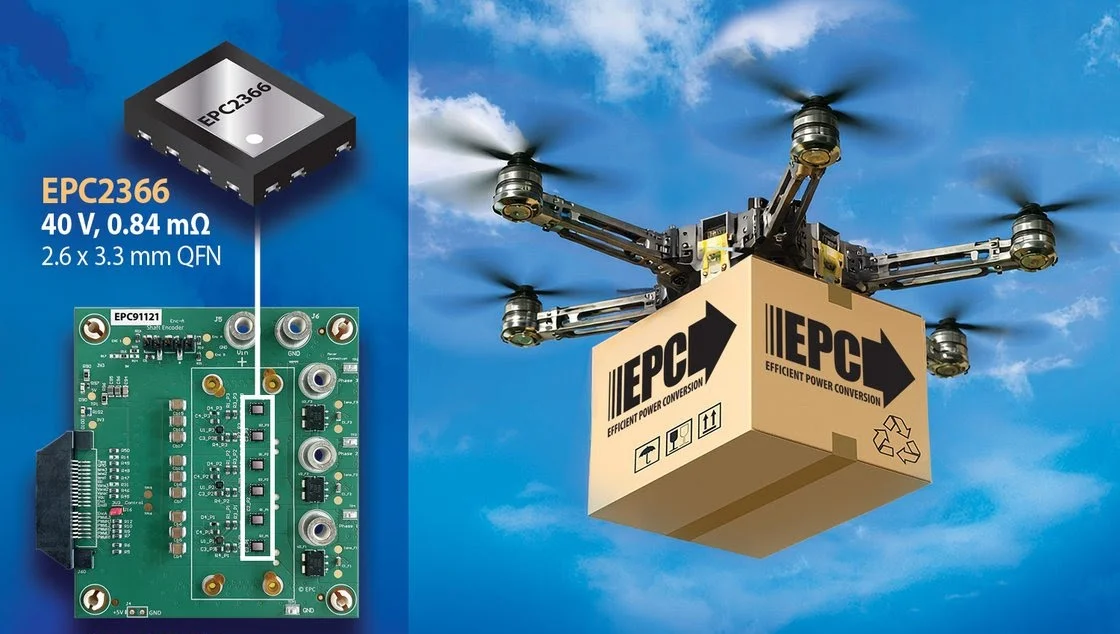
 There is a point in motor-drive development where transistor performance stops being the only story. Measurement bandwidth, controller access, voltage sensing, and layout quality all start deciding whether a board is genuinely useful or just technically impressive. The EPC91121 from EPC looks built with that reality in mind, pairing a 40 V Gen 7 GaN stage with the sort of inverter support circuitry engineers usually end up piecing together themselves.
The EPC91121 is a three-phase BLDC motor drive evaluation board used for prototyping compact high-current inverter systems. In a typical drone, robot actuator, or cordless power tool, the inverter sits between the battery rail and the motor phases, switching hard while the controller tries to keep torque smooth and current under control. That sounds straightforward until the board has to survive real switching edges, real sensing demands, and real debugging.
At the center of the platform is EPC’s EPC2366, a seventh-generation 40 V eGaN power transistor with an on-resistance of 0.84 mΩ. EPC is using it here in a board sized at 79 mm by 80 mm, which is small enough to stay relevant to the kinds of systems this hardware is meant to represent. That matters, because power density claims start to lose value when the evaluation hardware no longer resembles the physical constraints of the end product.
Current Measurement Starts To Matter More At Higher Speed
A motor inverter can look impressive on a headline spec sheet and still be frustrating on the bench. Once PWM frequency rises, the sensing path starts to become part of the real limitation. EPC has given the EPC91121 current sensing on all three phases with support up to ±125 A, along with phase-voltage and DC-bus voltage sensing, which makes the platform far more useful for engineers trying to study actual control behavior rather than just verify that the switches turn on and off.
That becomes more relevant when advanced control methods enter the picture. Field-oriented control and space-vector PWM are both mentioned in the release, and neither benefits from vague feedback or badly exposed measurement points. If the board is going to be used as an evaluation platform rather than a one-time demo, those support functions have to be treated as first-order design elements. Here, they seem to be.
150 kHz Switching Changes More Than Efficiency
EPC says the board supports PWM switching frequencies up to 150 kHz, which is considerably higher than the range many silicon-based motor-drive stages are typically run in. That does not just change loss calculations. It changes what happens around the power stage as well. Magnetics can shrink, control response can tighten, and the acoustic character of the motor can shift. Then the penalties show up elsewhere if layout discipline is poor.
This is where GaN earns its keep, but also where it can become awkward. Fast devices are easy to admire until dv/dt begins dragging noise into places it should not be. EPC claims the board controls dv/dt to below 10 V/ns for stable operation and improved electromagnetic compatibility, while also reducing torque ripple and motor acoustic noise. Those are the details that make a development board feel thought through instead of merely fast.
A Board Built For Bench Work
The rest of the platform reads like it was designed by people who have spent time trying to bring up motor hardware under deadline pressure. Gate drivers, housekeeping power supplies, voltage and temperature monitoring, and current sensing are already integrated. Shaft encoder and Hall-sensor interfaces are also included, along with multiple test points. None of that is glamorous, but those are exactly the details that save time once the board reaches a lab bench.
There is also a 40-pin controller interface compatible with ecosystems from Renesas, Microchip, Texas Instruments, and STMicroelectronics. That is a practical decision. Most engineers evaluating a new inverter stage do not want to rebuild the control side from scratch just to try a different switching technology. They want the power board to drop into a familiar workflow and let them focus on what has actually changed.
Why This Kind Of Platform Matters Now
Compact electromechanical systems are asking more from their motor stages than they used to. Drones want lower mass and quicker response. Robotics wants smoother control in tighter spaces. Industrial tools still care about ruggedness, but there is less tolerance now for wasted board area or sluggish switching. Evaluation hardware that exposes the right constraints early is often more useful than hardware that simply posts a big current number. That is what makes the EPC91121 interesting. It is not just a showcase for a GaN transistor. It is a reminder that once switching performance improves, everything around the switch has to become more intentional too.
Learn more and read the original announcement at www.epc-co.com
Technology Overview
The EPC91121 is a three-phase BLDC motor drive evaluation board built around the 40 V EPC2366 Gen 7 eGaN power transistor. It operates from an 18 V to 30 V input and delivers up to 70 A peak, or 50 ARMS, output current for compact battery-powered motor-drive systems. The board includes gate drivers, housekeeping power supplies, voltage and temperature monitoring, current sensing, and a 40-pin controller interface for motor-control development.
Frequently Asked Questions
What is the EPC91121 used for?
The EPC91121 is used to evaluate and prototype three-phase BLDC motor drive inverter designs for applications such as drones, robotics, industrial automation, and handheld power tools.
What input voltage and output current does the EPC91121 support?
The board supports an input range of 18 V to 30 V and delivers up to 70 A peak, or 50 ARMS, output current.
You may also like