
 There are certain power supply decisions that stop feeling like choices once the power level gets high enough. As output rises, designers often end up leaving flyback behind and moving into resonant territory, whether they want the extra complexity or not. That expectation has been built into power design for so long that many teams barely question it. At some point, the wattage goes up and the supply simply gets harder.
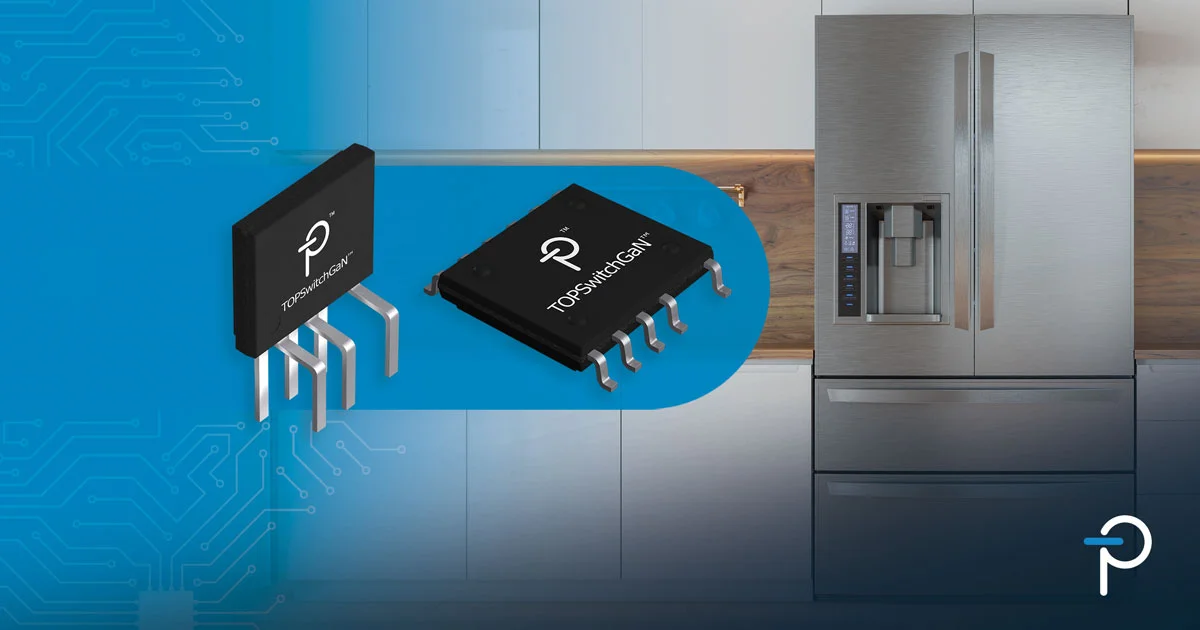
Power Integrations has introduced TOPSwitchGaN right at that point. The new family is a set of flyback power conversion ICs for offline power supplies up to 440 W, which pushes flyback into a range where many engineers would normally stop using it. At higher power, the expectation is usually that the design will move into LLC or another resonant topology. In e-bike chargers, appliances, and industrial supplies, that is often the point where the power stage stops being simple.
The Old Flyback Ceiling Has Always Been Practical
Flyback has never been attractive because it sounds sophisticated. Engineers use it because it is familiar, compact, and usually quicker to bring up than more elaborate topologies. The problem is that simplicity has a ceiling. As power climbs, conduction losses get harder to ignore, thermal margins tighten, and sooner or later the design starts leaning toward something resonant.
That is the ceiling Power Integrations is trying to raise. By combining its TOPSwitch platform with 800 V PowiGaN switches, the company says these devices push flyback converter output power to 440 W. The number matters, but the reason it matters is simpler. Lower RDS(ON) cuts conduction losses, which gives flyback more room before heat and efficiency start pushing back too hard.
Why This Is About More Than Efficiency
The press release leans on 92 percent efficiency across a load range from 10 percent to 100 percent, and that is strong enough on paper. But the more interesting part is that flyback may now stay viable further into a power range where many designers would normally switch topology.
Power Integrations also says the devices meet European ErP requirements with less than 50 mW power consumption in standby and off modes, and that they do it without synchronous rectification. That matters because standby behavior and housekeeping power are often where designs pick up small penalties that do not look serious at first, but add up fast in the finished product.
The Packages Point To Very Different Designs
The package split gives a better sense of where these parts are really supposed to be used. The low-profile eSOP-12 package is aimed at slimmer designs and can deliver 135 W across an 85 VAC to 265 VAC input range without a heat sink. That matters because this family is not only chasing the 440 W headline. It is also trying to keep flyback practical in products where profile, thermal behavior, and manufacturability all matter at once.
The eSIP-7 package goes the other way. Its vertical form reduces PCB footprint, and with a clipped metal heat sink it can move into higher-power designs such as power tools, e-bikes, and garage door openers. The constraints are different across those products anyway. Some teams care most about height, others about footprint, and others just want the power stage to stay manageable without being forced into a more involved topology.
The Familiar Workflow May Matter Just As Much
One of the more practical details in the announcement is pin-to-pin compatibility with TinySwitch-5 off-line switcher ICs. That matters because engineers rarely judge a new power IC on efficiency alone. They also look at how disruptive it will be to the design flow they already use. Because the parts are pin-to-pin compatible with TinySwitch-5 devices, Power Integrations says designers can use a familiar methodology across applications spanning 10 W to 440 W.
That does not suddenly make resonant designs irrelevant. There are still good reasons why they exist. But if flyback can now stay useful at power levels that once pushed it aside automatically, some power supplies may get simpler for a very straightforward reason: the old cutoff point may no longer be where engineers thought it was.
Learn more and read the original announcement at www.power.com
Technology Overview
TOPSwitchGaN is a family of offline flyback power conversion ICs from Power Integrations designed to extend flyback output power up to 440 W. The devices combine 800 V PowiGaN switches with TOPSwitch architecture, support switching frequencies up to 150 kHz, and are intended for appliances, e-bike chargers, and industrial power supplies.
Frequently Asked Questions
What is TOPSwitchGaN used for?
It is used to build offline flyback power supplies for applications including appliances, e-bike chargers, and industrial systems.
What power level does TOPSwitchGaN support?
Power Integrations says the family extends flyback converter designs up to 440 W.
You may also like