
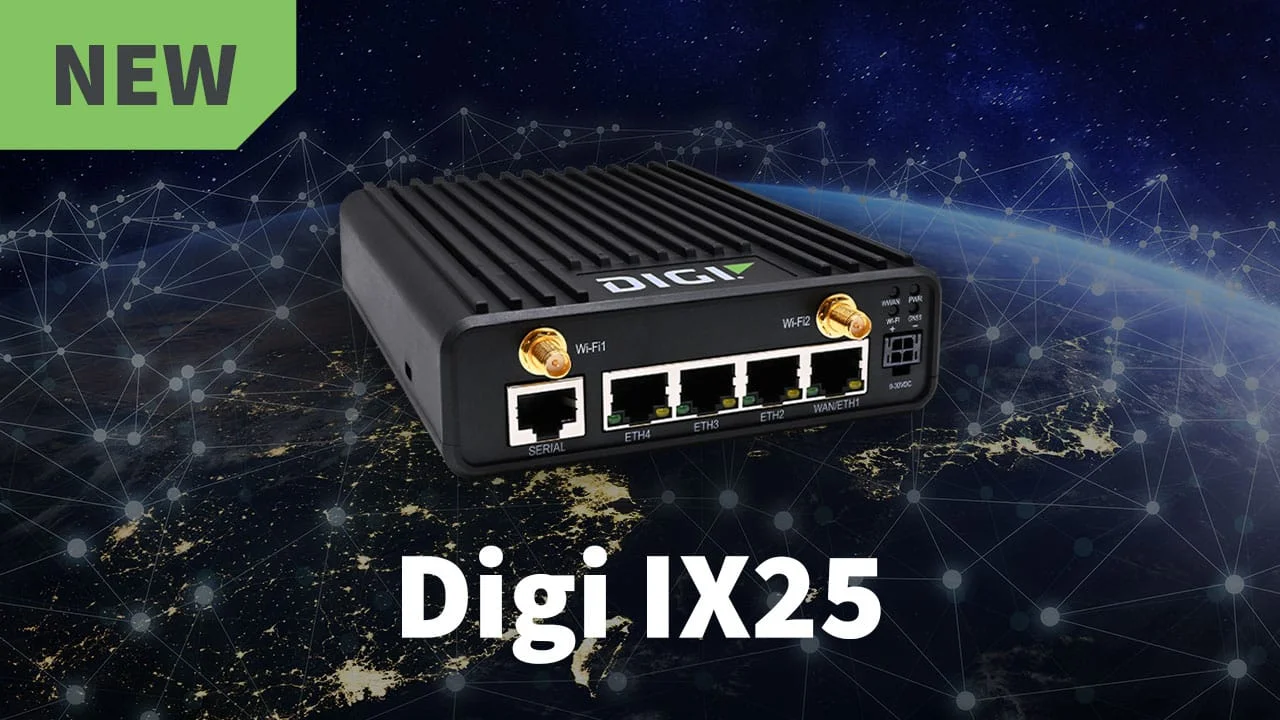
 Industrial routers are doing far more than moving traffic between a field site and the wider network. In many deployments they are also becoming the local switch, the provisioning endpoint, and increasingly the edge compute node as well. That shift is not just about feature expansion. It reflects the reality of cabinets, kiosks, and remote infrastructure where space is limited, support visits are expensive, and every extra box adds another power, thermal, and failure consideration. Digi is leaning into that direction with the IX25, a rugged industrial cellular router platform that brings LTE, 5G RedCap, and 5G eMBB options into a single hardware family.
The Digi IX25 is an industrial cellular router used to provide wide-area wireless connectivity, local Ethernet networking, and edge compute capability in distributed infrastructure. In a typical utility cabinet, roadside enclosure, or industrial control point, the router often sits between field equipment and upstream systems while also managing local traffic from controllers, sensors, and other connected hardware.
One Platform For Connectivity And Edge Compute
The more interesting part of this launch is the level of consolidation Digi is building into the platform. The IX25 includes four integrated Gigabit Ethernet ports, which means many installations will not need a separate external switch. That reduces hardware count in the cabinet and simplifies the physical network edge, which is a practical gain in environments where installations need to stay compact and supportable over long service lives.
Digi is also keeping the platform broad across radio options. LTE, 5G RedCap, and 5G eMBB variants all sit under the same IX25 architecture, giving operators a way to standardize on one platform while still matching performance and cost to the needs of different sites. That is a more sensible approach than treating each cellular tier as a separate hardware family, especially for fleets that will evolve over time rather than being deployed once and left unchanged.
The IX25 also carries a quad-core processor and support for Linux containers, which moves it beyond the role of a conventional industrial router. Digi points to use cases such as SCADA integration, telemetry processing, edge analytics, AWS IoT Greengrass, Microsoft Azure IoT, and custom applications running directly on the device. That changes the role of the router in a meaningful way. It is no longer only passing traffic back to a central platform. It is becoming a local execution point for industrial logic and data handling closer to the system itself.
Provisioning And Management Are Central To The Pitch
Provisioning is another clear focus. The IX25 supports GSMA SGP.32-compliant eSIM with live bootstrap connectivity, allowing zero-touch provisioning, remote carrier provisioning, and multi-carrier management without physical SIM replacement. For distributed industrial fleets, that is not a minor convenience. It changes how connectivity can be deployed and maintained once devices are already in service.
Digi is tying that operational model into Digi Remote Manager, which the company uses for provisioning, monitoring, firmware updates, and lifecycle management across device fleets. The AI-driven angle comes through the platform’s MCP server, which Digi says allows users to query fleets, automate workflows, and generate configuration insight using natural language. The broader point is less about AI as a headline and more about the fact that the IX25 is being positioned as managed infrastructure rather than a standalone router.
Built For Private Wireless And Long-Life Infrastructure
Digi is aiming the IX25 squarely at utilities, oil and gas, and other critical infrastructure environments, and the hardware profile reflects that. The platform is rated for operation from -40 °C to +75 °C and supports certifications including C1D2, ATEX, E-Mark, and MIL-STD-810H. TAA compliance and the use of Western cellular modules are also part of the positioning, particularly for buyers dealing with procurement rules and supply chain scrutiny.
The private-network support is also significant. Digi says the IX25 supports Anterix spectrum along with CBRS and FirstNet bands, which makes it relevant for deployments where public carrier connectivity is only one part of the network strategy. Taken together, the IX25 looks less like a generic industrial 5G router and more like a long-lifecycle connectivity platform built for infrastructure operators who need rugged hardware, local compute, and remote fleet control in the same device.
Learn more and read the original announcement at www.digi.com
Technology Overview
The Digi IX25 is an industrial cellular router platform for secure wireless connectivity, local Ethernet networking, and edge compute in distributed infrastructure. It is available in LTE, 5G RedCap, and 5G eMBB variants, includes four Gigabit Ethernet ports, supports Linux containers, and offers GSMA SGP.32-compliant eSIM provisioning. It is intended for industrial and critical infrastructure deployments such as utilities, oil and gas, and private wireless networks.
View the Digi IX25 datasheet
Frequently Asked Questions
What is the Digi IX25 used for?
The Digi IX25 is used for industrial cellular connectivity, local Ethernet networking, and edge computing in distributed infrastructure such as utility cabinets, kiosks, and industrial field deployments.
What network types does the Digi IX25 support?
The Digi IX25 supports LTE, 5G RedCap, and 5G eMBB across multiple SKUs built on a unified hardware architecture.
You may also like