
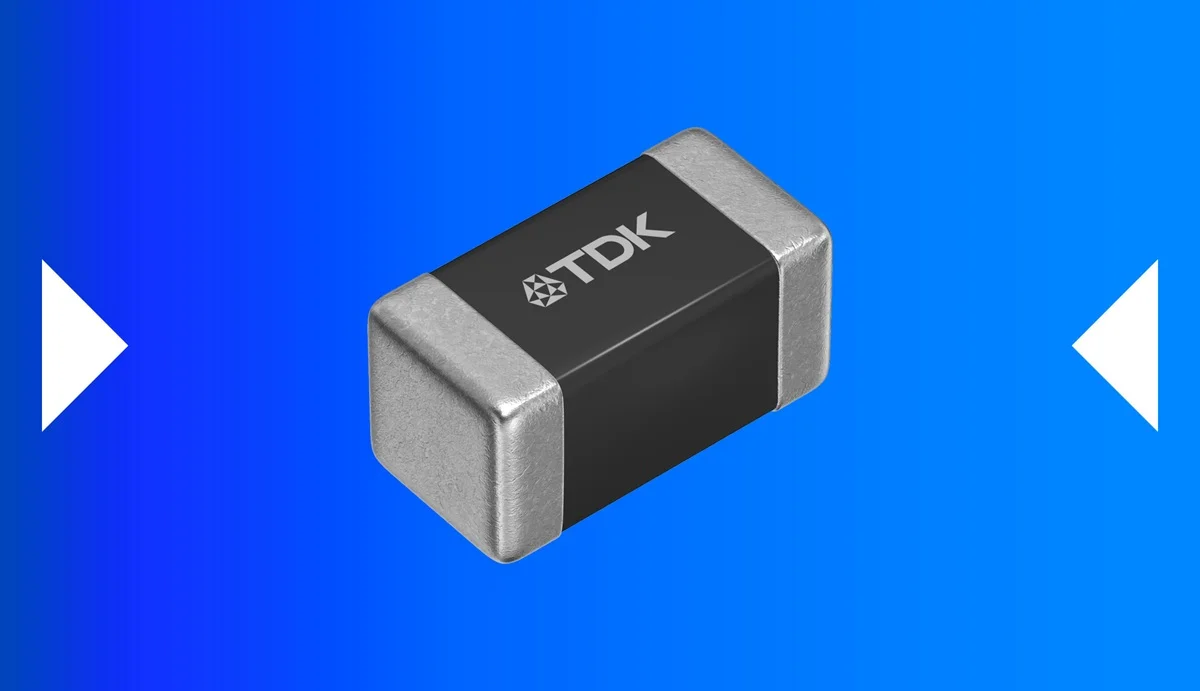
 Audio lines inside phones and wearables are not especially forgiving. They sit in cramped layouts, close to aggressive radios, and are expected to stay clean while the rest of the device throws out noise across multiple wireless bands. The usual fix has never been especially elegant. Chip beads can suppress the unwanted high-frequency noise, but they also have a habit of degrading the signal path they are supposed to protect. TDK’s new MAF0603GWY series goes after that exact compromise in a much smaller package than most engineers would expect.
The MAF0603GWY is an ultra-small noise suppression filter used on audio lines in compact consumer hardware such as smartphones, tablets, and wearable devices. In a typical wireless earbud case, smartwatch, or smartphone audio path, that means sitting in line with audio circuitry while RF noise from Bluetooth, Wi-Fi, or cellular subsystems tries to leak into places it should not.
What makes this launch worth attention is not the size on its own, even though 0.6 mm x 0.3 mm x 0.3 mm is tiny enough to matter in dense mobile layouts. The more useful point is that TDK is explicitly trying to avoid the normal penalty that comes with high-frequency suppression on audio lines. That penalty is usually not abstract. It shows up as distortion, altered line characteristics, and a signal path that no longer behaves as cleanly as it did before the “fix” was added.
The Real Problem Is Not Just Noise, It Is What the Fix Does to the Audio Path
This is where a lot of EMI mitigation becomes irritating. A designer deals with radiated noise from an audio line, adds suppression, and then ends up introducing another weakness into the same signal chain. The problem is technically solved, but the system is not necessarily improved.
TDK is leaning on a newly developed low-distortion ferrite material here, and that matters more than the usual broad claim of better suppression. If that material genuinely minimizes performance variation on the audio line, then the filter is doing something more useful than just pushing impedance higher at RF. It is reducing the chance that the cleanup step damages the thing being protected in the first place.
Why 5 GHz Performance Matters More Than It Used To
The company is putting a lot of emphasis on attenuation above 5 GHz, which makes sense given how crowded consumer wireless environments have become. Audio traces inside compact devices are now surrounded by Bluetooth, dual-band and tri-band Wi-Fi, 5G Sub-6, and whatever else is sharing the enclosure. There is not much physical separation left, so the filtering component has to do more of the isolation work.
TDK claims industry-leading attenuation in this region, with the top MAF0603GWY551AT000 part reaching a typical impedance of 3220 Ω at 5 GHz. That is a strong number, but the more interesting part is the context around it. If the filter can hit that level of suppression without dragging down audio quality in the process, then it becomes a lot more useful than a conventional bead that forces a compromise the user eventually hears.
Lower Resistance Helps More Than The Datasheet Table Suggests
The other detail that matters is DC resistance. TDK says the new series reduces attenuation of the audio signal by using lower resistance than conventional products, which helps preserve dynamic range. That is the kind of claim that deserves attention because it connects directly to signal integrity rather than simply RF suppression performance.
The three initial parts span typical 900 MHz impedances of 210 Ω, 300 Ω, and 550 Ω, with corresponding 5 GHz values of 1370 Ω, 1890 Ω, and 3220 Ω. Maximum rated current ranges from 0.125 A to 0.15 A. Those numbers are useful, but in practice the real value is that engineers now have another option for audio-line noise control that is not built around accepting distortion as collateral damage.
Small Parts Still Have To Earn Their Place
Miniaturized passives are easy to dismiss because they look incremental on paper. In reality, small consumer layouts are full of these quiet component decisions that shape whether a product behaves cleanly or feels compromised. A filter this small only matters if it solves a problem without creating another one nearby. That is the standard it will need to meet once it lands in real phone and wearable designs.
Learn more and read the original announcement at www.tdk.com
Technology Overview
The MAF0603GWY series is an ultra-small noise suppression filter for audio lines in compact consumer devices such as smartphones, tablets, and wearables. It is used to suppress high-frequency noise on audio paths while minimizing distortion and preserving audio-line performance. The series measures 0.6 mm x 0.3 mm x 0.3 mm and includes parts with typical impedance up to 3220 Ω at 5 GHz.
Frequently Asked Questions
What is the TDK MAF0603GWY series used for?
The MAF0603GWY series is used to suppress high-frequency noise on audio lines in compact devices such as smartphones, tablets, and wearables.
Why use the MAF0603GWY series instead of a standard chip bead?
TDK says the series reduces the audio distortion that can occur when conventional chip beads are used on audio lines, while still providing strong high-frequency noise attenuation.
How much impedance does the MAF0603GWY551AT000 provide at 5 GHz?
The MAF0603GWY551AT000 provides a typical impedance of 3220 Ω at 5 GHz.
You may also like