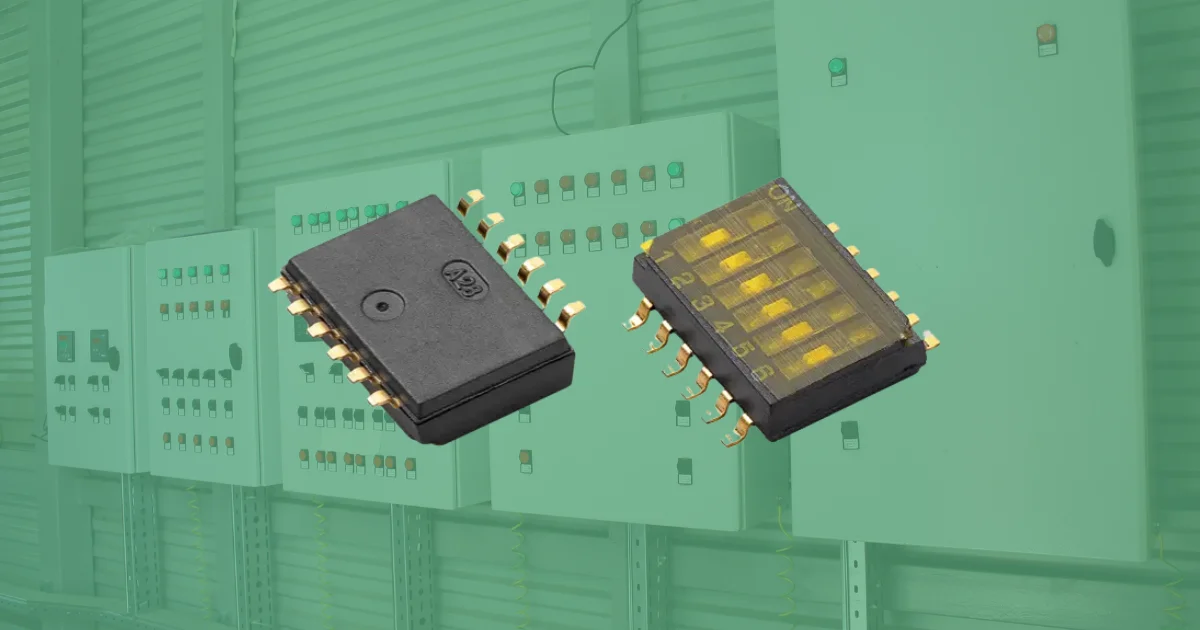
 DIP switches are still used on a lot of boards for address setting, mode selection, and basic hardware configuration. The problem is that standard switch footprints can take up more room than designers want to give them, especially on compact SMT layouts. Littelfuse/C&K’s TDB Series is built for that situation, bringing half-pitch DIP switching into smaller board spaces without making assembly more awkward.
In industrial control equipment, power supplies, alarm hardware, and building automation nodes, these switches still handle simple but necessary setup tasks. If the board is already dense, a full-size switch bank can start to feel oversized very quickly. The TDB Series answers that with a 1.27 mm half-pitch footprint that allows higher switch density without pushing too hard on PCB space.
A Smaller Footprint That Fits Better
The main advantage here is simple: the TDB Series takes up less room. That becomes more useful as switch count rises, because several positions grouped together can eat board area faster than they should. Littelfuse/C&K offers the family in 2, 4, 6, 8, and 10-position versions, so the same density benefit carries across a useful range of configurations. That gives designers a bit more freedom in compact products. A smaller control board may only need a couple of settings, while an industrial controller or inverter board may need more. Either way, the switch does not need to take over more of the layout than necessary.
Built for SMT Production
Small parts only help if they are easy to build with and Littelfuse/C&K has handled that properly with a top-tape sealed construction that supports automated surface-mount soldering and post-reflow aqueous cleaning. That makes the TDB Series easier to fit into standard SMT production without adding unnecessary process concerns. This is important because configuration switches can become a nuisance in assembly if they are not protected properly. The sealed construction helps avoid that and makes the part more practical for higher-volume builds.
Gold Contacts for Stable Low-Power Signals
The TDB Series also uses gold-plated bifurcated contacts, which suits the kind of low-power control work these switches are normally asked to do. This is not about high-current switching, it's about keeping contact behavior stable in products that may be configured once and then left alone for long periods.
Littelfuse/C&K rates the series up to 50 V DC and 100 mA steady state, with a maximum contact resistance of 100 mΩ and a mechanical and electrical life of 1,000 cycles. Those figures fit the job well. In most systems, the important thing is that the switch stays reliable and electrically clean over time.
A Better Fit for Dense Boards
DIP switches are still useful because they are simple, direct, and easy to verify during setup or service. That's not changed, but what has changed is how much board space designers are willing to hand over to them. The TDB Series gives engineers a more compact way to keep hardware configuration on the PCB while staying compatible with modern SMT assembly. For dense control and embedded designs, that is a solid improvement.
Learn more and read the original announcement at www.littelfuse.com
Technology Overview
The Littelfuse/C&K TDB Series is an ultra-miniature 1.27 mm half-pitch surface-mount DIP switch family used for manual configuration and address setting on compact PCBs. It supports up to 50 V DC and 100 mA steady-state operation, uses gold-plated bifurcated contacts, and includes top-tape sealing for automated SMT soldering and post-reflow aqueous cleaning. The series is available in 2, 4, 6, 8, and 10-position versions. View the Littelfuse/C&K TDB Series datasheet.
Frequently Asked Questions
What is the Littelfuse/C&K TDB Series used for?
It is used for manual hardware configuration and address setting in products such as industrial controls, power supplies, security systems, building automation hardware, and consumer IoT devices.
How is the TDB Series different from a standard DIP switch?
It uses a 1.27 mm half-pitch surface-mount design, which reduces PCB footprint and supports automated SMT assembly and aqueous cleaning.
Which configurations are available in the TDB Series?
The series is available in 2, 4, 6, 8, and 10-position versions.
You may also like