
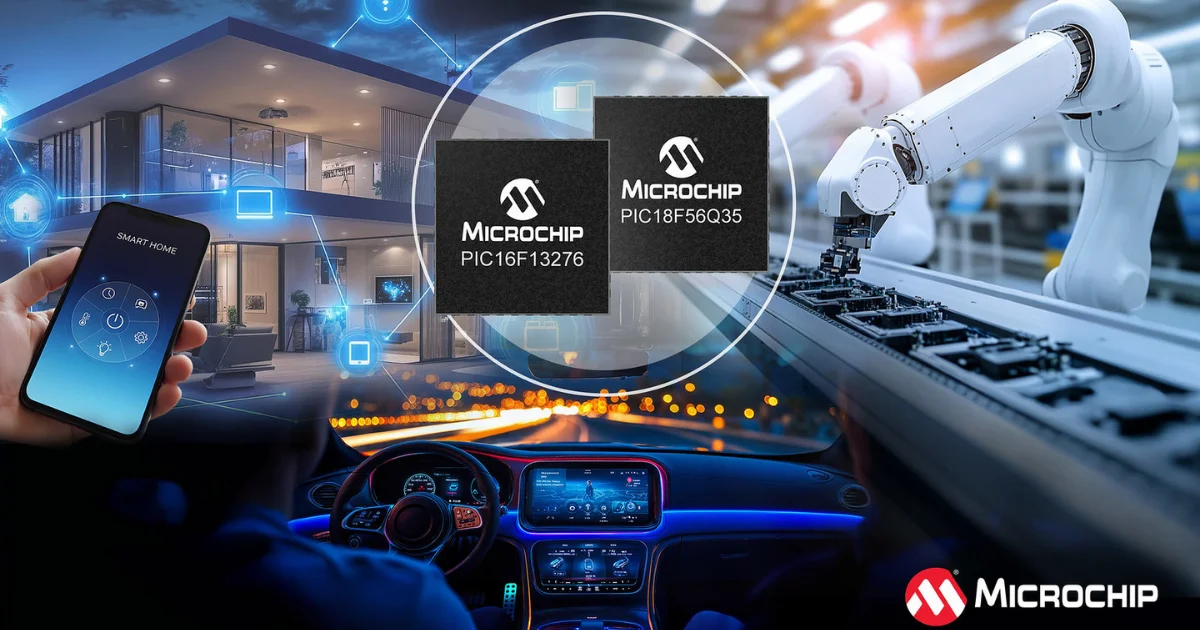
 Microchip has expanded its CLB-enabled PIC lineup with two MCU families that pull programmable logic and embedded control into the same device. The new PIC16F13276 and PIC18-Q35 parts are aimed at timing-sensitive designs where software timing jitter, extra device count, or startup behavior can complicate an otherwise straightforward control problem. That makes them relevant to applications such as motor drives, industrial automation nodes, and automotive safety subsystems, where the control loop is only part of the job and some logic really wants to live in hardware instead.
The PIC16F13276 is an 8-bit MCU family with an integrated Configurable Logic Block containing 32 Basic Logic Elements, while the PIC18-Q35 family integrates 128 Basic Logic Elements. Microchip’s pitch is not that these devices replace larger programmable logic platforms, but that they can absorb the kind of deterministic glue logic, timing paths, and control-side decisions that would otherwise push a design toward a separate CPLD or extra supervisory logic. In other words, they are being positioned as microcontrollers that can take on a bit more of the digital hardware burden before a second chip becomes necessary.
Logic That Starts Before The CPU
One of the more useful details here is the way the CLB can be loaded automatically at power-up or reset. That lets the logic initialize independently of the CPU, which matters in systems where startup behavior cannot wait for firmware to get fully in place. Microchip is clearly framing this as a functional safety and industrial control advantage, but it also has more general value in systems where the first milliseconds after reset are not meant to be left to software timing alone.
This changes the feel of the device slightly compared with a normal low-cost MCU plus a clever firmware workaround. The CLB is there to handle fast, deterministic logic paths directly in hardware, which can reduce latency and make behavior more predictable than a software-only approach. That is the real thread running through this launch. It is less about raw MCU performance and more about moving the right jobs out of firmware before they turn into edge cases, interrupts, or timing headaches.
Where The Extra Logic Actually Helps
The obvious use case is any design that has embedded control on one side and tightly defined digital behavior on the other. Motor control is one example, but so are industrial I/O timing, safety interlocks, custom state sequencing, and smaller hardware acceleration tasks that do not justify a separate programmable logic device. By integrating that logic fabric on-chip, Microchip is trying to cut BOM count, reduce board space, and avoid some of the integration overhead that comes with pairing an MCU and CPLD in the same design.
Microchip also says the new families are drop-in compatible with existing PIC16 and PIC18 designs, which matters because this kind of product only becomes attractive if it can be adopted without a full board respin. The company is also including Programming and Debugging Interface Disable, or PDID, as an anti-tamper measure to restrict programming and debug access after deployment. That puts these parts in a more practical position for embedded products that need both flexible logic behavior and some degree of design protection.
Tooling Matters As Much As The Silicon
Microchip has also done the sensible thing on the software side. Its CLB Configuration tool is now available in VS Code with a drag-and-drop interface, and the company says the integrated flow includes synthesis, timing analysis, simulation, and hardware debug support. The wider ecosystem still includes MPLAB X and MPLAB Code Configurator, along with Curiosity Nano boards for both families. That is important because integrated programmable logic only helps if engineers can get visibility into timing paths and validate behavior without turning a small MCU project into a full HDL workflow.
For volume pricing, Microchip lists the PIC16F13276 family from $0.32 and the PIC18-Q35 family from $0.62. Those numbers are part of the point. These are not high-end logic devices being repositioned as controllers. They are low-cost PIC MCUs that have picked up a hardware logic fabric, and that is what makes the launch more interesting than a routine 8-bit refresh.
Learn more and read the original announcement at www.microchip.com
Technology Overview
The PIC16F13276 and PIC18-Q35 are CLB-enabled PIC microcontroller families that combine embedded control with on-chip programmable logic. The PIC16F13276 family integrates 32 Basic Logic Elements and the PIC18-Q35 family integrates 128, with support for CLB auto-load at startup and development support through VS Code, MPLAB X, and MPLAB Code Configurator. Volume pricing starts at $0.32 for PIC16F13276 and $0.62 for PIC18-Q35.
Frequently Asked Questions
What are the PIC16F13276 and PIC18-Q35 designed for?
They are aimed at timing-sensitive embedded systems that need both MCU control and deterministic hardware logic, including motor control, industrial automation, and automotive safety applications.
How much programmable logic is integrated into each family?
The PIC16F13276 family includes 32 Basic Logic Elements, while the PIC18-Q35 family includes 128.
Do these MCUs support CLB initialization at startup?
Yes. Microchip says the CLB can be automatically loaded at power-up or reset so the logic can initialize independently of the CPU.
You may also like