
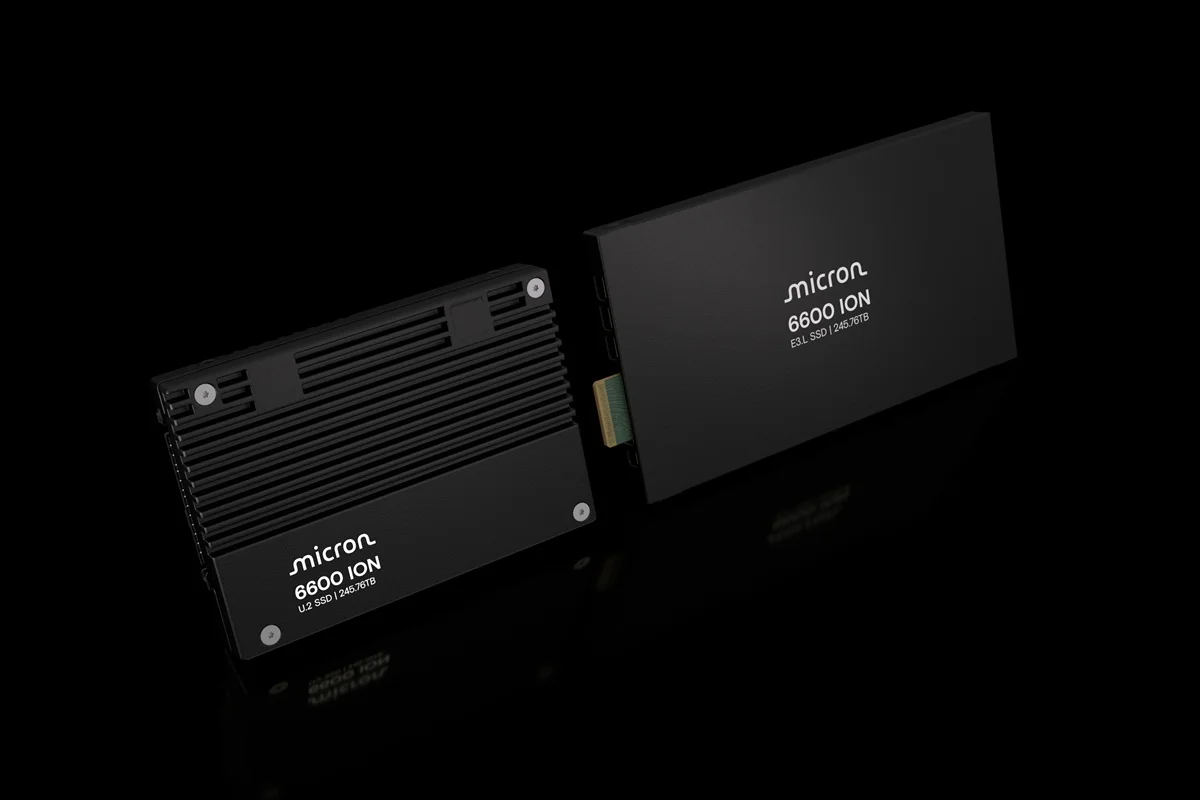
 Micron has begun shipping a 245TB version of its 6600 ION SSD, giving data center operators a single drive that pushes close to a quarter petabyte of storage capacity. The drive is aimed at AI and hyperscale infrastructure where storage density is becoming a practical deployment issue, especially in facilities already dealing with power and cooling limitations.
The Micron 6600 ION is a QLC NAND-based data center SSD built for large-scale storage environments including AI data lakes, object storage platforms, and cloud infrastructure. The new 245TB version is available in both U.2 and E3.L form factors and is intended for systems where operators want to increase storage capacity without continuing to scale drive count at the same rate.
That matters more now than it did a few years ago. AI infrastructure is generating and moving enormous amounts of data, and storage systems are starting to absorb some of the same rack-level pressures already affecting accelerator clusters. More drives means more backplanes, more airflow restrictions, more cables, and more systems to maintain once deployments start growing into multi-rack installations.
Rack Density Is Becoming a Storage Constraint
One of the more significant aspects of the 245TB 6600 ION launch is how aggressively it changes storage density at the rack level. According to Micron, deployments using the new SSD can reduce rack requirements by 82% compared to equivalent HDD-based infrastructure providing the same raw storage capacity. That has implications well beyond storage consolidation. In modern AI infrastructure, rack space and available power are increasingly tied directly to deployment cost and expansion capability. Reducing the number of drives, storage servers, and supporting infrastructure can simplify everything from airflow management to serviceability and power distribution.
The density shift also changes the economics of high-capacity flash storage. In many environments, SSD adoption has historically been limited by cost-per-terabyte comparisons against HDDs. At quarter-petabyte scale per drive, the operational tradeoffs start looking different, particularly once power, cooling, and maintenance costs are included at deployment scale.
QLC NAND Continues Moving Into Large-Scale Infrastructure
Micron built the 6600 ION around its ninth-generation QLC NAND platform, continuing a trend that has been gradually pushing QLC flash into more performance-sensitive enterprise workloads. QLC has typically been viewed as the high-capacity, lower-cost side of enterprise flash, often reserved for colder storage tiers or read-heavy environments. But workloads tied to AI training, inference, and large distributed datasets are starting to favor flash storage in places where HDDs were previously considered acceptable.
In object storage systems and AI preprocessing pipelines, storage latency and throughput can quickly become part of the bottleneck once large numbers of GPUs or users start requesting data simultaneously. Micron says the 245TB 6600 ION delivers major gains in throughput-per-watt and significantly lower latency compared to comparable HDD deployments, alongside faster AI preprocessing performance.
Power And Cooling Pressures Continue To Grow
The launch also reflects a wider change happening across AI infrastructure design. Power availability is rapidly becoming one of the largest constraints in modern data centers, particularly in facilities supporting high-density GPU deployments.
According to Micron, the 245TB 6600 ION consumes up to 30 W at maximum power, substantially lower than comparable HDD deployments providing equivalent capacity. At large deployment scale, reducing drive count and lowering overall storage power requirements can also reduce cooling demand and supporting HVAC overhead. That becomes increasingly relevant as operators attempt to expand AI infrastructure within existing power envelopes. In many facilities, adding more racks is no longer simply a floor-space problem. Cooling capacity, power delivery infrastructure, and operational efficiency now have a direct influence on how quickly additional compute and storage resources can realistically be deployed.
Micron says the 245TB 6600 ION SSD is now shipping and will be demonstrated in Dell PowerEdge storage systems during Dell Tech World 2026.
Learn more and read the original announcement at www.micron.com
Technology Overview
The Micron 6600 ION is a high-capacity QLC NAND data center SSD available in U.2 and E3.L form factors. The new 245TB version is designed for AI data lakes, object storage, hyperscale infrastructure, and cloud-scale deployments where storage density, power efficiency, and rack utilization are critical factors. Micron states the SSD consumes up to 30 W at maximum power while supporting quarter-petabyte-scale storage capacity in a single drive.
Frequently Asked Questions
What workloads is the Micron 6600 ION SSD designed for?
The drive targets AI data lakes, object storage, cloud-scale file systems, enterprise storage, and hyperscale infrastructure deployments.
What form factors are available for the 245TB Micron 6600 ION?
Micron states the drive is available in both U.2 and E3.L form factors.
Why is storage density becoming important in AI infrastructure?
Higher-capacity SSDs can reduce rack count, power consumption, cooling demand, and maintenance overhead in large-scale AI and cloud storage deployments.
You may also like