
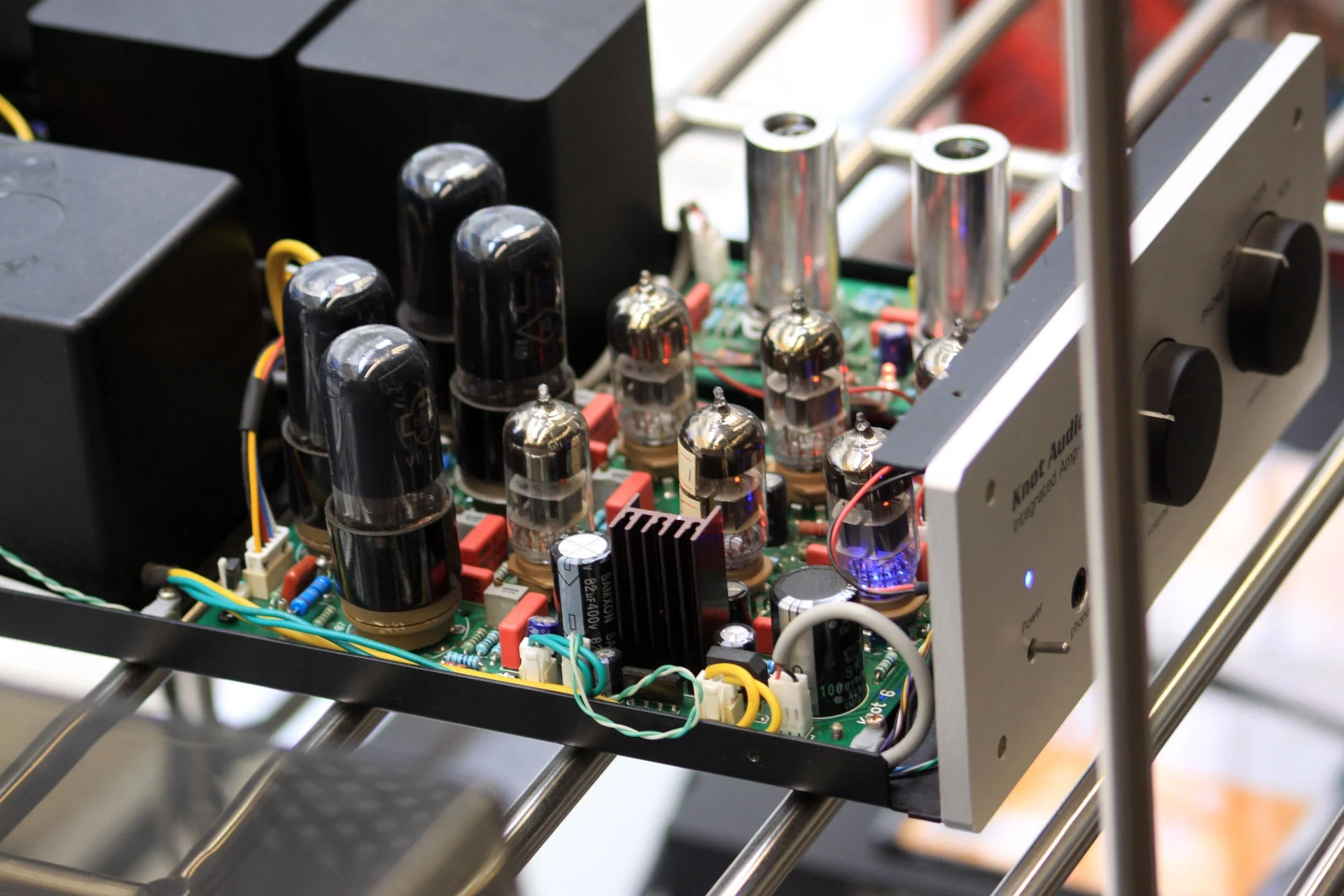
Vacuum tubes were phased out decades ago in favor of silicon transistors. But recently, researchers demonstrates planar vacuum devices which could very well replace transistors due to their superior performance. What challenges did tubes face, what did the researchers develop, and why could they potential replace transistors in the future?
The Challenge with Tubes
Vacuum tubes used to be one of the most important components in electronics. Unlike passive components, they are active devices, meaning they can amplify and control electrical signals. This made them essential in early radio systems, enabling the recovery and amplification of weak RF signals. They also powered early televisions, and later became the foundation of the first electronic computing systems through their use as switches and logic elements.
Despite this importance, vacuum tubes disappeared rapidly once transistors arrived. But why is this the case?
Firstly, vacuum tubes are extremely power hungry. Where early transistors operate in the micro-watt range, tubes typically consume power in watts, and that difference alone made them highly impractical where scaling or efficiency was needed.
Secondly, they rely on a heated cathode to function, which introduces continuous heat generation. For designs with a few tubes, this isn’t a major issue, but when scaled to many thousands and it becomes a serious engineering problem.
Thirdly, vacuum tubes fail in a way that resembles incandescent bulbs in that they burn out over time requiring replacement. In small systems this is manageable, but in large-scale installations it becomes a constant maintenance burden. Tubes can be left running in a low-stress idle state to extend lifespan, but that does not solve the underlying issue of inefficiency.
Fourthly, they are very difficult to miniaturize. Even if extreme size reduction were possible, the introduction of integrated circuits removed any remaining advantage that tubes could have held over early transistors. Modern semiconductor fabrication allows millions, and now billions, of transistors on a single die. The result is not just smaller hardware, but dramatically lower power consumption and far higher complexity at lower cost.
Once that shift happened, vacuum tubes were effectively removed from mainstream electronics.
Researchers Create Planar Vacuum Tubes
Despite being largely abandoned, the vacuum tube concept has never fully disappeared from research. One of the key reasons for this comes down to physics; electron transport through a vacuum is extremely fast compared to carrier drift in semiconductors, approaching a significant fraction of the speed of light. Because of this, it theoretically offers a pathway to ultra-high-speed devices.
The problem, however, has always been implementation.
Traditional planar vacuum tube designs attempted to replicate MOSFET-like behavior, where a gate electrode controls electron flow between cathode and anode, but in practice, this approach often fails. Electrons in vacuum do not behave like charge carriers in a solid lattice, and instead, tend to collide with gate structures or leak unpredictably, preventing stable integrated operation.
Recently, researchers from Shanghai Jiao Tong University and Shaoxing University published a paper in Microsystems & Nanoengineering describing a new device called the cathode-modulated vacuum/air-channel electron tube (CMVET). Importantly, the device is fabricated using standard silicon-on-insulator processes, meaning it is compatible with existing semiconductor manufacturing techniques. Instead of using the gate to steer electrons toward the anode, the CMVET uses a back-gate to modulate electron emission from the cathode itself.
The device is built around an ultrathin silicon cathode, approximately 45 nm thick, where the gate controls how many electrons are emitted into the vacuum gap. Once emitted, electrons travel in a relatively direct path to the anode, removing the need for complex steering fields and avoiding gate collision losses.
This effectively shifts control from “directing electron flow” to “controlling electron injection”. The result is a device that avoids the fundamental leakage problem seen in earlier designs. Reported gate current is extremely low, below 10⁻¹¹ A, and the emitted electrons consistently reach the anode without significant loss.
The device also operates at room temperature and atmospheric pressure, removing one of the most restrictive requirements of traditional vacuum systems. However, its electrical behavior is not identical to typically MOSFETs. The current-voltage characteristics are non-saturating, meaning current continues increasing with anode voltage rather than flattening into a saturation region. While this may not be a defect, it does mean existing circuit design assumptions do not directly apply.
Despite this, experimental results have show functional circuit behavior, with devices demonstrating amplifier operation with a gain of around 1.6, clear logic states in both NAND and NOR configurations, a switching ratio of approximately 10⁴, and a trans-conductance of roughly 23 μS.
More importantly, the same device architecture has been shown to operate in multiple roles, including amplifier, differential pair, and logic gate. Such flexibility suggests the very real possibility of monolithic vacuum-based integrated circuits rather than isolated laboratory devices.
Could Planar Vacuum Tubes Be Key to Future Electronics?
Even with these results, it is unlikely that planar vacuum tubes will replace transistors in mainstream electronics.
Current semiconductor technology is too mature, too cheap, and too well understood. Replacing it would require not just incremental improvement, but a complete redesign of how electronic systems are manufactured and designed. Such levels of disruption only ever happen when there is a clear and overwhelming advantage, which is not yet the case.
Where these devices may find value is in specialized environments. Their resilience makes them attractive for space applications, high-radiation environments, and potentially defense systems where reliability under extreme conditions matters more than cost or density.
High-frequency electronics are another possible niche for planar vacuum transistors. Because electron transport in vacuum is fundamentally faster than in silicon, there is a potential path toward RF amplification and ultra-high-speed signal processing where conventional transistors begin to struggle.
There is also a longer-term possibility that planar vacuum devices could play a role in specialized processors or accelerators. However, that would require significant advances in gain, scalability, and circuit integration.
For now, they remain firmly in the experimental stage. The physics is promising, the fabrication is improving, but the engineering problem is far from solved. Whether they become a niche technology or something more fundamental will depend entirely on how far researchers can push scalability without losing the advantages that make them interesting in the first place.
You may also like