
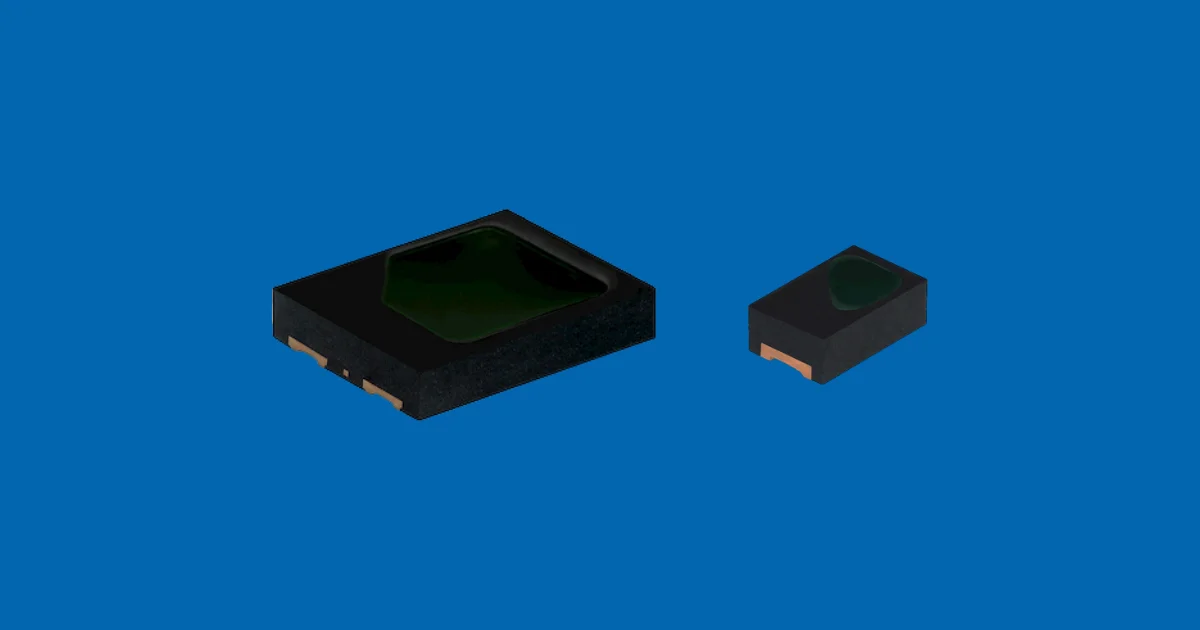
 Vishay Intertechnology has expanded its optoelectronics portfolio with the introduction of the VEMD4210FX02 and VEMD5525FX02 automotive-grade ambient light sensors. The new PIN photodiode sensors are designed for applications including automotive displays, head-up displays, rain light tunnel systems, and industrial backlight dimming.
Both devices are AEC-Q102 qualified and feature spectral sensitivity designed to closely match the response of the human eye. Vishay states that the sensors have a peak sensitivity wavelength of 530 nm and do not exhibit the infrared sensitivity peak, or IR bump, commonly seen in many photodiodes.
Designed for Visible Light Measurement
According to Vishay, eliminating the IR bump allows the sensors to measure visible light without unwanted influence from infrared radiation. The company states that this can improve measurement accuracy in applications where display brightness, lighting control, or ambient light monitoring are based on visible light levels.
Vishay also highlights the angular characteristics of the devices, stating that spectral accuracy remains stable across different angles of incoming light.
Two Sensor Options
The VEMD4210FX02 is designed for space-constrained applications and is supplied in an 0805 package measuring 2.0 mm × 1.25 mm × 0.7 mm. The device features a radiant sensitive area of 0.42 mm² and a typical reverse light current of 0.014 µA at 100 lx.
For applications where higher sensitivity is required, Vishay offers the VEMD5525FX02 in a top-view QFN package. The larger device increases the radiant sensitive area to 7.5 mm² and provides a typical reverse light current of 0.11 µA at 100 lx.
The two sensors also differ slightly in their spectral response. Vishay specifies a range of 470 nm to 610 nm for the VEMD4210FX02, while the VEMD5525FX02 covers 480 nm to 590 nm.
Automotive Qualification and Environmental Performance
Both parts are qualified to the AEC-Q102 automotive standard and incorporate wettable flanks to support optical inspection after soldering.
Vishay states that the sensors operate across an ambient temperature range from -40°C to +110°C and support lead-free reflow soldering. The devices are classified as MSL 4 under J-STD-020 and provide a floor life of 72 hours.
The sensors are supplied as RoHS-compliant, halogen-free components and are designated as Vishay Green products.
View the VEMD4210FX02 and VEMD5525FX02 datasheets
Learn more and read the original announcement at www.vishay.com
Technology Overview
The VEMD4210FX02 and VEMD5525FX02 are automotive-grade PIN photodiode ambient light sensors with peak sensitivity at 530 nm. Both devices are designed to match human eye response while eliminating the infrared sensitivity peak found in many conventional photodiodes. The sensors are qualified to AEC-Q102 and operate from -40°C to +110°C.
Frequently Asked Questions
What is the main difference between these sensors and conventional photodiodes?
According to Vishay, the sensors do not exhibit an infrared sensitivity peak, allowing visible light to be measured without IR influence.
What applications are the sensors designed for?
The devices target automotive displays, head-up displays, rain light tunnel systems, and industrial backlight dimming applications.
What is the difference between the two devices?
The VEMD4210FX02 is optimized for compact designs with a 0.42 mm² sensitive area, while the VEMD5525FX02 offers a larger 7.5 mm² sensitive area for higher sensitivity applications.
You may also like