
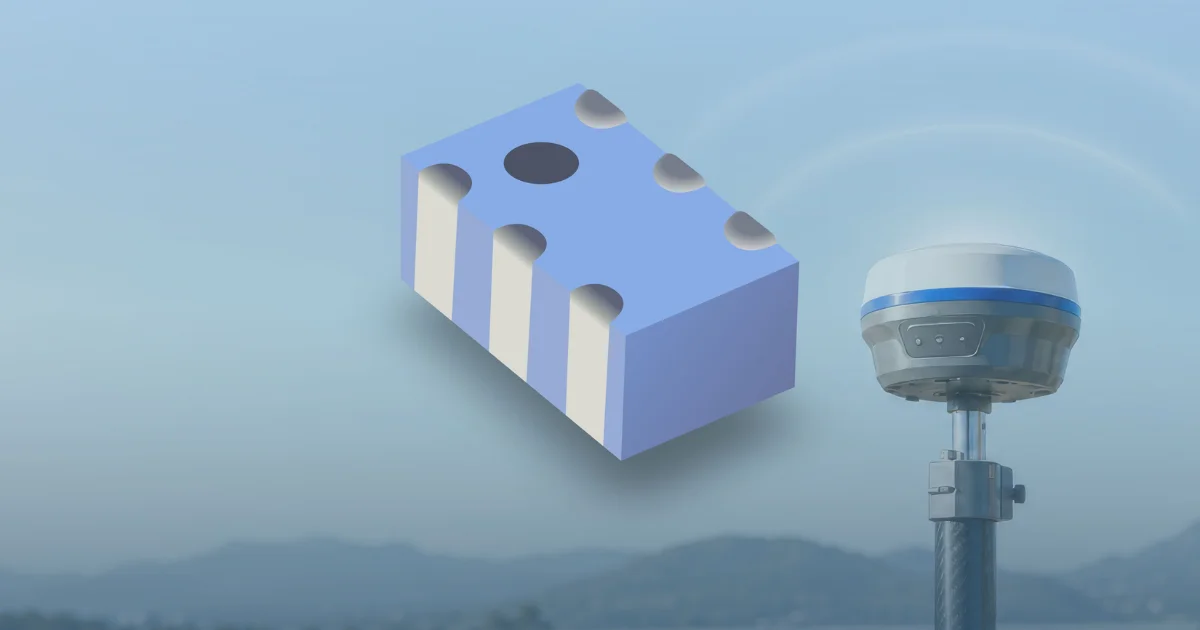
 Bourns has introduced the Model FDP2009N122157H4 LTCC diplexer, designed for RF front-end integration in GNSS L-band applications where signal isolation, low insertion loss, and compact layout are required. The device integrates distributed inductive and capacitive elements within a monolithic ceramic structure, reducing interconnect parasitics while maintaining consistent RF performance across dual frequency bands.
GNSS receiver architectures require the separation and recombination of multiple L-band signals while preserving signal integrity under low-power operating conditions.
According to Bourns, discrete filter implementations can introduce layout sensitivity and parasitic effects that degrade isolation and increase insertion loss, particularly in compact designs. Integrating the filtering structure into a single component reduces these dependencies and improves repeatability across operating temperature and frequency ranges.
Dual-Band Frequency Operation
The Model FDP2009N122157H4 supports frequency ranges of 1164-1285 MHz and 1539-1606 MHz, enabling GNSS L1, L2 and L5 signal separation. Maximum insertion loss is specified at 1.0 dB at 25°C, with typical values of 0.56 dB for the low band and 0.87 dB for the high band.
Across the operating temperature range of -40°C to +105°C, maximum insertion loss is specified at 1.2 dB. Minimum attenuation and isolation are both specified at 20 dB, while minimum return loss is 10 dB. Electrical specifications also include 50 Ω impedance and 3 W maximum power handling.
LTCC Monolithic Construction
The LTCC monolithic construction integrates inductive and capacitive elements within a multilayer ceramic structure to reduce interconnect parasitics and improve RF consistency.
The compact 2.0 × 1.25 × 0.9 mm package reduces PCB area and simplifies routing in dense RF front-end designs. The diplexer is intended for GNSS receiver RF front ends supporting L1, L2 and L5 bands, GPS-based positioning and navigation systems, timing synchronization infrastructure requiring frequency separation, and satellite-enabled agriculture and surveying equipment.
Availability
The Model FDP2009N122157H4 LTCC diplexer is available now through Bourns' authorized distribution network. Samples may be requested through Bourns Customer Service.
Learn more and read the original announcement at the Bourns website.
Technology Overview
An LTCC (Low Temperature Co-fired Ceramic) diplexer combines multiple filtering functions within a single multilayer ceramic component. Integrating inductive and capacitive elements into the ceramic structure reduces interconnect parasitics, minimizes PCB space, and provides stable RF performance for compact wireless and GNSS receiver designs.
Frequently Asked Questions
Which GNSS bands does the diplexer support?
The diplexer supports the 1164-1285 MHz and 1539-1606 MHz frequency ranges, covering GNSS L1, L2 and L5 bands.
What is the maximum insertion loss?
Maximum insertion loss is specified at 1.0 dB at 25°C and 1.2 dB across the full operating temperature range of -40°C to +105°C.
What package size does the diplexer use?
The Model FDP2009N122157H4 is supplied in a compact 2.0 × 1.25 × 0.9 mm package.
You may also like