
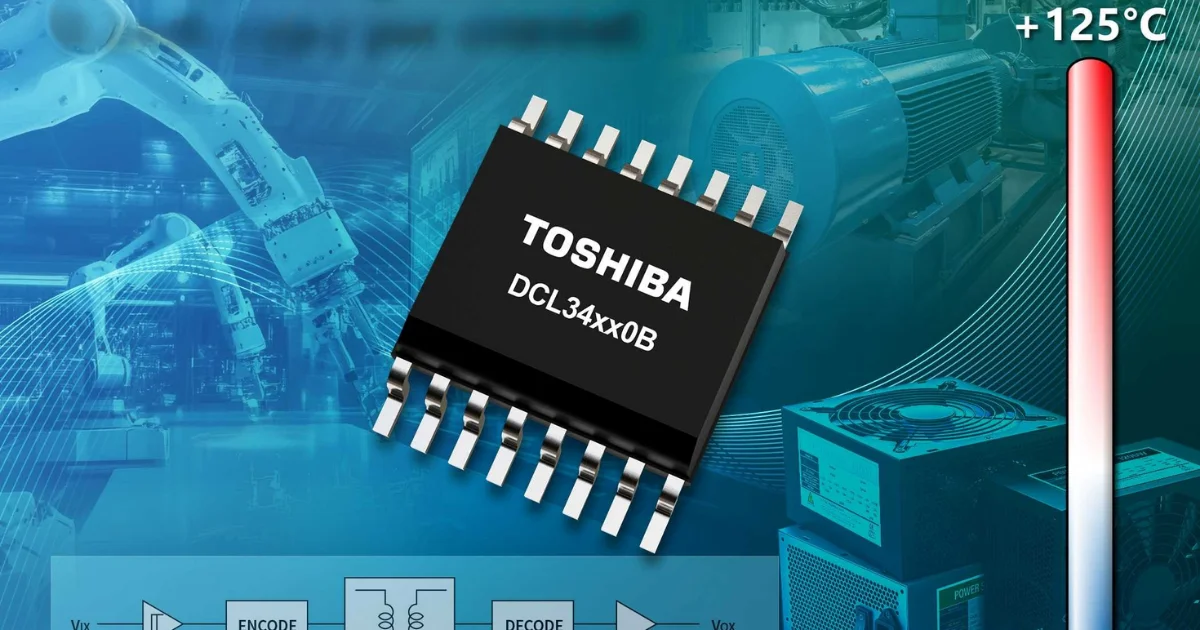
 Toshiba Electronics Europe has expanded its DCL34xx0B digital isolator family with four quad-channel devices for industrial control and automation equipment. The new DCL340L0B, DCL340H0B, DCL342L0B and DCL342H0B operate at up to 25 Mbps while drawing a typical 0.2 mA per channel.
Rather than pushing communication speed, Toshiba has focused this part of its isolator range on keeping power consumption low. The four devices combine the 25 Mbps data rate with 3000 Vrms minimum isolation, a 2.25 V to 5.5 V supply range and operation from -40°C to +125°C.
Four Devices Cover Two Channel Configurations
The choice between the new parts starts with the direction of the four isolated channels.
DCL340L0B and DCL340H0B have a 4:0 configuration, with all four channels running in the same direction. DCL342L0B and DCL342H0B use a 2:2 arrangement, providing two forward and two reverse channels for bidirectional signal transmission.
The L and H versions provide different default output states. The DCL340L0B and DCL342L0B default low, while the DCL340H0B and DCL342H0B default high. This gives designers a choice of both channel direction and output behaviour within the new group.
They join the existing DCL341L0B and DCL341H0B, which split their channels 3:1 and can be used with interfaces such as SPI. Taken together, the DCL34xx0B family now covers 4:0, 3:1 and 2:2 configurations without moving to a different isolator series.
0.2 mA per Channel at 25 Mbps
All four additions use Toshiba's CMOS technology and magnetic-coupling isolation structure. Current consumption is typically 0.2 mA per channel, with communication supported at up to 25 Mbps.
Typical propagation delay is 33 ns when operating from 5 V. Minimum common-mode transient immunity is specified at ±30 kV/µs, providing the noise immunity needed to maintain isolated digital communication in industrial equipment.
The devices accept supply voltages from 2.25 V to 5.5 V on either side of the isolation barrier and provide a minimum withstand voltage of 3000 Vrms. They are specified across an operating temperature range of -40°C to +125°C.
SSOP16 Package for Industrial Control
Toshiba houses the DCL34xx0B family in a 16-pin SSOP measuring 4.9 × 6.0 × 1.75 mm. The devices are UL 1577 and cUL approved, with Toshiba also listing additional safety certification for the series.
The new isolators are intended for PLCs and industrial I/O interfaces, as well as field equipment including sensors and actuators. Toshiba also lists motor control, inverters and switching power supplies among the target applications.
For applications where communication speed takes priority over the lower current consumption of the DCL34xx0B family, Toshiba's wider industrial isolator portfolio includes the higher-speed DCL54xx01A and DCL52xx00 series.
Learn more and read the original announcement at the Toshiba Electronics website.
Technology Overview
A digital isolator transfers digital signals between electrically separated parts of a circuit without creating a direct conductive connection. Toshiba's DCL34xx0B devices use magnetic coupling to transmit signals across the isolation barrier while providing galvanic isolation between the two sides.
Frequently Asked Questions
Which devices has Toshiba added to the DCL34xx0B series?
The new devices are the DCL340L0B, DCL340H0B, DCL342L0B and DCL342H0B. The DCL340 devices use a 4:0 channel configuration, while the DCL342 devices use a 2:2 configuration.
How much current do the new DCL34xx0B isolators consume?
Toshiba specifies typical current consumption of 0.2 mA per channel. The devices support data rates up to 25 Mbps.
What isolation and CMTI ratings do the devices provide?
The new isolators provide a minimum isolation voltage of 3000 Vrms and minimum common-mode transient immunity of 30 kV/µs.
You may also like