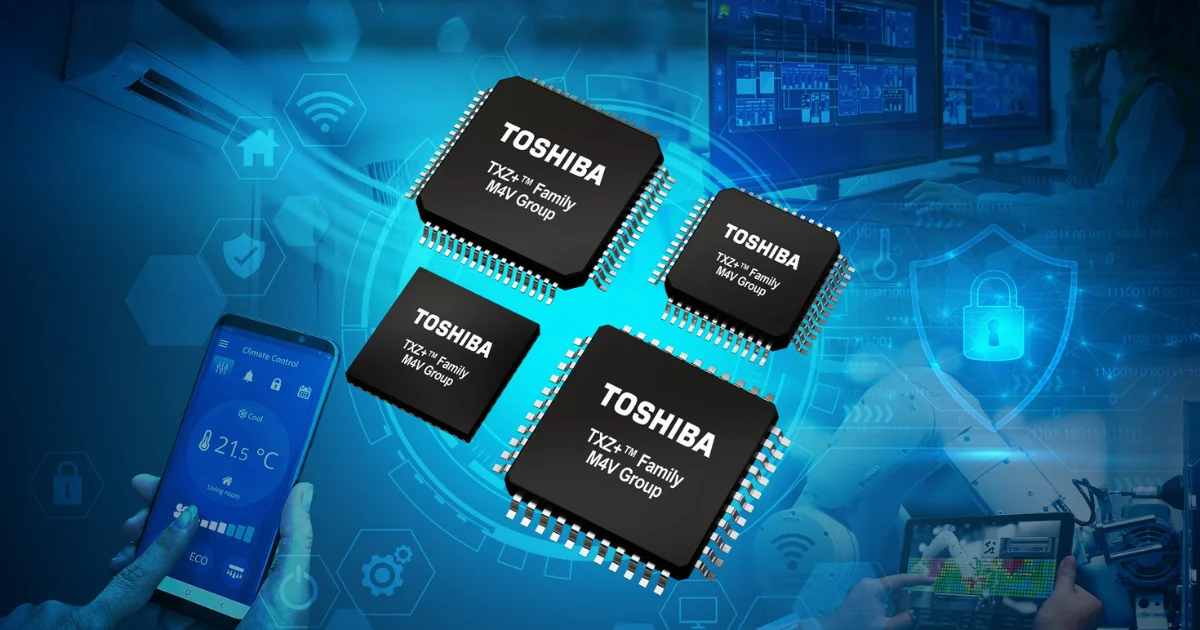
 Toshiba Electronics Europe has started shipping engineering samples of the TXZ+ Family Entry-Class M4V Group of standard microcontrollers. Featuring an Arm Cortex-M4 core with a floating-point unit operating at up to 80 MHz, the M4V Group is designed for system control applications in industrial equipment, consumer products and IoT devices.
The group consists of four devices: the TMPM4V4FWUG in a 0.5 mm-pitch LQFP64 package, TMPM4V2FWDUG in LQFP48, TMPM4V2FWQG in VQFN48 and TMPM4V1FWUG in a 0.8 mm-pitch LQFP44 package.
Security and Data Management
The M4V Group integrates a multilayered security architecture combining access control, memory protection and execution control. Built-in self-diagnostic functions are also included to support functional safety.
Each device integrates 128 kB of code flash memory, 64 kB of data flash and 32 kB of RAM. The dedicated data flash allows rewritable information, including configuration settings and system logs, to be stored separately from application code.
A serial memory interface (SMIF) provides direct access to external flash memory for firmware, log files and other application data. By mapping external memory directly into the address space, the interface supports high-speed memory access with minimal CPU intervention through dedicated hardware control.
The MCUs operate from a single 2.7 V to 5.5 V supply and include an internal high-speed oscillator with ±1% accuracy.
System and Motor Control Peripherals
Peripheral functions include a 12-bit analog-to-digital converter, timers, UART, SPI, I²C and direct memory access. The devices also incorporate Toshiba's Advanced Programmable Motor Driver (A-PMD2), enabling brushless DC motor control where required.
Toshiba is targeting a broad range of embedded control applications with the M4V Group. These include connected household appliances such as washing machines, refrigerators and air conditioners, as well as industrial inverters, motors, pumps and factory automation systems. Security equipment, servers and remote monitoring devices are also listed as potential applications.
To support evaluation and software development, Toshiba provides starter kits, sample software, CMSIS-compliant drivers and support for major integrated development environments.
Engineering samples of the M4V Group are shipping now.
Learn more and read the original announcement at toshiba.semicon-storage.com.
Technology Overview
The M4V Group uses the 32-bit Arm Cortex-M4 processor core with a floating-point unit and operates at up to 80 MHz. The MCUs integrate system-control peripherals, separate code and data flash, security functions, external flash access and Toshiba's A-PMD2 motor-control hardware.
The serial memory interface can map external flash directly into the MCU's address space, providing hardware-controlled access to firmware, log files and other application data with minimal CPU intervention.
FAQ
What is the Toshiba M4V Group?
The M4V Group is a series of Arm Cortex-M4 microcontrollers in Toshiba's TXZ+ Family for system control applications in industrial equipment, consumer products and IoT devices. The Cortex-M4 core operates at up to 80 MHz.
How much memory do the Toshiba M4V MCUs include?
Each device integrates 128 kB of code flash, 64 kB of data flash and 32 kB of RAM. The dedicated data flash can store rewritable information such as configuration settings and system logs separately from application code.
What peripherals are included in the M4V Group?
The M4V MCUs include a 12-bit ADC, timers, UART, SPI, I²C and DMA. They also integrate Toshiba's A-PMD2 for brushless DC motor control and an SMIF for direct access to external flash memory.
You may also like