
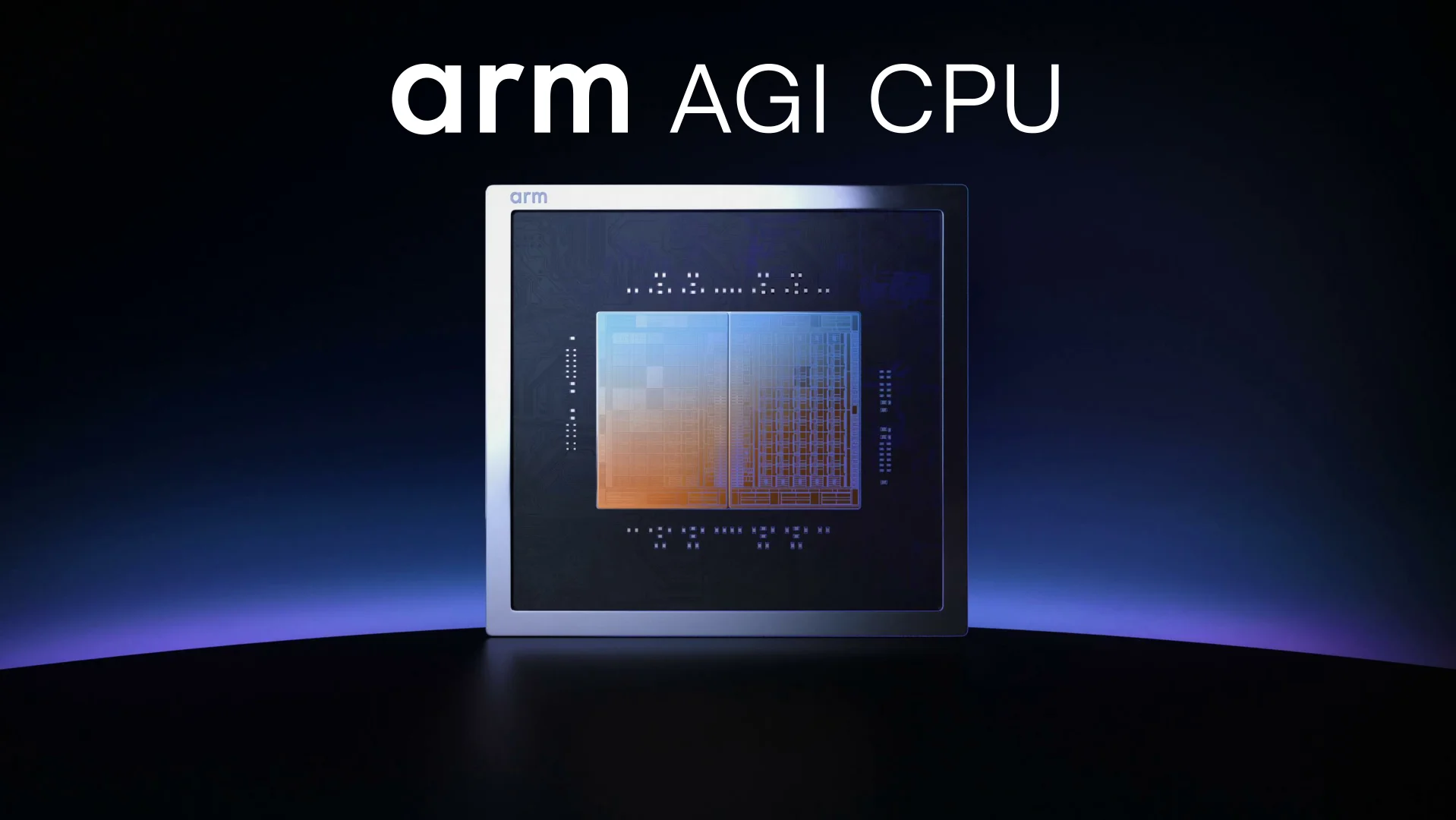
 We are now in the era of the hundred billion transistor, with companies left right and center all trying to max out the number of transistors on a chip. Now, ARM has unveiled its latest AGI CPU that packs 100 billion transistors into a single package. What exactly can this chip do, and why is it crucial for AGI?
Arm Unveils 100b Transistor AGI Chip
At the recent Hot Chips 2026 conference, Arm announced the development of AGI, its first complete commercial CPU design. While Arm is famous for its wide range of RISC CPU architectures, including those found in devices such as the Raspberry Pi, the company has historically focused on licensing its IP to semiconductor manufacturers, who then create their own silicon products.
The new CPU is designed specifically for AI and data centre workloads, and is built around Arm's Neoverse V3 architecture. This gives the processor support for up to 136 V3 CPU cores, making it considerably larger than the CPUs typically found in conventional servers.
Interestingly, the new processor doesn't use a single monolithic design, but instead is made up of two chiplets. Each chiplet contains 35 compute tiles, alongside DDR memory, PCIe and CXL I/O, and a dedicated die-to-die interconnect.
Each compute tile contains two CPU cores, as well as cache, SRAM and peripherals. By splitting the processor across two chiplets, Arm can increase the overall size of the CPU without having to manufacture one enormous piece of silicon.
The two chiplets are connected using a UCIe interconnect, with each lane providing up to 32Gbps of bandwidth. This allows the two processors to communicate at extremely high speeds, helping them operate together as a single CPU rather than behaving like two completely independent processors.
Each chiplet is manufactured using TSMC's N3P process and contains more than 50 billion transistors. Combined, this gives the complete processor around 100 billion transistors.
According to Arm, the chiplet approach was not simply chosen to make a larger processor, but also to improve energy efficiency. The complete processor is designed to consume no more than 300W while supporting up to 136 active cores running at up to 3.7GHz. Lower-core-count configurations can reach operating frequencies of up to 4.1GHz.
The processor also has an enormous amount of memory bandwidth. It supports 12 channels of DDR5-8800 memory, providing up to 845GB/s of bandwidth. This is combined with 96 PCIe Gen6 lanes, CXL 3.0 and high-bandwidth UCIe connections.
Arm has also integrated advanced memory-management features to help maintain performance when working with large memory spaces, something that is becoming increasingly important as AI models continue to grow.
Finally, Arm has stated that AGI is only the first step in a much larger data centre CPU roadmap. The technology is expected to form the basis of multiple commercial server designs, ranging from conventional servers through to rack-scale systems, with future generations moving towards newer manufacturing technologies such as N2.
Why is this Chip Crucial for AGI?
While AGI hasn't actually been developed yet, there are numerous researchers working on the problem, with some believing that we are getting increasingly close.
However, what we currently have is still a long way from true AGI. Modern AI systems can perform incredibly complex tasks, but they remain largely specialised systems that need to be given a problem and the tools required to solve it.
In order to create something closer to AGI, we need AI models that are not only powerful, but can work together to produce a solution.
For example, one AI could write the code for a game, while another AI could test that game, identify bugs and send the results back to the first model. Another system could then analyse the results and determine what needs to be changed.
This creates an entirely different hardware problem.
Sure, standard GPUs are extremely good at running a single LLM, but when multiple AI systems need to operate together, everything from memory access to communication between processors becomes critical.
The different systems need to exchange information rapidly, access shared data and interact with external hardware, all while continuing to perform their own computations. If the connections between these systems are too slow, much of the performance of the individual processors can simply be wasted waiting for information.
This is where the new Arm processor could become particularly important.
With its huge memory bandwidth, many CPU cores and high-speed connections, AGI provides the kind of hardware infrastructure that could allow engineers to build systems containing multiple AI agents, LLMs and other specialised software components.
Rather than having one AI model attempting to do everything, future systems could instead consist of dozens or even hundreds of different models working together, with the CPU managing the enormous amount of data moving between them.
Of course, the processor itself will not create AGI. The algorithms, models and software architecture required to create a genuinely general intelligence still need to be developed.
However, as AI systems become increasingly interconnected, hardware will need to evolve alongside them. At around 100 billion transistors, Arm's AGI processor represents how far this development has already progressed, and considering that semiconductor manufacturing is still shrinking, the number of transistors inside future AI processors is only likely to continue increasing.