
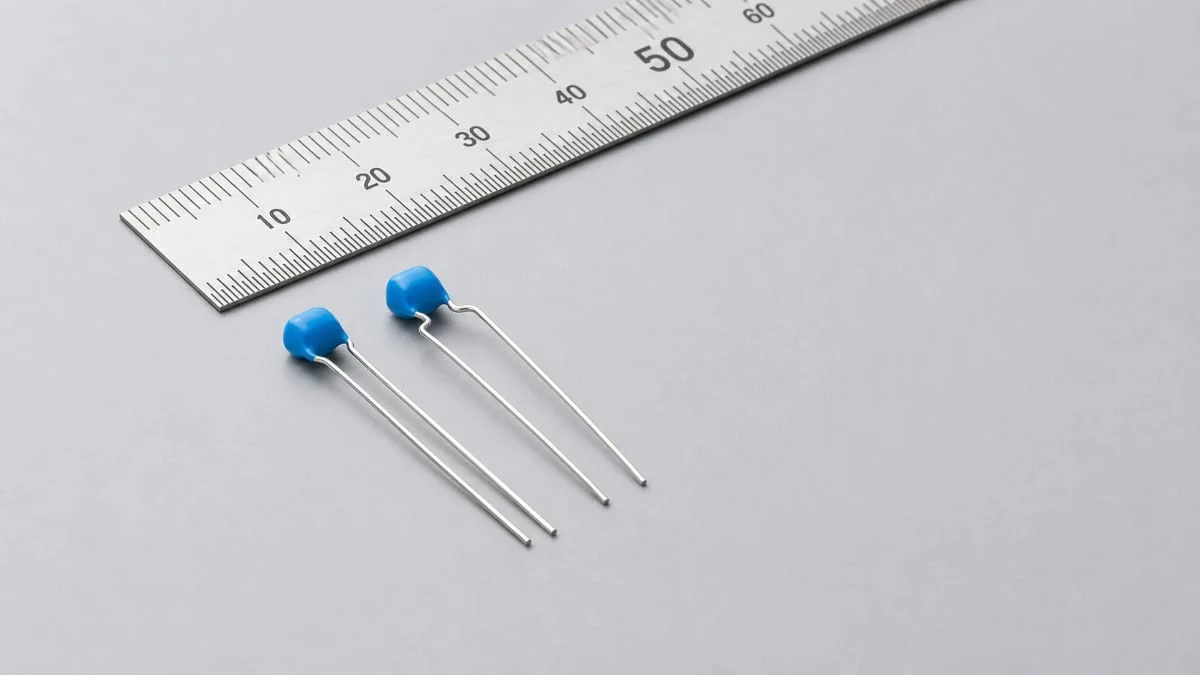
 Murata has expanded its RCE and RDE series of lead-type multilayer ceramic capacitors (MLCCs) with a new product rated at 100 VDC and 10 µF. Intended for applications adopting 48 V power systems, the new capacitor entered mass production in August 2026.
The RCEC72A106K3 and RDEC72A106K3 measure 5.5 × 4.0 × 5.0 mm, with Murata claiming the world's smallest volume and height among lead-type MLCCs at this voltage rating and capacitance.
The RCE series is designed for automotive powertrain and safety equipment, while the RDE series targets consumer electronics and industrial equipment.
10 µF Capacitance for 48 V Power Systems
High-capacitance capacitors rated at 25 to 50 VDC and 10 µF or higher are commonly used in automotive 12 V power systems, including electric power steering, brake systems and water pumps. As 48 V power systems become more widely adopted, Murata is seeing increased demand for capacitors rated at 100 VDC with capacitance of 10 µF or higher.
Similar requirements are emerging in consumer and industrial equipment using 48 V power systems, including humanoid robotics.
Until now, the maximum capacitance available in Murata's 100 VDC lead-type MLCC range was 4.7 µF. The new product increases this to 10 µF ±10%. Compared with Murata's existing lead-type MLCC of the same size rated at 50 VDC and 10 µF, the rated voltage has approximately doubled.
The new capacitor has X7S temperature characteristics and an operating temperature range of -55°C to +125°C.
Lead Wires Absorb Mechanical Stress
The new product consists of an MLCC with lead wires attached and molded in resin. The lead wires absorb mechanical stress caused by board flexure, vibration and thermal expansion, reducing the load placed on the capacitor body.
This construction also means the capacitor can be mounted in locations away from the PCB, which can be difficult with chip capacitors designed for direct surface mounting.
The leaded design is particularly relevant to the RCE series' target automotive applications, where Murata identifies powertrain and safety equipment as key uses. The RDE version brings the same 100 VDC, 10 µF rating to consumer and industrial equipment.
Automotive and Industrial Applications
Alongside 48 V automotive systems such as electric power steering, brake systems and water pumps, Murata is targeting applications where higher-voltage power architectures are being adopted in industrial and consumer equipment.
Humanoid robotics is one example identified by Murata, as higher functionality and output increase the use of 48 V power systems. The RCE and RDE devices provide the same 10 µF capacitance and 100 VDC rating across these automotive and industrial applications.
Mass production of the new lead-type MLCCs began in August 2026.
Learn more and read the original announcement at murata.com.
Technology Overview
Murata's new RCEC72A106K3 and RDEC72A106K3 are 100 VDC, 10 µF lead-type MLCCs for 48 V automotive, industrial and consumer power systems. The capacitors use lead wires and resin molding to absorb mechanical stress and operate from -55°C to +125°C with X7S temperature characteristics.
FAQs
What are the Murata RCEC72A106K3 and RDEC72A106K3?
They are lead-type multilayer ceramic capacitors rated at 100 VDC and 10 µF. The RCE version targets automotive powertrain and safety equipment, while the RDE version is intended for consumer and industrial equipment.
Why has Murata developed a 100 VDC, 10 µF MLCC?
Murata developed the new devices for the growing use of 48 V power systems. Its previous 100 VDC lead-type MLCC range offered a maximum capacitance of 4.7 µF.
Why are lead wires used instead of direct surface mounting?
The lead wires absorb mechanical stress caused by board flexure, vibration and thermal expansion. They also enable installation in off-board locations where direct surface mounting may not be suitable.
You may also like