
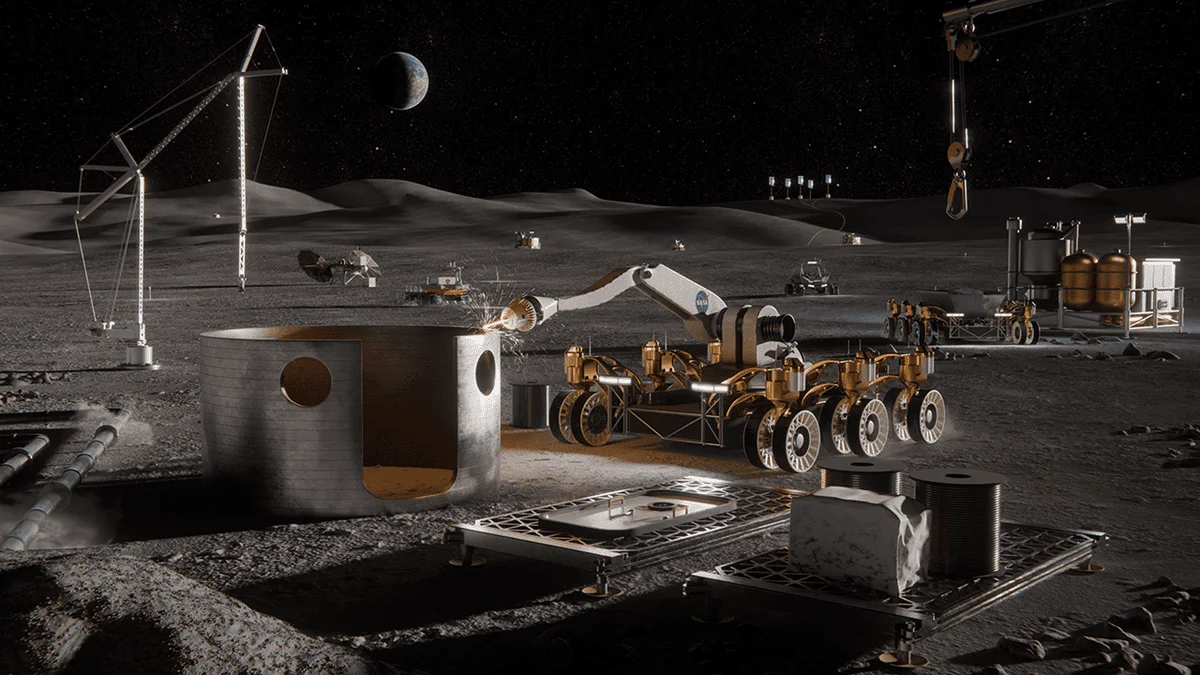
 Artistic concept of lunar surface technologies. Credit: NASA
NASA wants to establish a permanent base near the Moon's South Pole, but getting astronauts there is arguably only the beginning of the engineering challenge. A long-term presence needs electrical power, oxygen, communications, manufacturing and equipment capable of operating for extended periods without the support infrastructure we take for granted on Earth.
NASA has now called for proposals to accelerate five technologies that it believes will help make this possible. These include vertical solar arrays, oxygen production from lunar regolith, radioisotope Stirling generators, advanced manufacturing and nanomaterials production.
On the surface, these might look like five largely separate engineering challenges. Look a little closer, however, and they all depend to some degree on power electronics, sensors, control systems and reliable electrical infrastructure. So, what electronics does it actually take to turn a temporary lunar mission into something resembling a permanent Moon base?
Building an Electrical Grid on the Moon
Perhaps the most obvious requirement is power. NASA specifically wants vertical solar array technology capable of providing not only power generation, but also power management, distribution and energy storage.
Generating electricity on the Moon using photovoltaics is already possible, but operating a permanent base creates a considerably larger electrical problem. Solar energy has to be converted into usable electrical power, distributed between loads and stored for periods when generation can't meet demand. Habitats, communications equipment, scientific instruments, vehicles and industrial systems could all have very different power requirements, meaning that the Moon base effectively needs its own electrical grid.
Power electronics would sit throughout such a system. DC/DC converters could adjust voltage between generation, storage and individual loads, while switching devices would control large amounts of electrical energy with as little loss as possible. Energy storage systems would require their own monitoring and management electronics, while current, voltage and temperature sensors would allow the wider control system to determine how power is being generated, stored and consumed.
Efficiency also takes on greater importance when every watt has been generated by infrastructure transported hundreds of thousands of kilometres from Earth. A few percentage points lost through conversion don't simply appear on an electricity bill. They become heat that has to be managed and energy that isn't available elsewhere.
Reliability presents another problem. A failed converter or connector in a terrestrial solar installation can be replaced by an engineer. The same failure on the lunar surface could potentially take an important system offline with no replacement readily available. Electrical distribution therefore has to consider redundancy, fault detection and isolation alongside the usual questions of voltage, current and efficiency.
What Happens When Solar Power Isn't Available?
Solar arrays aren't the only source of electricity NASA is considering. Another of the five technologies identified in the new solicitation is the radioisotope Stirling generator, intended to provide electrical power in some of the darkest, dustiest and most remote lunar environments.
The idea is relatively straightforward. Heat produced by radioactive decay drives a Stirling convertor, which uses the movement of a piston and linear alternator to generate electricity. NASA has investigated Stirling radioisotope power systems for years because they can convert considerably more of the available thermal energy into electricity than conventional radioisotope thermoelectric generators.
NASA Glenn puts Stirling radioisotope conversion efficiency at around 20% or higher, compared with approximately 6% for previous NASA radioisotope power systems. The higher efficiency means less radioisotope fuel can potentially be used to produce a given amount of electrical power.
Again, however, generating electricity is only part of the challenge. The alternating electrical output of a Stirling convertor has to be controlled and conditioned before it becomes useful to other equipment. NASA's previous work on Stirling systems has included controllers responsible for regulating the AC produced by the linear alternator, maintaining the required output voltage and controlling operating parameters such as piston amplitude and temperature.
This makes radioisotope generation particularly interesting from an electronics perspective. A nuclear heat source may attract most of the attention, but power conversion and control electronics are what ultimately turn that heat into stable electricity that a sensor, communications system or robotic vehicle can actually use.
Turning Moon Dust Into Oxygen
Power is only useful if there is something to power, and NASA's next priority begins to make the Moon base look less like a spacecraft and more like an automated industrial facility.
Transporting everything needed for a permanent presence from Earth would be extremely difficult, which is why NASA is developing in-situ resource utilisation, or ISRU. One of the capabilities requested under the new programme is technology capable of extracting oxygen that is chemically bound within lunar regolith.
NASA is already experimenting with several approaches. Its Carbothermal Reduction Demonstration project, for example, has used concentrated solar energy and a reactor to process simulated lunar regolith. An integrated prototype combined the reactor and solar concentrator with precision mirrors, avionics, control software and gas-analysis equipment.
Other NASA-backed work has investigated molten regolith electrolysis, which can extract oxygen while leaving metal-rich material that could potentially be processed for manufacturing. Blue Origin's Blue Alchemist programme has gone further by demonstrating an integrated process that takes simulated regolith and produces oxygen alongside silicon solar cells, aluminium wire, iron and other materials.
The interesting part for electronics engineers is how quickly this becomes an automation problem. Material needs to be collected and moved, processes need to be controlled, temperatures and gases monitored and electrical power delivered to equipment operating largely without human intervention. That means motors, drives, sensors, embedded processors, power converters and communications all become part of the oxygen-production system.
Instead of shipping an industrial plant to the Moon and surrounding it with technicians, engineers have to develop machinery capable of monitoring and controlling much of itself.
Electronics Have to Survive the Moon Too
Of course, there is another complication. All of those converters, sensors, processors and control systems have to operate in an environment considerably less forgiving than a factory floor.
Vacuum immediately changes how equipment handles heat because conventional air cooling isn't available. Electronics still generate heat, but that heat has to be conducted away from components and ultimately rejected to the environment by thermal radiation rather than convection. At the same time, lunar equipment can experience extreme temperatures, while radiation creates additional problems for semiconductor devices and memory.
Then there is lunar dust. Fine regolith can accumulate on surfaces and equipment, potentially interfering with mechanisms, optical systems and thermal surfaces. Dust accumulation can also reduce solar-array performance and interfere with the ability of radiator surfaces to reject heat, making it a problem for both power generation and thermal management.
These environmental challenges affect hardware at almost every level, from semiconductor devices and circuit assemblies through to connectors, cables, mechanisms, enclosures and thermal interfaces. Reliability therefore becomes as much a component and system-design problem as it is a question of protecting the equipment from the wider lunar environment.
Redundancy can reduce the consequences of a failure, but even that isn't free. Every duplicate power supply, controller or cable adds mass and complexity that eventually has to be transported to the lunar surface. Engineers therefore face an unusual balancing act between making systems sufficiently redundant to survive failures and avoiding unnecessary hardware.
Can the Moon Eventually Make What It Needs?
This leads into perhaps the most ambitious part of NASA's latest request: advanced manufacturing.
NASA wants technologies that can reduce reliance on resupply missions from Earth while improving the flexibility and resilience of lunar operations. In the long term, that means making greater use of materials and manufacturing capabilities already available on or near the Moon rather than transporting every structure, tool and replacement part from Earth.
This is also where several of NASA's technology priorities start to connect. ISRU could provide useful materials, power systems supply the energy needed to process them, and automated manufacturing equipment could eventually turn some of those materials into useful objects.
Exactly what can realistically be manufactured on the Moon remains an enormous engineering question, and complex electronics are unlikely to suddenly roll off a lunar production line. But even the ability to manufacture comparatively simple structures, mechanical parts, conductors or other materials locally could reduce the amount of equipment that has to be launched from Earth.
And whatever form that manufacturing takes, it will itself depend on electronics. Motors have to be driven, machinery controlled, processes monitored and data communicated. Machine vision and other sensors could allow equipment to inspect what it produces, while embedded control systems would have to keep processes running with limited human intervention.
NASA's NextSTEP-3 programme is ultimately looking at technologies considerably larger than individual electronic components. But the five areas it has identified reveal just how dependent a permanent Moon base will be on them.
Solar arrays need power converters and storage. Radioisotope generators need control and power-conditioning electronics. Oxygen production needs sensors and industrial automation. Manufacturing needs motors, processors and machine control. And all of it has to operate reliably in an environment where replacing a failed component is anything but straightforward.
Putting humans back on the Moon is an enormous engineering achievement in itself. Keeping the lights on once they get there may prove just as interesting.
You may also like