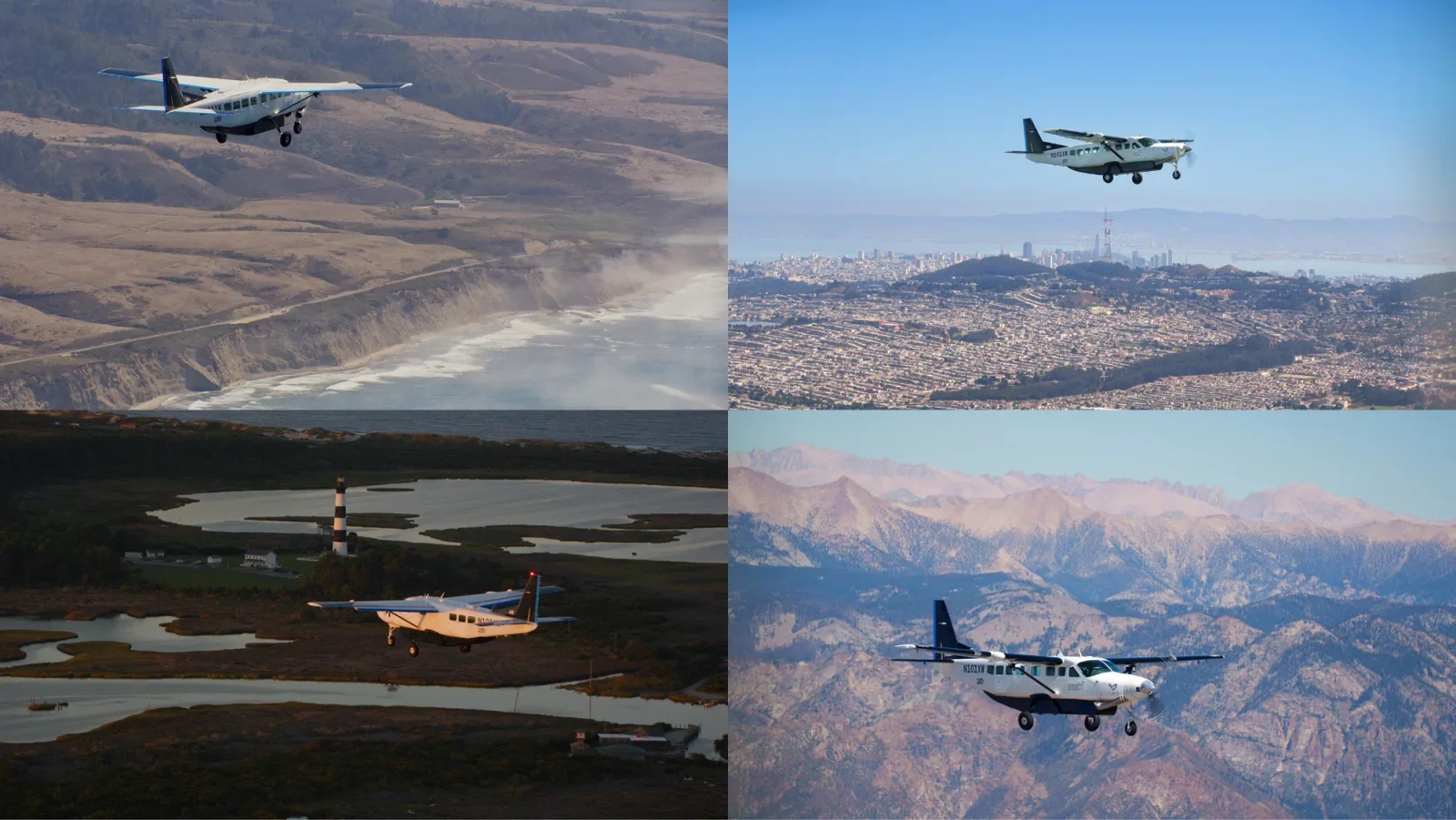
 Image credit: Joby Aviation (https://www.jobyaviation.com/news/joby-completes-first-ever-fully-autonomous-flight-across-the-united-states)
A converted Cessna Caravan recently flew 3,199 miles across the United States without its onboard safety pilot touching the controls. Joby Aviation says the aircraft handled taxiing, takeoff, navigation and landing itself, while people on the ground supervised the flight from as far as 2,323 miles away.
At first glance, that might not sound dramatically different from the automation already found in modern aircraft. Autopilots can hold altitude, follow routes and assist with approaches and landings. But someone in the cockpit is still responsible for everything happening around those functions. So what has to change when the aircraft is expected to manage the flight instead?
What Is The Aircraft Doing That An Autopilot Does Not?
The aircraft used by Joby is a Cessna 208B Caravan fitted with Superpilot, an autonomous flight system developed by Xwing before Joby acquired its autonomy business in 2024.
The platform had already completed more than 400 flights and 800 automated flight hours before the latest US tour. A conventional autopilot deals mainly with controlling the aircraft. Superpilot still performs familiar functions such as stabilisation, trajectory following and engine management, but Xwing developed it to deal with several jobs that normally sit with the pilot. These include avoiding hazards, changing the planned mission and responding to emergencies. The system covers the flight from taxi and takeoff through to landing and taxi at the other end.
Some of the hardest work happens before a flight-control command is ever sent. A pilot looking through the windscreen is constantly gathering information about other aircraft, the runway, weather and the wider environment. An autonomous system needs enough information to make similar decisions without relying on someone onboard to notice a problem.
Xwing's development programme has used cameras, radar and lidar to collect that information. The company previously fitted sensor pods to Cessna 208Bs operating normal cargo flights, allowing it to record real-world data without connecting the experimental equipment to the controls. Cameras, radar and lidar do not see the world in the same way, so using several sensing methods provides more information than relying on a single source.
That feeds into the detect-and-avoid part of Superpilot. Xwing describes this as the system responsible for detecting hazards in the air and on the ground, while its mission-management software handles decisions that would otherwise be made by the pilot. The flight-control system can then act on those decisions.
This is also why autonomous taxiing is worth paying attention to. Following a route at cruise altitude is only part of the journey. The aircraft has to operate around runways and taxiways, where other aircraft, vehicles and infrastructure may all be nearby. Joby says its transcontinental flight included autonomous taxiing at both ends as well as the airborne parts of the journey.
If Someone Is Watching From The Ground, Is It Really Autonomous?
The distinction between autonomous and remotely piloted aircraft can become confusing because Joby's J208 was supervised from the ground throughout the flight.
Superpilot was not designed around someone sitting thousands of miles away and moving the aircraft's controls remotely. Xwing calls its approach “human-on-the-loop”. A remote supervisor monitors the flight, handles communications with air traffic control and ground crews, and can give the aircraft instructions, but does not have conventional stick-and-rudder control. The immediate flying remains onboard.
That difference becomes important as soon as the communications link is unreliable. If every control input had to travel from a ground station to the aircraft, losing that connection would become an immediate flight-control problem.
Instead, Xwing designed the aircraft to handle failures and contingencies onboard. Communication with the ground gives the supervisor information and the ability to provide higher-level instructions, but the aircraft is not supposed to depend on a continuous stream of control commands to remain in the air.
There is still a considerable communications system behind that arrangement. Xwing has used a combination of air-to-ground and satellite links rather than relying on one connection, providing alternative paths as the aircraft moves beyond the range of terrestrial infrastructure or encounters interruptions. During Joby's coast-to-coast flight, supervision took place from facilities in California and South Carolina, with a maximum separation of 2,323 miles between the aircraft and the people monitoring it.
The same basic problem exists with sensing. A camera can encounter poor visibility, satellite navigation can be degraded and individual electronic systems can fail. For an aircraft intended to operate without someone immediately taking the controls, detecting those problems and deciding what information can still be trusted becomes part of the autonomy problem itself.
Xwing's earlier work with NASA gives an indication of some of the issues involved. The programme examined safety cases around vision-based runway detection, aircraft localisation and ways of enhancing GPS, rather than assuming that one navigation or perception method would always remain available.
So Why Was There Still A Pilot Onboard?
Joby's aircraft completed the transcontinental journey with a safety pilot in the cockpit, despite the company reporting zero control inputs from that pilot. That is an important distinction. Demonstrating that an autonomous system can complete a flight is not the same as having approval to operate routine commercial services with nobody onboard.
Large uncrewed aircraft still have to satisfy airworthiness and operational requirements before they can be used commercially without an onboard pilot. The FAA notes that type and airworthiness certification become important for more complex unmanned aircraft operations, with the aircraft expected to demonstrate that it is reliable, controllable and safe.
Xwing had already taken Superpilot into the FAA certification process before Joby bought the autonomy business. Its approach is particularly interesting because it starts with a conventional aircraft rather than a purpose-built autonomous vehicle. The Cessna Caravan is already widely used for cargo and utility operations, while Xwing designed its technology so that the same underlying approach could be transferred to other aircraft.
That also points towards where this technology could appear first. Joby is demonstrating the J208 for freight, emergency response and defence logistics, all of which involve missions where removing the need for an onboard crew could have a practical benefit.
The September crossing does not show that autonomous aviation is finished. There was still a safety pilot onboard, certification remains a major part of the work and completing one long flight is very different from operating the same system commercially day after day.
It does show why autonomous flight is a much wider problem than autopilot. The aircraft already knows how to hold a heading or follow a route. What engineers are now trying to reproduce are the other parts of the pilot's job: watching what is happening outside, deciding when the plan needs to change, dealing with failures and keeping the flight moving when a person is no longer sitting at the controls.
You may also like