
Infineon Launches PSOC Control C3 MCUs for Quad-Motor and Power Conversion Systems
Infineon expands PSOC Control C3 with 180 MHz Cortex-M33 MCUs for quad-motor control and power conversion, with CNSA 2.0 post-quantum firmware protection.
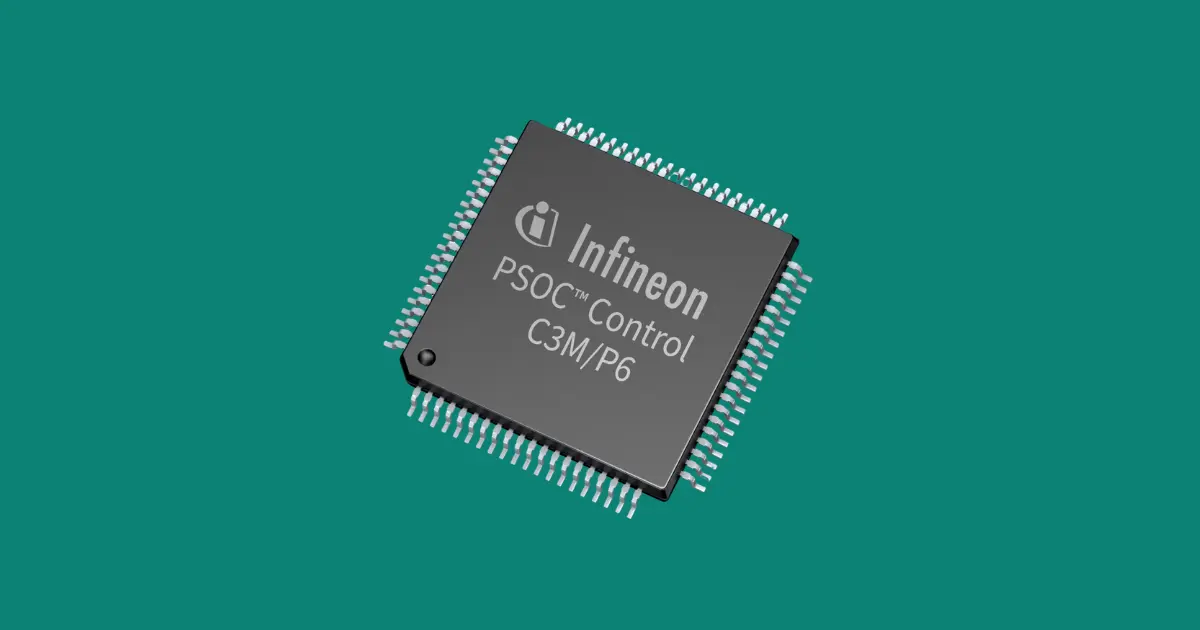
The Arm Cortex-M33-based devices run at up to 180 MHz and are designed to control as many as four brushless DC motors from a single MCU, in either sensored or sensorless configurations. Infineon is also targeting PFC, high-RPM motor control and power-conversion systems built around wide-bandgap devices.
Rather than treating security as a separate part of the design, Infineon has integrated support for post-quantum firmware protection into the same MCU family. The devices support CNSA 2.0 requirements, PSA Level 3 enablement and DICE-ready security, with SHA-512 and LMS used for secure boot and firmware update verification.
One MCU for Multiple Motor and Power Functions
The PSC3M/P6 family is intended for systems where several real-time control functions need to run from the same controller.
For motor applications, the PSC3M6 devices can drive up to four BLDC motors, covering sensored and sensorless control. Infineon is also positioning the family for very high-RPM motors and industrial drives, where faster control loops and precise analog processing are required.
The PSC3P6 variants are aimed more directly at power-conversion applications, including power-factor correction and wide-bandgap power stages. Fast analog processing and digital control are built into the devices, while on-chip operational amplifiers reduce the need for some external analog circuitry around the control loop.
USB and I3C interfaces extend the family beyond motor and power systems into applications including robotics, renewable energy, telecommunications equipment, data centers, smart-home products and industrial automation.
Post-Quantum Security Moves into the Control MCU
The security side of the new family is more substantial than a basic secure-boot feature.
Infineon says the PSC3M/P6 devices are compliant with the firmware-protection requirements outlined in CNSA 2.0 and support PSA Level 3 enablement. SHA-512 and LMS are included for secure-boot and firmware-update verification, giving designers a route toward systems that need to remain secure over longer product lifetimes.
That is particularly relevant in industrial equipment, where motor drives and power converters increasingly sit on connected networks and may remain in service for many years. Infineon is also positioning the devices around Cyber Resilience Act requirements, although compliance ultimately depends on the complete product and its development process rather than the MCU alone.
The family is available in multiple package options up to 100 pins, with PSC3M6 parts for motor control and PSC3P6 parts for power conversion.
Infineon supports the devices through ModusToolbox Motor Suite and Power Suite, which provide control libraries and development tools for the two application areas.
The PSOC Control C3 Main Line PSC3M/P6 MCUs are available now.
Learn more and read the original announcement at infineon.com.
Technology Overview
Infineon PSC3M/P6 MCUs are Arm Cortex-M33 devices running at up to 180 MHz for multi-motor control and power-conversion applications. The family supports control of up to four BLDC motors, wide-bandgap power stages, on-chip analog functions, and CNSA 2.0-compatible firmware protection with SHA-512 and LMS.
FAQs
How many motors can the PSC3M/P6 MCUs control?
The family can control up to four BLDC motors from a single MCU, using either sensored or sensorless operation.
What security features are included?
The devices support CNSA 2.0 firmware-protection requirements, PSA Level 3 enablement and DICE-ready security, with SHA-512 and LMS for secure boot and firmware update verification.
What is the difference between PSC3M6 and PSC3P6?
PSC3M6 devices are aimed primarily at motor-control applications, while PSC3P6 devices target power-conversion systems such as PFC and wide-bandgap power stages.
Related news
Keep up with the components and technology shaping electronics.
Join the club for member features, engineering discussion and easier access to the latest Component Club content.