
Microchip Launches LX-820 Radiation-Tolerant Oscillator for LEO Satellites
The 3.2 × 2.5 mm quartz oscillator offers CMOS and LVDS outputs, operates from −55°C to +125°C and is designed for space applications requiring radiation-tolerant timing.
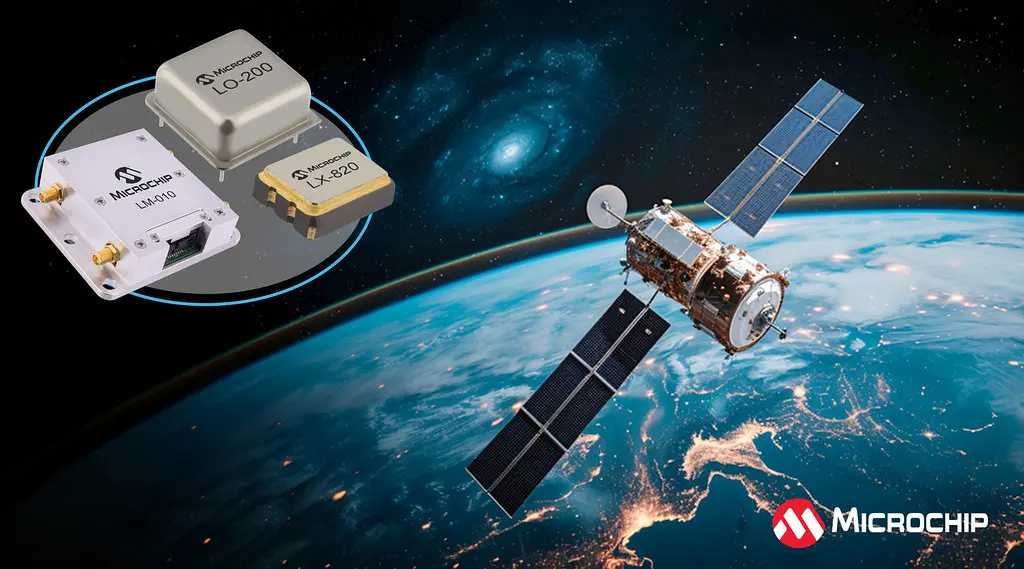
Available in a 3.2 × 2.5 mm surface-mount package, the LX-820 operates from −55°C to +125°C and is engineered to meet MIL-PRF-55310 Level B. It has a frequency performance specification of ±100 ppm, with CMOS outputs covering 1.25 MHz to 135 MHz and low-voltage differential signaling (LVDS) outputs from 100 MHz to 250 MHz.
Radiation Testing and Construction
Microchip's L-Series uses commercial- or military-grade components alongside production inspection, electrical and thermal analysis, and hybrid manufacturing. The L-Series oscillators have passed Total Ionizing Dose (TID) and Single-Event Latchup (SEL) testing as complete, functioning devices, with radiation tolerance up to 50 krad and SEL testing to 40 MeV·cm²/mg.
Most L-Series products also use swept quartz to reduce radiation-induced frequency drift. The company's L-Series oven-controlled crystal oscillators (OCXOs) incorporate ruggedized construction and four-point crystal mounts designed to survive launch and the intended mission profile.
These measures are part of Microchip's approach to offering radiation-tolerant timing components without the full component pedigree, documentation and inspection overhead associated with traditional high-reliability space-grade products.
Timing Options and Availability
Alongside the LX-820, Microchip's L-Series includes temperature-compensated crystal oscillators (TCXOs), oven-controlled crystal oscillators (OCXOs) and a pulse-per-second (PPS) disciplined oscillator. The range covers different frequency stability, phase noise, power and size requirements.
Many L-Series configurations are available from stock or with lead times of less than 20 weeks. Microchip says the range is intended to address the procurement costs and extended lead times commonly associated with traditional space-grade timing components.
The LX-820 and other L-Series oscillators are now available in production quantities.
Learn more and read the original announcement at microchip.com.
Technology Overview
The Microchip LX-820 is a radiation-tolerant quartz oscillator for Low Earth Orbit satellites and other space applications. It supports CMOS output frequencies from 1.25 MHz to 135 MHz and LVDS frequencies from 100 MHz to 250 MHz, with ±100 ppm frequency performance. The device operates from −55°C to +125°C in a 3.2 × 2.5 mm surface-mount package and is engineered to meet MIL-PRF-55310 Level B. It forms part of Microchip's L-Series of timing devices, which undergo radiation testing and additional production inspection.
FAQs
What is the Microchip LX-820 designed for?
The LX-820 is a radiation-tolerant quartz oscillator developed for Low Earth Orbit satellites and other space applications that require a frequency reference.
What frequency outputs does the LX-820 support?
It supports CMOS output frequencies from 1.25 MHz to 135 MHz and LVDS output frequencies from 100 MHz to 250 MHz, with ±100 ppm frequency performance.
What radiation testing does Microchip specify for its L-Series?
Microchip states that L-Series oscillators have passed Total Ionizing Dose and Single-Event Latchup testing as complete devices. Across the portfolio, it specifies radiation tolerance up to 50 krad and SEL testing to 40 MeV·cm²/mg.
Related news
Keep up with the components and technology shaping electronics.
Join the club for member features, engineering discussion and easier access to the latest Component Club content.