
 Edge computing is no longer about simply connecting sensors and passing data upstream. Today’s systems are expected to process high-resolution video, run AI inference, and respond to real-time events, all within the size and power limits of embedded platforms. That shift has made the computer-on-module (COM) one of the most important building blocks in industrial design.
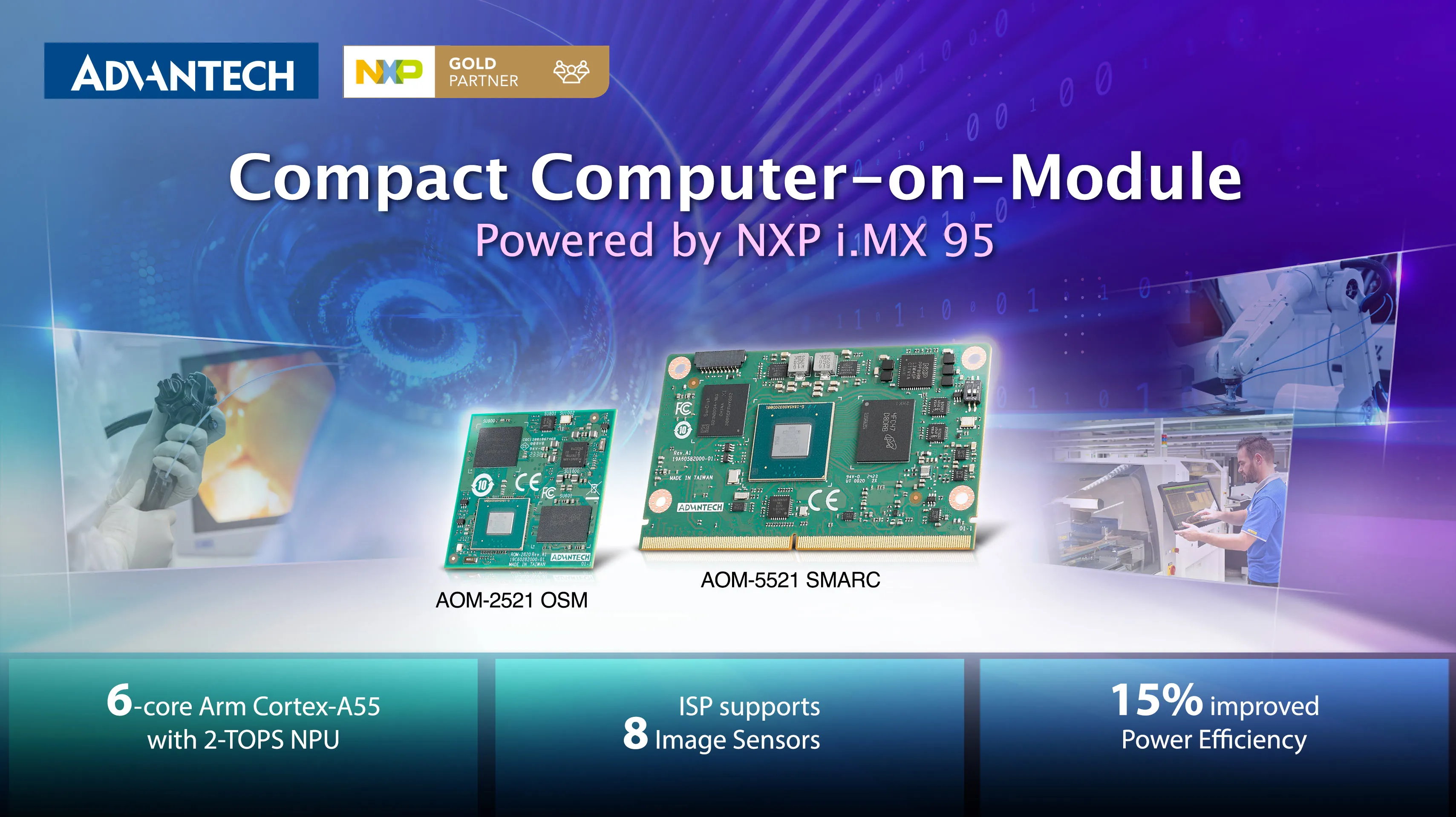
Advantech’s latest additions, the AOM-5521 (SMARC) and AOM-2521 (OSM), are built around NXP’s i.MX 95 processor family and aim to provide engineers with a ready-made route to deploy edge AI and machine vision in compact systems.
Why the i.MX 95 Matters
At the heart of these modules is a multi-domain architecture: up to six Arm Cortex-A55 cores for general processing, a Cortex-M7 and Cortex-M33 for safety-critical control, and a 2-TOPS neural processing unit (NPU) for AI acceleration. For engineers, that means a single module can handle everything from deterministic control loops to defect detection on a production line.
Compared with earlier devices, the i.MX 95 offers a step change, four times the machine learning performance, and double the data throughput, all while improving efficiency. For industries where thermal budgets are tight, that balance between performance and power is often the deciding factor.
Vision and Graphics at the Edge
One of the standout features of the i.MX 95 is its integrated image signal processor (ISP). Capable of handling up to 500 megapixels per second across eight image sensors, it enables applications such as multi-camera machine vision, automated inspection, or advanced driver assistance in transport systems. A built-in video unit manages 4K H.265/H.264 streams, while a Mali G310 GPU adds support for modern graphics and compute APIs.
For engineers, the benefit is consolidation. Instead of bolting on separate processors for imaging, video, and AI, these functions are already integrated into a compact module, simplifying design and reducing system cost.
Connectivity for Industrial Networks
Industrial deployments live and die by connectivity. Here, the modules deliver one 10GbE port and two 1GbE ports with Time-Sensitive Networking (TSN), making them suitable for synchronised control across distributed systems. Support for CAN-FD, PCIe Gen 3.0, and USB 3.0 Type-C further broadens integration into factory networks, gateways, and IoT infrastructure.
Memory and security features also reflect industrial needs: LPDDR5 with ECC helps protect data integrity, while built-in encryption supports applications where secure operation is mandatory.
Building Reliable Systems
Reliability and safety are often overlooked in marketing headlines, but for industrial and medical engineers, they are deal-breakers. The i.MX 95 architecture supports ASIL-B and SIL-2 functional safety, while Advantech’s choice of SMARC and OSM form factors gives designers flexibility in footprint and lifecycle planning. Long-term availability is another important factor, one that ensures system builders aren’t left redesigning every few years.
Why It Matters
The edge is where AI meets reality. For many applications, success depends on being able to run vision and inference workloads reliably in small, power-conscious devices. By combining NXP’s i.MX 95 with industrial-grade connectivity and safety, Advantech’s AOM-5521 and AOM-2521 are more than just new modules; they’re a way for engineers to close the gap between proof-of-concept AI and real-world, long-lived systems.
Learn more here.
You may also like