
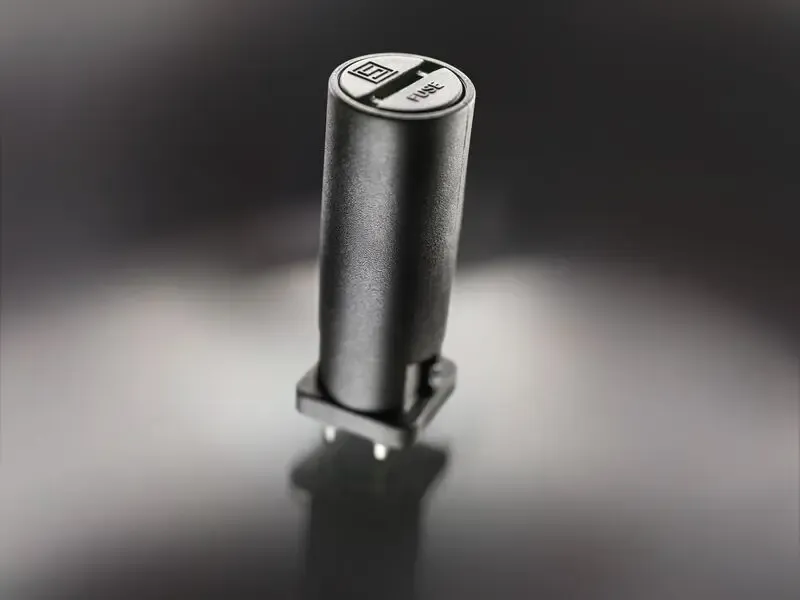
 Power density is a constant challenge in modern electronics. Systems are expected to handle ever higher current loads, yet board space is often already constrained by processors, interfaces, and thermal management. Fuseholders are rarely the first part considered in a design review, but their ability to dissipate heat directly influences system reliability.
SCHURTER’s new FPR fuseholder has been designed with this challenge in mind. Compared with the established FPG4 series, the FPR offers around 30% higher power consumption capacity while keeping the same compact footprint. For engineers, this means greater thermal headroom without needing to redesign the PCB layout.
Higher Thermal Capacity in the Same Package
At 10 A and 23 °C, the FPR consumes just 3.2 W, a clear improvement over the previous generation. The dimensions remain unchanged at 12.5 mm, allowing straightforward integration into designs that already use the FPG4. This drop-in compatibility makes the upgrade path low risk, particularly for projects where qualification cycles are lengthy or expensive.
Despite its small size, the component is designed to handle tough operating conditions. It meets IEC 60068-2-6 vibration standards, offers reliable performance across -40 °C to +85 °C, and provides IP40 protection. These factors make it well-suited for industrial and building automation environments where thermal cycling and mechanical stress are common.
Practical Benefits for Engineers
The FPR’s biggest advantage is that it removes a common trade-off. Traditionally, achieving higher power handling meant allocating more board space or switching to bulkier holders. By keeping the footprint identical to the FPG4, SCHURTER gives engineers a way to increase system reliability and current capability without layout changes.
Target applications include industrial automation, mechanical engineering, and building automation, all sectors where space is constrained but current demand is growing.
The Takeaway
Fuseholders may be a small part of a system, but when thermal margins are tight they can make the difference between stable operation and early failure. SCHURTER’s FPR fuseholder combines higher power handling with footprint compatibility, giving engineers an easy upgrade path for compact, high-current designs.
Learn more and read the original article on www.schurter.com
You may also like