
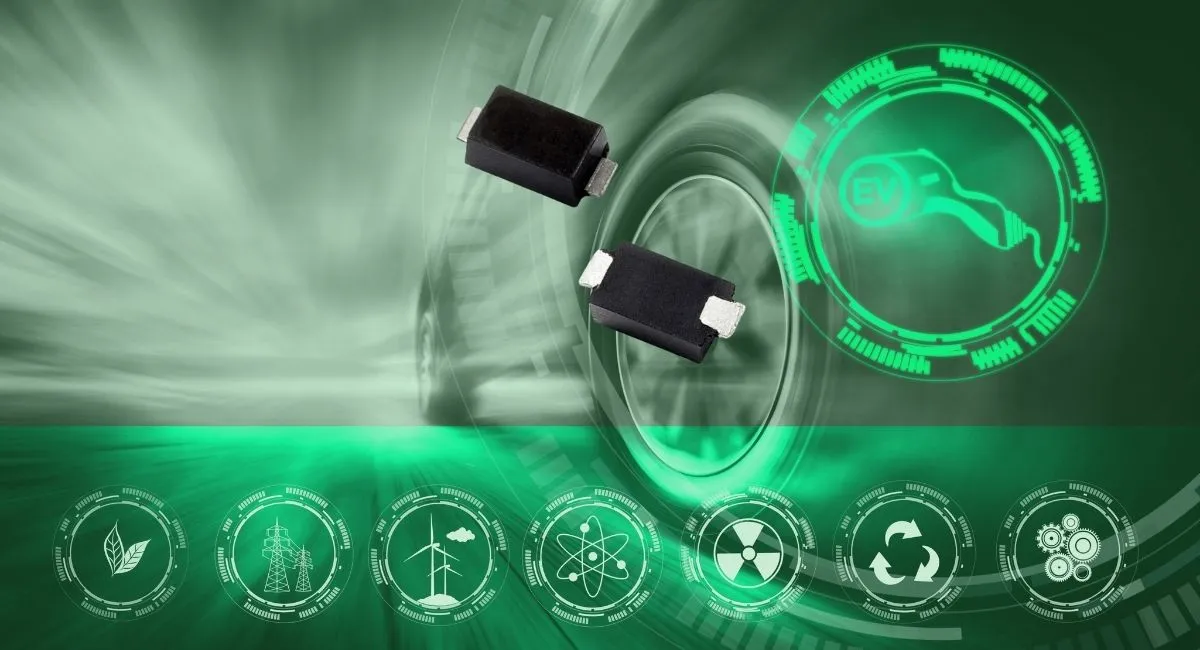
 Littelfuse has broadened its automotive TVS line with the SZSMF6L Series, a new range of diodes aimed at protecting EV and automotive systems from high-energy transients. The parts push peak pulse power handling up to 600 W while keeping the same compact SOD-123FL footprint used in the earlier 400 W SZSMF4L range.
More Protection Without Redesign
For engineers, the attraction here is straightforward: more surge protection without changing the board. The SZSMF6L offers a 50% increase in power handling compared with its predecessor, giving designers additional headroom against switching spikes, load dumps, or electrostatic discharge. Both unidirectional and bidirectional devices are available, covering working voltages from 5 V to 75 V.
The sub-nanosecond response time is worth noting. A TVS device that reacts this quickly can clamp a transient before it has a chance to stress downstream circuits. The planar chip design also brings lower leakage and more predictable clamping behaviour, small details that matter when you’re working on tightly regulated automotive platforms.
Built for Harsh Conditions
Automotive systems rarely run in gentle environments. With a maximum operating temperature of 175 °C, the SZSMF6L provides more margin than the 150 °C ceiling common to many devices. Littelfuse also quotes an ESD capability above 16 kV (HBM Class 3), which will be reassuring for anyone designing sensor interfaces or other vulnerable nodes scattered throughout modern vehicles.
Typical applications include EV powertrains, inverters, battery management units, onboard chargers, and power distribution modules, as well as body electronics and domain controllers.
Straightforward Upgrade Path
Because the new parts share the same package as the 400 W SZSMF4L, engineers can raise the protection level without changing layouts or sacrificing space. That makes the SZSMF6L a useful drop-in choice for designs moving into higher stress territory, particularly as automotive electronics continue to evolve toward denser, zonal architectures.
Learn more and read the original article on www.littelfuse.com
You may also like