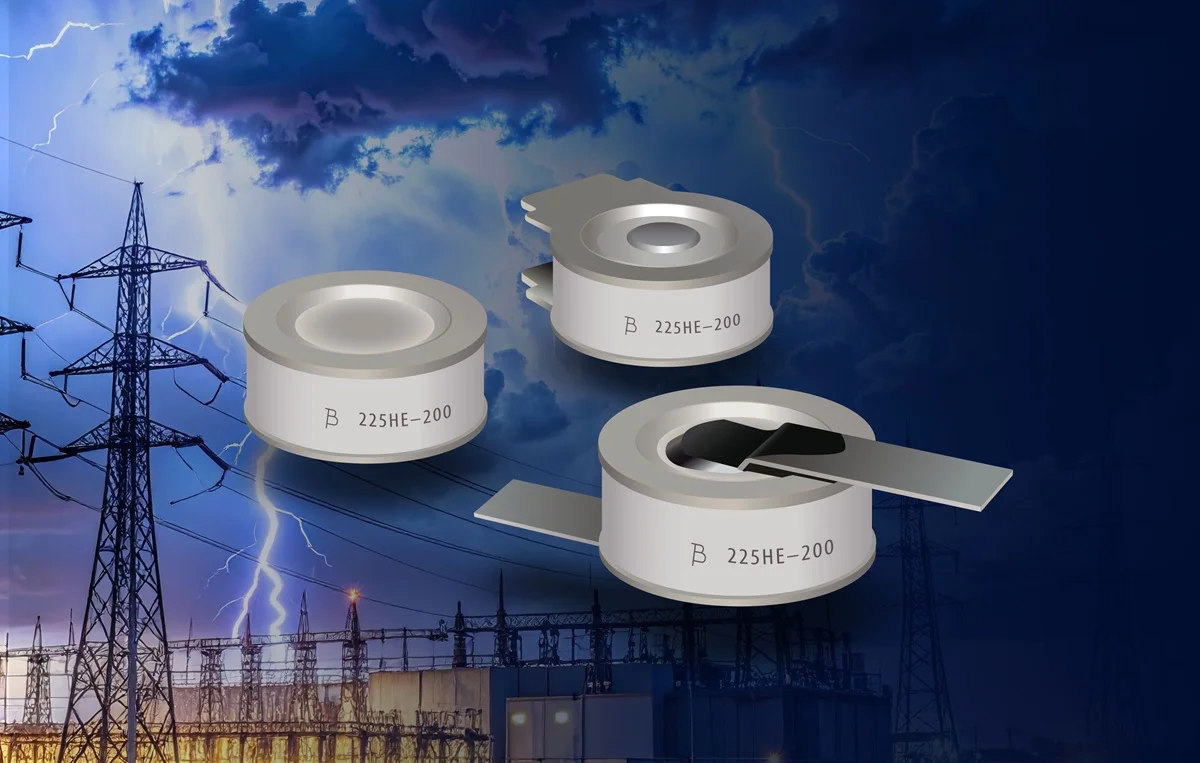
 In high-voltage power systems the real challenge is rarely the steady state. It is the moment a fault inserts itself onto the line and the system tries to move that energy somewhere safe. Designers see it when commutation events push currents far outside the margins of their surge elements or when a line hit redirects lightning energy into places the layout never expected. Many protection devices can manage fast peaks. Far fewer stay intact when the energy stretches longer and forces the component to absorb more thermal mass than the PCB was designed for. That mismatch between expected surge behavior and the real waveform is often where protection chains fail in the field. The GDT225HE Series from Bourns is built for that more difficult region where the problem is not only how high the current goes but how long it tries to stay there.
Handling Energy That Outlives Traditional Surge Paths
Gas discharge tubes look simple, yet the shape of their protection window changes dramatically depending on how long the fault persists and how the upstream system behaves during that window. The GDT225HE Series spans a breakdown range from 1000 to 2000 volts, and what stands out is how the part handles high I²t energy without collapsing into failure modes seen in smaller devices. With nominal discharge current ratings around 40 kA and maximum levels near 60 kA on an 8 by 20 microsecond waveform, the tubes provide enough margin that system designers are not relying on a single sharp peak but a more sustained profile. This becomes important in EV charging or battery storage hardware where switching events rarely behave like ideal surges and instead stretch into longer thermal loads that stress component internals in subtler ways.
Space Constraints That Influence Protection Strategy
High-energy protection components once demanded large mechanical housings or dedicated surge modules, and they often pulled designers toward compromises in footprint or mechanical routing. The GDT225HE Series fits into a compact, low-profile form that helps align the device with PCB layouts rather than external surge blocks. The various lead shapes become useful when designers need the part to sit close to high-voltage nets without violating creepage or clearance paths that shift during enclosure design. This flexibility is often appreciated late in development when mechanical constraints tighten and the protection stage must thread between power planes, heat sinks, and structural elements without losing isolation integrity.
Built for Systems That Experience Real Transients, Not Idealized Ones
High-power AC systems such as EV chargers and industrial converters deal with switching artifacts that do not always follow standardized waveforms. Commutation faults generate energy that persists through several cycles before the upstream circuitry clears the event. A device that can hold its structure during those conditions reduces the risk of secondary damage deeper in the power chain. The GDT225HE family behaves predictably under these stresses, which makes it suitable for designs where lightning exposure, surge coordination, and equipotential bonding are not theoretical considerations but daily environmental realities. This predictability influences decisions about where to place the tubes and how to pair them with MOVs or TVS devices to shape coordinated protection.
A Protection Element Suited to Modern High-Voltage Equipment
The environments that expose protection stages to high-energy surges are becoming more common as renewable systems, outdoor telecom nodes, and vehicle charging networks expand. Designers increasingly need components that tolerate both fast impulses and the longer, higher-energy stress that accompanies fault insertion. The GDT225HE Series aligns with that shift by offering breakdown flexibility, current headroom, and a mechanical profile that fits the density of modern boards. It is built for equipment that cannot afford protection stages that behave differently once temperature, mechanical stress, or repeated surges start pushing the limits of older component designs.
Learn more and read the original announcement at www.bourns.com
You may also like