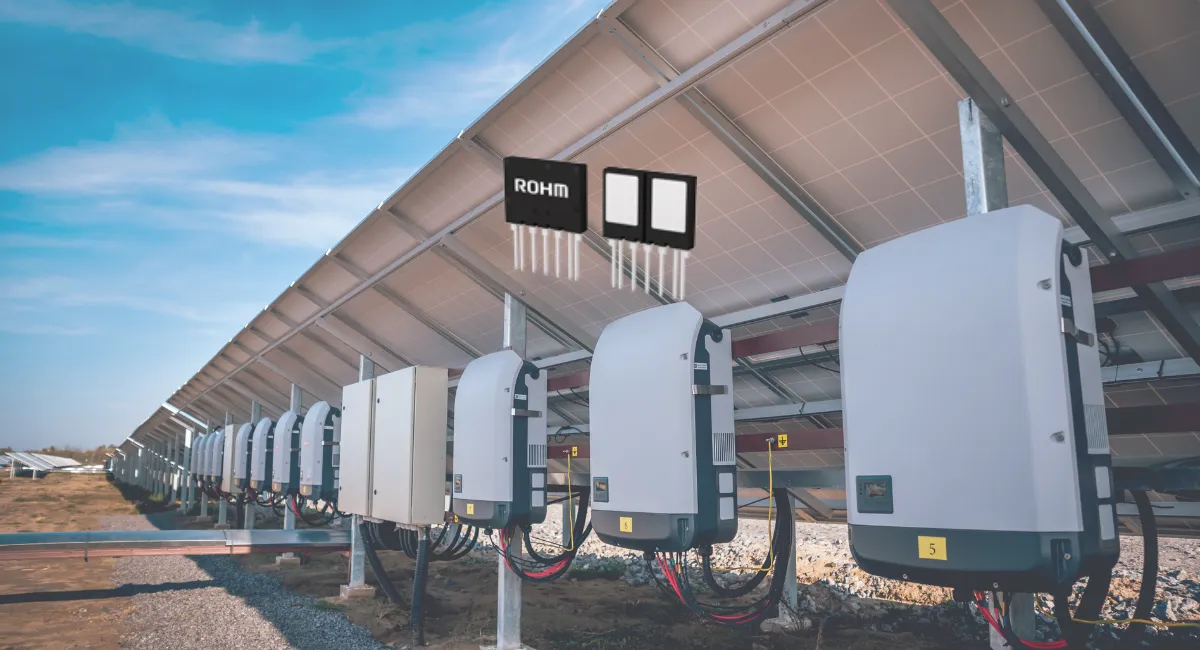
 ROHM has introduced the DOT-247, a new 2-in-1 SiC molded module (SCZ40xxDTx, SCZ40xxKTx) designed for applications demanding high power density and flexible topologies. Target markets include PV inverters, UPS systems, semiconductor relays, and other industrial and automotive power conversion systems.
Higher Power Density in a Familiar Footprint
The DOT-247 package retains the versatility of the widely used TO-247 format while combining two packages into a single module. This allows larger chip sizes and a unique internal structure that reduces on-resistance. The result is 15% lower thermal resistance and 50% lower package inductance compared with TO-247 devices, enabling a 2.3× higher power density in a half-bridge configuration. In practical terms, the same power conversion circuit can now fit into roughly half the volume.
Flexible Topologies for Multi-Level Power Systems
Available in half-bridge and common-source configurations, the DOT-247 modules simplify the design of multi-level inverter systems such as NPC, T-NPC, and ANPC. These topologies are increasingly adopted in PV inverters and high-voltage applications where voltage stress and efficiency must be carefully managed. By integrating the smallest building blocks of these circuits into a single module, ROHM reduces the number of components and the required mounting area, streamlining circuit layout and supporting miniaturisation.
Designed for Real-World Engineering
To help engineers adopt the new modules quickly, ROHM provides evaluation boards, SPICE models, and LTspice® simulation models (with three-level NPC support available from October 2025). An evaluation kit for double-pulse testing is already available, with a 3-phase inverter kit and reference designs scheduled for release in November 2025.
Availability and Reliability
The DOT-247 family is now in mass production with sample pricing at $140 per unit. Devices qualified to the AEC-Q101 automotive reliability standard will begin sampling in October 2025, making them suitable for demanding environments, including EV charging stations and fuel-cell vehicle boost converters.
Learn more and read the original article on www.rohm.com
You may also like