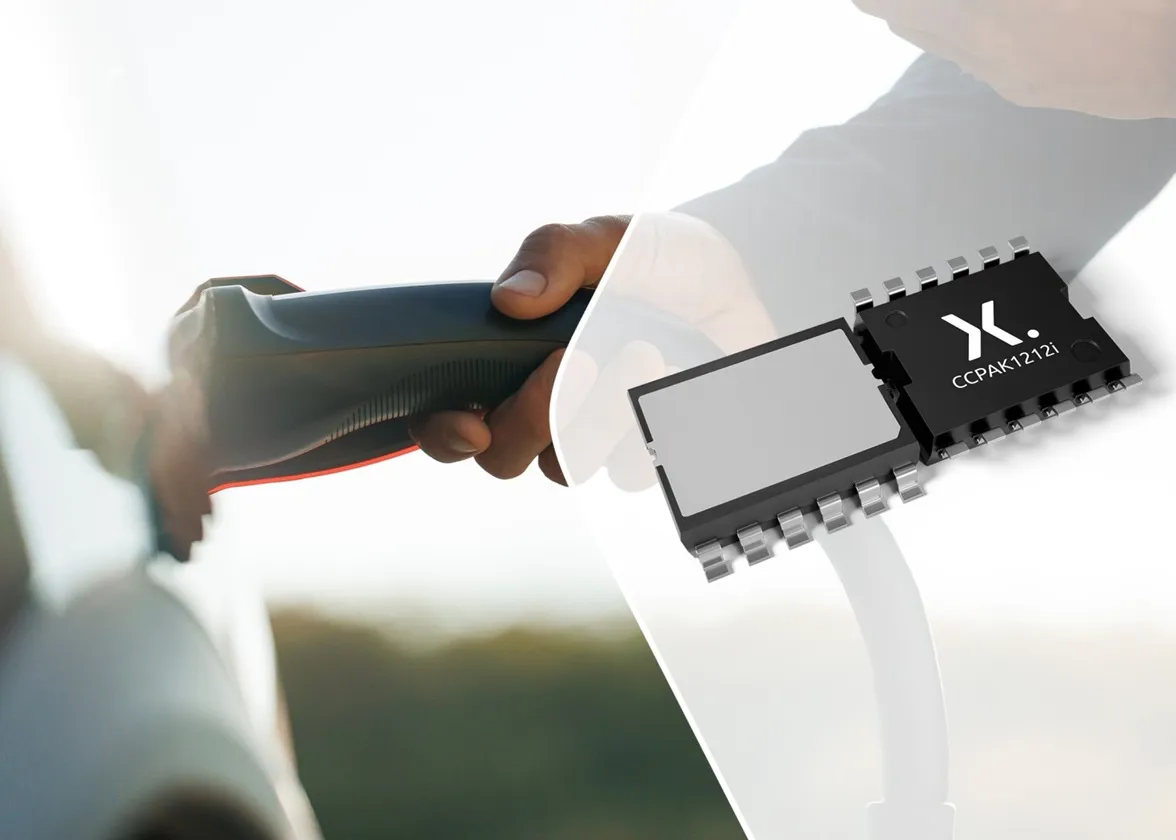
 Car makers are steadily moving from 12 V to 48 V power systems to improve efficiency and reduce wiring losses, but that shift puts new pressure on the MOSFETs driving traction inverters, DC-DC converters, and battery management systems. Lower conduction losses mean less heat and smaller thermal budgets, which are crucial as engineers pack more electronics into tighter spaces.
Nexperia’s new 100 V MOSFETs in the CCPAK1212 package are designed with that challenge in mind. They offer on-resistance down to 0.99 mΩ and handle more than 460 A of continuous current, giving design teams a way to cut power losses without stacking multiple devices in parallel.
Compact Size, Higher Power Density
Each device fits a 12 × 12 mm footprint, letting engineers free up board area compared with larger TOLL or TOLT packages. In many designs this can reduce PCB space by as much as 40 %, helping to boost overall power density and leave room for controllers, sensors, or connectors on the same board.
Copper-Clip Thermal Advantage
The CCPAK1212 uses a copper-clip connection that improves current handling and keeps junction-to-board thermal resistance to just 0.1 K/W. That means heat can flow efficiently into the PCB or heatsink, which is especially useful under heavy load or during transient events. Engineers can choose between bottom-side cooled and inverted top-side cooled (CCPAK1212i) versions to match their preferred cooling strategy.
Built for Automotive Reliability
These MOSFETs use Nexperia’s latest trench silicon technology and have a strong Safe Operating Area rating up to 400 A at 100 V. This extra margin helps maintain reliability during fault conditions or high-current surges that are common in electric vehicle power stages.
By combining very low RDS(on), excellent thermal performance, and flexible cooling options, the CCPAK1212 family gives automotive designers a practical way to meet tougher efficiency and space requirements in next-generation 48 V systems.
Learn more and read the original article on www.nexperia.com
You may also like