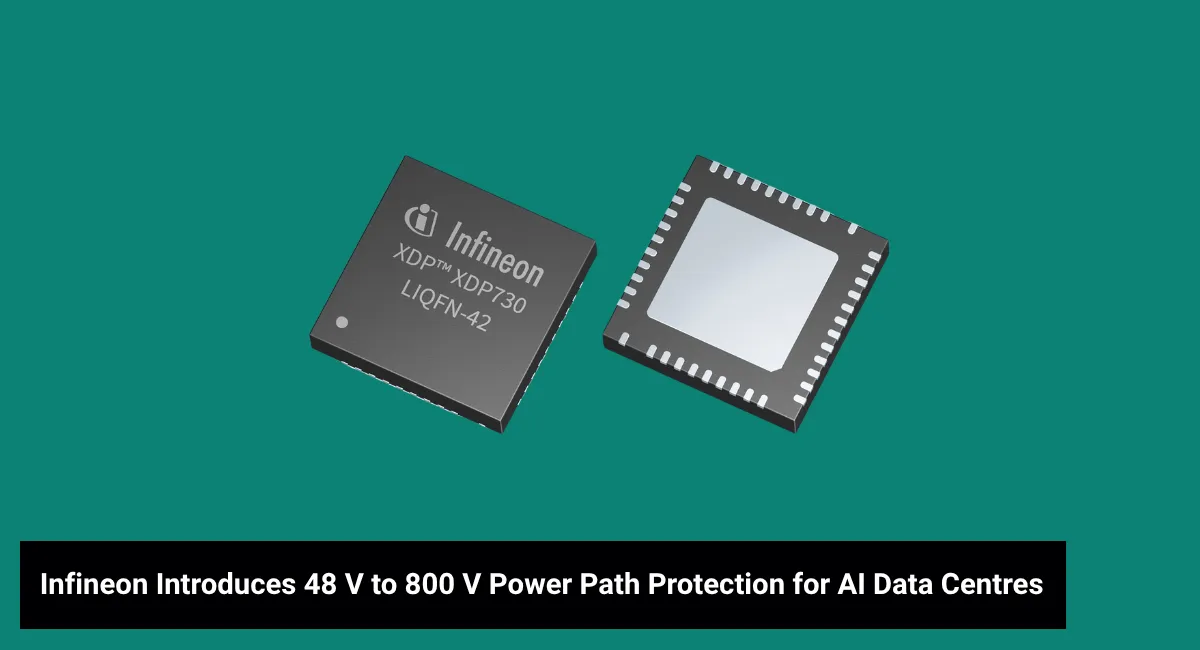
 AI data centres are drawing more power than ever, and keeping that energy stable is now a design challenge of its own. Infineon Technologies is responding with a new 48 V smart eFuse family and hot-swap controller reference design for 400 V and 800 V systems, giving engineers a scalable path to safer, higher-efficiency power delivery.
Protecting the Power Path
The company’s latest XDP730, XDP720, and XDP721/22 smart eFuse ICs are designed for the 48 V buses found in most current AI servers. Each integrates a digital controller, an OptiMOS™ FET, a gate driver, and a current sensor to monitor and protect energy flow from grid to rack.
These eFuses react in microseconds to overcurrent or short-circuit events. They also enable hot-swapping, so hardware can be connected or removed while the system remains live. Continuous telemetry on voltage, current, and power lets operators analyse trends and detect potential issues before they cause downtime.
Preparing for 400 V and 800 V Architectures
As next-generation racks move to higher voltages, protection becomes more complex. Higher DC levels reduce losses and cable size but also increase fault energy. Infineon’s new REF_XDP701_4800 reference board is built for these environments, using the proven XDP™ hot-swap controller and 1200 V CoolSiC™ JFET™ technology to manage startup and inrush safely.
The controller regulates current in linear mode to stay within the Safe Operating Area (SOA) of the device. This approach limits stress on the semiconductors and keeps the system stable during transient events. The design supports a 12 kW nominal Thermal Design Power (TDP), giving engineers a tested platform for scaling to full-rack installations.
Designed for Reliability
Infineon’s simplified architecture reduces component count and shortens design time, helping data-centre engineers meet uptime and efficiency goals. With smart eFuses covering 48 V distribution and hot-swap control at 400 V and 800 V, the company now spans the full range of voltage domains needed for AI infrastructure.
Why It Matters
In high-power compute environments, uptime is directly tied to cost. Every second of outage can disrupt AI workloads across thousands of processors. Infineon’s extended protection portfolio gives designers a toolkit for building safer, more efficient systems that can evolve from today’s 48 V standards to the high-density architectures of the future.
Learn more and read the original article on www.infineon.com
You may also like