
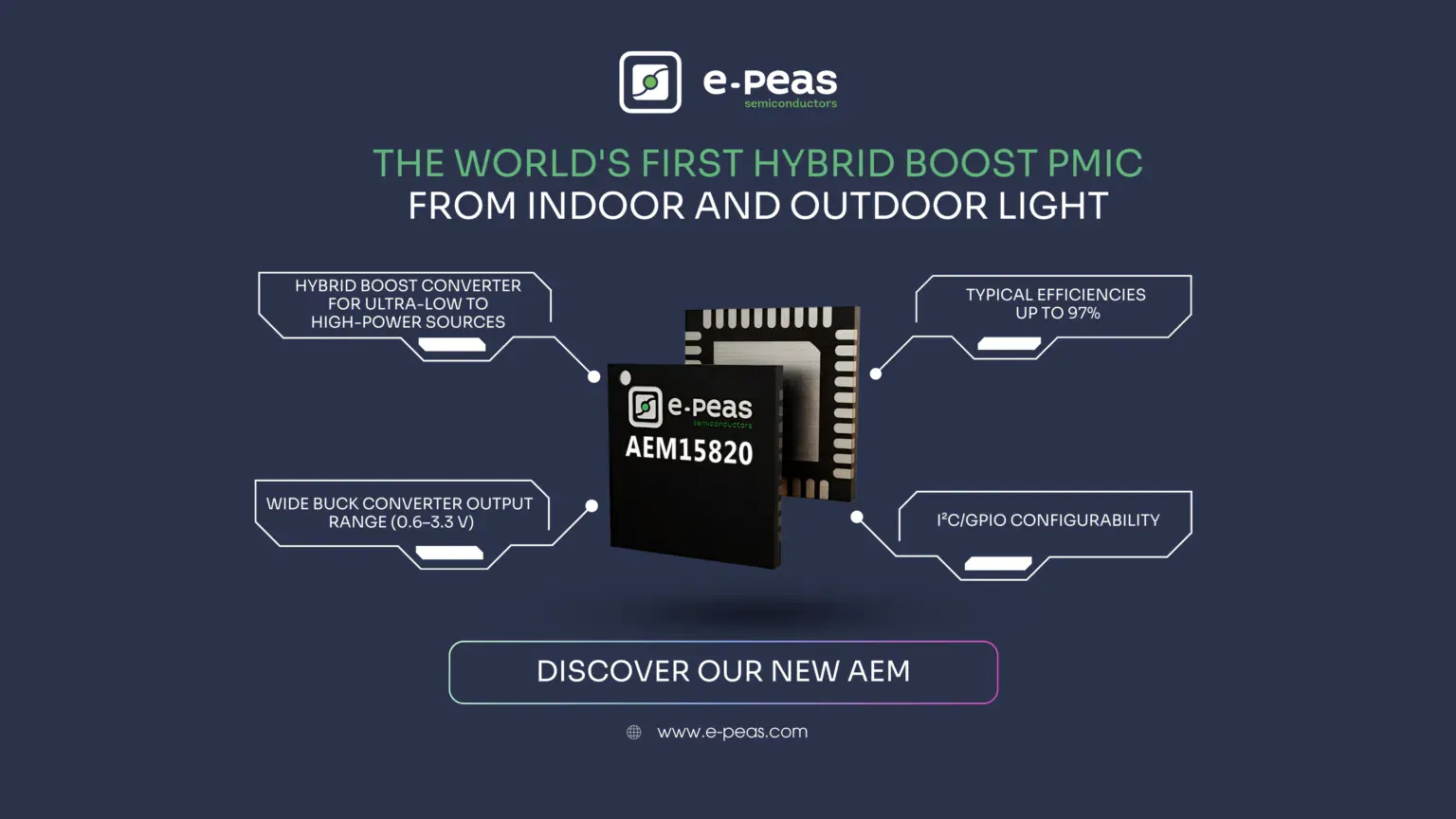
 Energy harvesting has always been held back by the narrow operating range of conventional photovoltaic sources. Indoor lighting offers only microwatts while full sunlight provides several orders of magnitude more. Designing a single power path that behaves predictably across both scenarios is difficult, particularly for self charging or battery assisted consumer devices. The new AEM15820 from e peas targets that gap by managing the entire operating span of modern hybrid PV cells.
Hybrid PV In Real Products
Hybrid photovoltaic structures are becoming attractive in consumer gear because they can harvest from office lighting, shaded indoor areas and direct outdoor sun. The challenge is the variability. A device might see tens of microwatts on a desk and several watts while outside. Without a PMIC that remains efficient in both extremes the system either fails to cold start or leaves energy unused. The AEM15820 gives engineers a practical path to support that range which brings self powered and extended lifetime products into reach.
This matters for wearables, e readers and portable equipment that spend time both indoors and outdoors. It also suits compact security devices, smart glasses and accessory products where integrating a PV layer is easy but designing the power system is not. In many of these designs the PMIC becomes the limiting factor rather than the cell itself.
Managing A Wide Power Window
The AEM15820 can cold start from just 5 microwatts at 275 millivolts which is important for dim indoor conditions. After startup it can deliver an output between 0.6 and 3.3 volts at up to 100 milliamps. The device regulates the source voltage to protect the energy store and supports both lithium ion capacitors and conventional batteries. That flexibility allows designers to balance capacity, cycle life and size for different categories of products.
Two boost converters are integrated, one sized for low power input and one for higher power. The PMIC switches between them automatically which avoids the efficiency penalty that appears when a single converter is pushed outside its optimal range. A 5 volt DC input is available for wired charging so devices can combine energy harvesting with traditional charging behaviour.
Configuration is handled through GPIO or I2C which lets developers tune thresholds, thermal behaviour, storage protection and load management. For devices exposed to temperature swings or variable usage patterns this control reduces unexpected behaviour as the system ages.
Integration Factors For Engineers
The AEM15820 arrives in a 5 by 5 millimetre QFN40 package which suits wearables, small IoT modules and thin consumer accessories. Because the device covers both indoor and outdoor lighting conditions there is no need to swap PMICs or build parallel power paths to handle seasonal or usage variation. For engineers this simplifies the system architecture and helps maintain predictable battery behaviour across very different environments.
Hybrid PV is gaining interest in security cameras, smart backpacks and outdoor accessories where the device sits idle for long periods and only wakes occasionally. In these cases consistent trickle charging matters more than peak power. The AEM15820 fits that requirement by keeping the storage element supplied even when lighting is poor.
Where Hybrid Harvesting Is Heading
Energy harvesting has been moving slowly into mainstream consumer design. The missing component has been reliable power management that spans the entire indoor to outdoor spectrum. The AEM15820 reflects a shift toward single chip controllers that can handle real world variation without compromise on form factor or lifetime behaviour. It also broadens the landscape for new categories of self powered devices that rely on steady indoor lighting or occasional sunlight to maintain charge.
Learn more and read the original announcement at www.e-peas.com
You may also like