 Designing reliable 12 V battery protection has always been a balancing act. Negative surge events can force engineers to oversize MOSFETs and diodes, leading to higher conduction losses and unnecessary BOM cost. Littelfuse is looking to reshape that equation with the TPSMB Asymmetrical Series, a group of TVS diodes built specifically for 12 V anti reverse protection where conventional bi directional devices often fall short. The aim is simple but valuable for automotive electronics teams: lower clamping where it matters and a cleaner single component design path.
How Asymmetrical Clamping Supports 12 V Battery Systems
In a typical 12 V architecture, negative pulses from load dumps, inductive kickback or wiring faults can push MOSFETs into stress regions well above their intended rating. The TPSMB devices handle this differently by separating positive and negative surge behaviour. Positive clamping sits in the 24 to 30 V range, while negative clamping drops to 12 to 18 V, which is low enough to protect downstream components without forcing heavy overspecification. This approach means designers can use lower rated MOSFETs or diodes that run more efficiently under normal operation. It also avoids stacking multiple Zeners or secondary TVS devices to catch both directions of the surge.
Technical Structure And Performance Characteristics
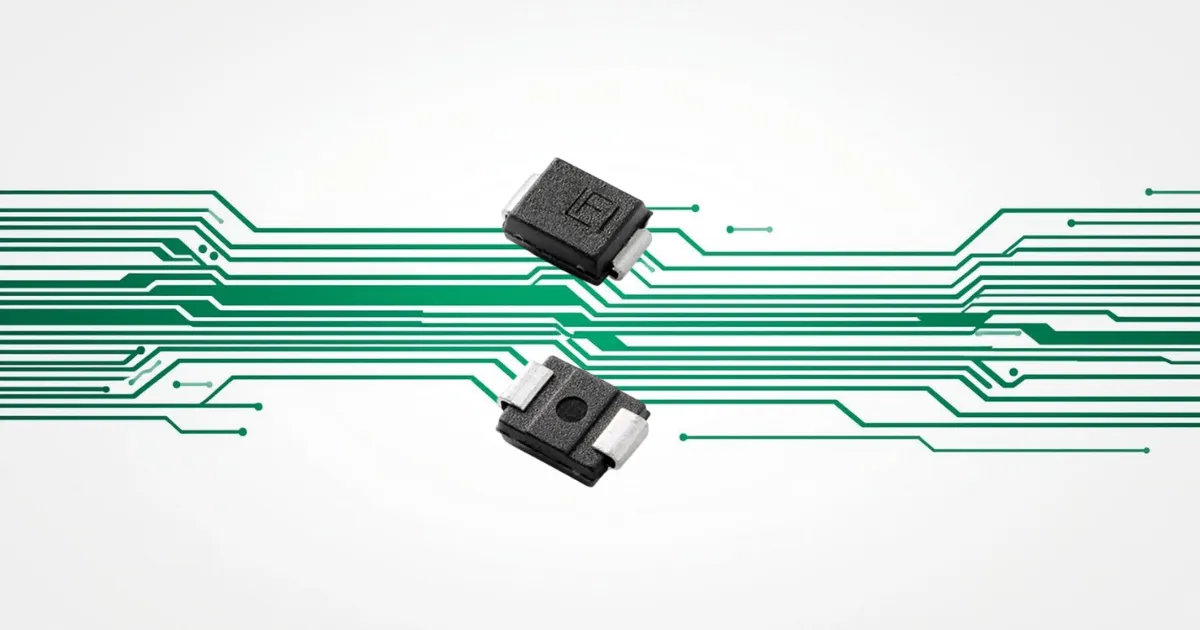
Each device in the TPSMB Asymmetrical Series is built on a 600 W peak pulse platform with sub nanosecond response times for fast suppression in ignition, body control and power seat systems. The package is the familiar DO 214AA format, keeping mechanical integration straightforward for existing boards. Surge performance extends to 30 kV ESD, which helps protect susceptible pins on domain controllers and DC/DC converters. Automotive qualification to AEC Q101 and a wide junction temperature range from minus 65 to 175 degrees Celsius round out the electrical profile, supporting long term reliability in thermally stressed engine bay and cabin mounted modules.
System Integration And Layout Advantages
Moving from multiple discrete parts to a single asymmetrical clamping device can simplify layout in ways that matter during platform updates. Board space freed from Zeners or secondary TVS diodes offers more flexibility around thermal paths, high current traces and connector placement. The streamlined bill of materials also reduces sourcing friction for high volume automotive assemblies. In practice, this helps teams building zonal controllers, power distribution modules or infotainment ECUs where rapid design cycles demand predictable, repeatable protection behaviour.
A Step Toward More Efficient Automotive Electronics
As automotive architectures continue shifting toward domain and zonal control, reducing conduction losses and part count becomes increasingly valuable. Devices like the TPSMB Asymmetrical Series align with that direction by addressing a common weakness in 12 V surge management while keeping the integration overhead low. For engineers designing ADAS nodes, motor pretensioner modules or lighting systems, the payoff is the ability to specify smaller switching devices without compromising transient robustness. It is a small change at the component level that can deliver measurable performance gains across an entire platform.
Learn more and read the original announcement at www.littelfuse.com
You may also like