
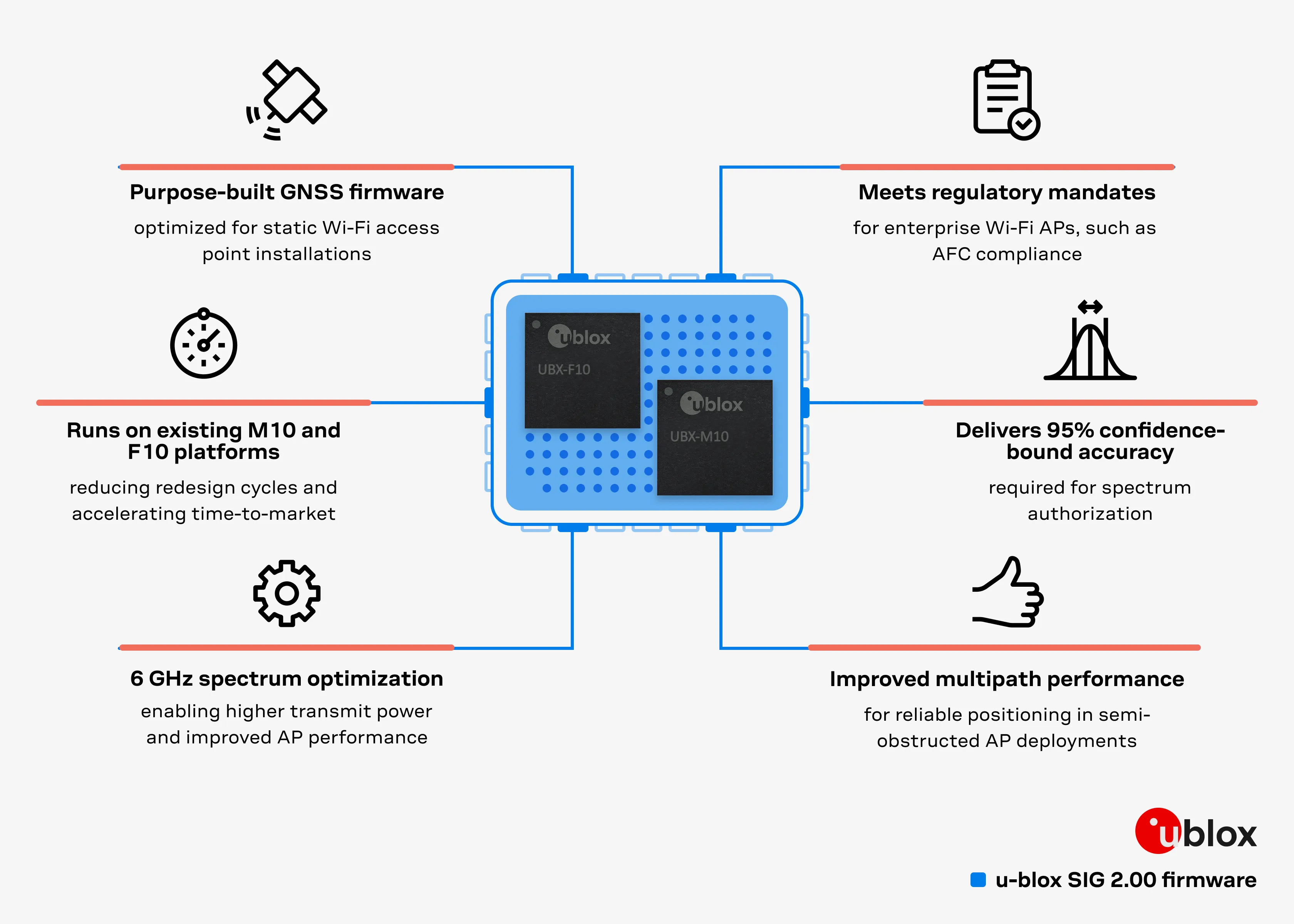
 As Wi Fi systems move into the 6 GHz spectrum, access points are expected to deliver precise geolocation to satisfy Automated Frequency Coordination rules before transmitting at standard power. That is a new design burden for OEMs who traditionally treated GNSS as optional for infrastructure equipment. u blox is targeting this shift with SIG 2.00, a firmware package that brings 95 percent confidence bound geolocation to Wi Fi 6E, 7 and 8 access points using the company’s M10 and F10 GNSS platforms. The goal is to give OEMs a predictable path to regulatory compliance without reinventing the RF stack.
GNSS Firmware Designed For AFC Requirements
The challenge in the 6 GHz band is that standard power operation depends on proving where the access point is located and ensuring it will not interfere with incumbent microwave and satellite users. SIG 2.00 focuses on that requirement by tightening position estimates and delivering them in a form AFC systems can consume reliably. The firmware improves handling of multipath, which is a common problem when access points are mounted near buildings, canopies or reflective structures. Better multipath behaviour means the AFC backend receives geolocation data consistent with the required accuracy threshold, reducing the number of rejected or delayed requests during network deployment.
Platform Options For Different Integration Paths
u blox is offering SIG 2.00 on two platforms so designers can match performance, cost and power needs. On M10, SIG 2.00 operates in single band mode with low power consumption suited to cost sensitive or high density access points. On F10, the firmware takes advantage of dual band L1 and L5 reception and includes RAW data output for applications that demand higher resilience in crowded or reflective environments. Both platforms support the 95 percent confidence accuracy objective, allowing OEMs to choose a footprint that aligns with their product line while keeping firmware behaviour consistent for regulatory reporting.
Simplifying 6 GHz Deployment For OEMs
Integrating GNSS into an enterprise access point is not only a hardware task. It also involves reporting, formatting and timing data so AFC services can validate the location quickly. SIG 2.00 abstracts much of that complexity by packaging the required GNSS behaviour into a turnkey firmware layer. This reduces the engineering overhead for products that need to launch across regions with different spectrum regulations. It also helps teams avoid piecemeal solutions that rely on third party libraries or multi component positioning pipelines, which often introduce variability into the AFC reporting chain.
Toward Location Enabled Wireless Infrastructure
The arrival of 6 GHz Wi Fi is pushing infrastructure toward tighter interaction with positioning systems. Access points that once acted purely as RF distribution nodes now need to anchor themselves accurately in space. SIG 2.00 positions u blox to support that transition by focusing on confidence bound accuracy rather than just raw positional data. As enterprises deploy outdoor networks across campuses, stadiums and industrial sites, and as municipalities scale smart city installations, this type of GNSS behaviour becomes directly tied to how quickly networks can be activated. For OEMs, a firmware based solution also shortens validation cycles when extending a product family into regions adopting AFC rules.
Learn more and read the original announcement at www.u-blox.com
You may also like